
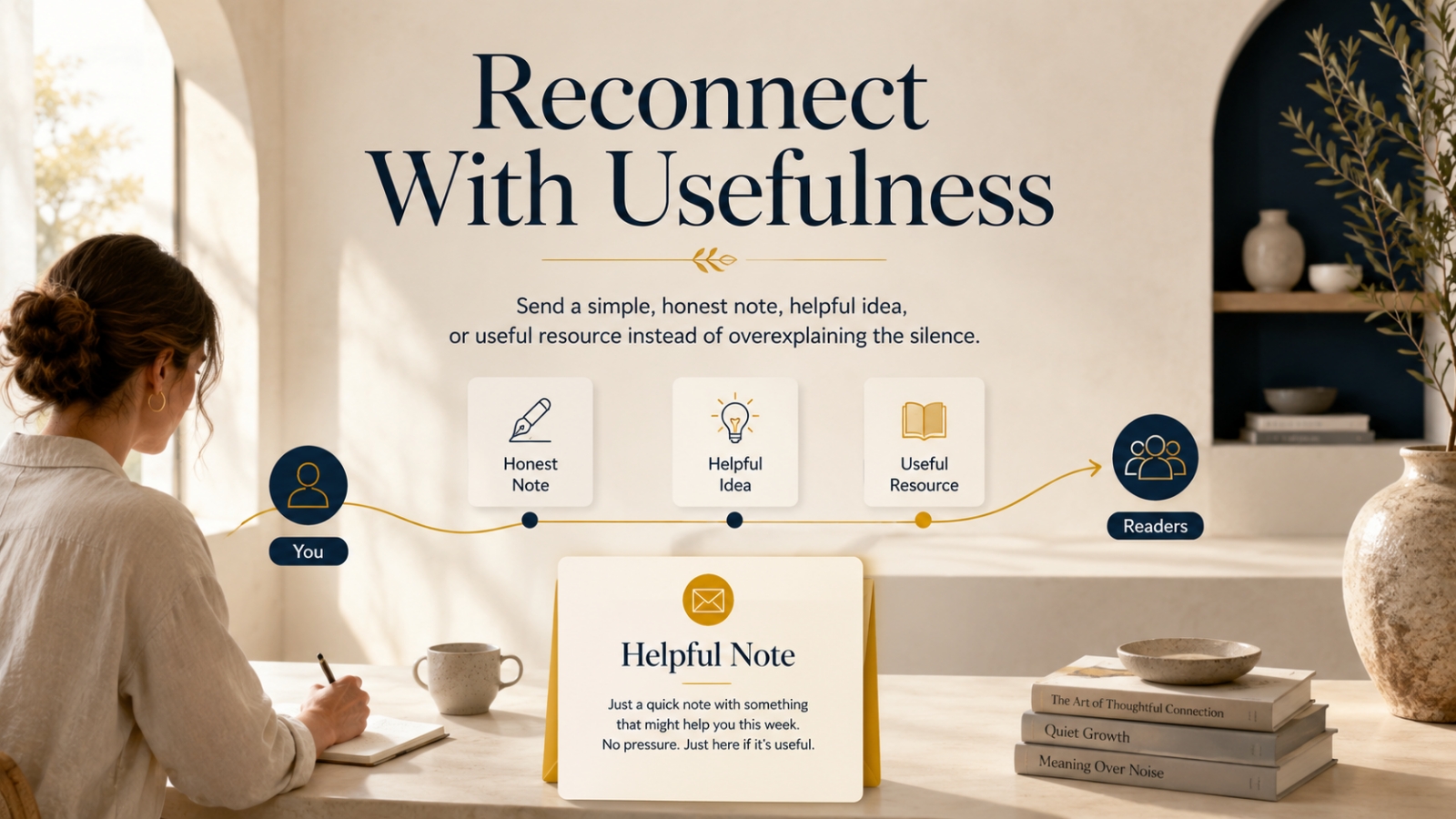
A simple way to email your subscribers again with honesty, usefulness, and less awkwardness.
Emailing your list after a quiet season can feel uncomfortable.
You open a blank email.
Then the questions arrive.
Will they remember me?
Should I explain why I stopped?
Do I need to apologize?
What if people unsubscribe?
What should I even say?
That awkward feeling is normal.
But it can also make you delay the return.
One quiet week becomes one quiet month.
One quiet month becomes several.
And then the email feels even harder to send.
Here is the good news.
You do not need a long explanation to reconnect.
You do not need a dramatic apology.
You do not need to tell the whole story of why you went quiet.
You can return with a simple honest note, one helpful idea, or one useful resource.
That is often enough to restart the conversation.
Why Reconnecting Feels So Awkward
When you have not emailed your list for a while, it can feel like walking back into a room after leaving mid-conversation.
You may feel the need to explain everything.
But your subscribers are not watching your schedule as closely as you are.
They have their own work, family, goals, problems, and inboxes.
Some may not even notice the gap.
Others may remember you but simply need a useful reason to re-engage.
That means your return email does not need to focus heavily on your silence.
It should focus on helping them again.
A short acknowledgement is fine.
Then bring the message back to the reader.
The Big Mistake Bloggers Make
The big mistake is making the return email all about the absence.
You may write a long message explaining why you have been away.
You may apologize several times.
You may promise a big new plan.
You may overcompensate by writing too much.
But the reader may only be thinking:
“Is this useful to me?”
That does not mean you should be cold or pretend nothing happened.
It means you should keep the return simple.
Acknowledge the quiet period briefly.
Then offer something helpful.
That is the best way to rebuild connection.
The Simple Email Reconnection Framework
Use this five-part framework:
- Acknowledge the quiet period briefly
- Reconnect around the reader’s problem
- Share one helpful idea
- Offer one useful resource or next step
- Set a simple expectation
This keeps the email warm without making it heavy.
Let’s walk through each part.
Step 1: Acknowledge the Quiet Period Briefly
You can mention the silence in one simple sentence.
For example:
It has been a little quiet here, but I wanted to return with something useful.
That is enough.
You do not need to write a full explanation unless the reason is directly helpful or important to your audience.
A brief acknowledgement shows honesty.
Then you can move forward.
What to Avoid
Avoid opening with several paragraphs about:
- how guilty you feel
- how long you have been gone
- how busy life became
- how you promise to do better forever
- how you are completely changing everything
That puts too much weight on the message.
Keep it light and honest.
Step 2: Reconnect Around the Reader’s Problem
After the brief acknowledgement, shift the focus back to the reader.
Ask:
What problem is my reader likely facing right now?
For example, if your audience is trying to restart their blog, the problem might be:
They want to return, but the restart feels too big.
You could write:
If your blog has been quiet too, you may feel like you need a full relaunch before you can return. But you may only need one useful step back into motion.
Now the email is no longer about your silence.
It is about their situation.
That is what makes the message useful.
Step 3: Share One Helpful Idea
Give the reader one useful idea inside the email.
Not ten.
One.
For example:
Choose one older post and improve only the title, intro, example, formatting, and next step. You do not need to create something brand new to rebuild momentum.
That is helpful.
It gives the reader a practical way forward.
A reconnect email should deliver value even if the reader does not click anything.
That builds trust.
Step 4: Offer One Useful Resource or Next Step
After sharing the idea, point to one resource.
This could be:
- a blog post
- a checklist
- a worksheet
- a short guide
- a refreshed resource
- a useful email reply prompt
- a product or toolkit if it fits naturally
For example:
I wrote a guide showing how to refresh one old blog post without turning it into a huge rewrite project.
Then link to the post.
The resource should match the email.
Do not reconnect with a random product pitch.
Reconnect with usefulness first.
Step 5: Set a Simple Expectation
End by setting a light expectation.
For example:
Over the next few weeks, I’ll be sharing simple ways to rebuild blogging momentum without starting from zero.
This tells subscribers what to expect.
It also helps you return without making a huge promise.
Keep it realistic.
Do not say you will email daily if you are not sure you can keep that rhythm.
A simple expectation builds trust.
Three Simple Reconnection Email Types
You can reconnect in several ways.
Here are three good options.
Option 1: The Honest Helpful Note
This works when your list has been quiet for a while.
Structure:
- brief acknowledgement
- reader problem
- helpful idea
- link to useful resource
Example opening:
It has been a little quiet here, but I wanted to return with something practical. If your blog has been quiet too, you may not need a full restart. You may only need one useful step back into motion.
This feels honest and helpful.
Option 2: The Useful Resource Email
This works when you have a blog post, checklist, or guide to share.
Structure:
- share the resource
- explain who it helps
- give one reason it matters
- invite the reader to use it
Example opening:
I put together a simple guide for bloggers who want to return after a quiet season without starting from zero. If that is where you are, this may help you choose one next step instead of rebuilding everything.
This leads with value.
Option 3: The Simple Question Email
This works when you want to rebuild conversation.
Structure:
- brief note
- ask one easy reply question
- make it low-pressure
Example:
It has been quiet here for a little while, and I am returning with a simpler focus: helping you build or rebuild your blog one useful step at a time.
Quick question: what feels hardest for you right now — choosing topics, writing consistently, building your email list, or creating an offer?
This can invite replies.
Reader replies can guide future content.
Worked Example: Reconnecting With a Blogging Audience
Let’s imagine your list is made up of beginner bloggers and digital product creators.
You have not emailed them for several weeks.
You want to reconnect.
Weak Return Email
Sorry I have not emailed in a long time. I have been busy and trying to get things organized. I know I should have been more consistent. I promise I will try harder going forward. I have a lot of plans and many exciting things coming.
This email may be honest, but it is too focused on the sender.
The reader does not yet know why it matters to them.
Stronger Return Email
It has been a little quiet here, but I wanted to return with something useful.
If your blog has been quiet too, you may feel like you need to start over. But you probably do not need a full restart. You may only need one useful step back into motion.
One simple place to begin is with an older post. Update the title, improve the intro, add one clearer example, make the formatting easier to read, and add one next step.
That gives you a useful win without starting from a blank page.
I wrote a guide that walks through how to refresh one older blog post. You can read it here: [Insert Link]
This email works better because it:
- briefly acknowledges the quiet period
- connects to the reader’s experience
- shares one helpful idea
- points to a useful resource
- avoids overexplaining
That is a strong reconnection email.
What If People Unsubscribe?
Some people may unsubscribe when you email after a quiet season.
That is normal.
It does not always mean you did something wrong.
Some people no longer need the topic.
Some forgot they subscribed.
Some are cleaning their inbox.
Some are not your right readers anymore.
Do not let unsubscribes stop you from reconnecting with the people who still want your help.
A healthy email list is not only about keeping every subscriber.
It is about staying connected with the right subscribers.
What to Avoid When Reconnecting
Mistake 1: Overexplaining the Silence
A short note is enough.
Do not make the whole email about where you have been.
Shift back to helping the reader.
Mistake 2: Making Big Promises
Do not promise a big new schedule unless you are ready to keep it.
Set a simple expectation.
One useful email per week or a short series may be enough.
Mistake 3: Returning With a Hard Pitch
If the list has been quiet, return with value first.
A product can come later when the connection feels warmer.
Mistake 4: Sending a Long, Heavy Email
A reconnect email should feel easy to read.
Keep it clear.
Use short paragraphs.
Focus on one idea.
Mistake 5: Waiting Until the Perfect Email Is Ready
You do not need a perfect email.
You need a useful one.
A simple helpful note sent this week is better than a polished email you keep postponing.
A Simple Reconnection Email Template
Use this template when you are ready to email your list again.
Hi {{ subscriber.first_name | capitalize }},
It has been a little quiet here, but I wanted to return with something useful.
If [reader situation/problem], you may feel like [common frustration].
One simple way to move forward is to [helpful idea or small action].
You do not need to [overwhelming action]. Start with [simple next step].
I put together a short guide/resource that can help:
[Insert Link]
Over the next few emails, I’ll be sharing simple ways to [relevant outcome].
Regards,
Peter Teo
You can adjust the wording based on your audience.
The structure is what matters:
Brief acknowledgement.
Reader problem.
Helpful idea.
Useful resource.
Simple expectation.
Quick Exercise: Write Your Reconnection Email
Use this worksheet.
My List Has Been Quiet For:
[Write the timeframe if needed.]
The Reader Problem I Want to Reconnect Around Is:
[Write one problem.]
One Helpful Idea I Can Share Is:
[Write one useful tip.]
One Resource I Can Link To Is:
[Write one blog post, checklist, guide, or worksheet.]
My Simple Expectation Going Forward Is:
[Write what readers can expect.]
My Email Subject Line Could Be:
[Write one subject line.]
Now write the email in 150 to 250 words.
Keep it simple.
Do not overexplain.
Lead with usefulness.
Final Thought: Reconnect Through Usefulness
If your email list has been quiet, you do not need to make the return awkward.
You do not need a long apology.
You do not need a dramatic explanation.
You do not need a big announcement.
Send a simple honest note.
Share one helpful idea.
Point to one useful resource.
Set one realistic expectation.
That is enough to restart the conversation.
Your subscribers do not need a perfect comeback.
They need a reason to hear from you again.
Usefulness gives them that reason.
Use This With Blogger’s Success Toolkit
If you already own Blogger’s Success Toolkit, log in to the Blogger Success Blueprint members area and use the planning resources to write one simple reconnection email.
Start with a short honest note, one helpful idea, and one useful resource your readers can use.
Members Login:
https://bloggersuccessblueprint.com/members/
New to Blogger’s Success Toolkit?
Blogger’s Success Toolkit gives you a beginner-friendly path to choose your direction, plan useful content, write stronger titles, and begin building your blog or product path with more structure.


4 replies to "How to Reconnect With Your Email List"
Hi,
I recently came across http://bloggersuccessblueprint.com and wanted to get in touch. Your website has good potential, and with the right SEO strategy, it could reach more customers through Google.
Our SEO services are customized to improve rankings, increase organic traffic, and help businesses generate consistent leads.
If this is something you’d be interested in, let me know, and I’ll send our SEO strategies along with our package details.
Best regards,
Arpit
Hey Mishra,
Send over for my view. No obligation.
Hello Dear http://bloggersuccessblueprint.com,
We offer professional SEO services to bring your website to Google’s 1st page.
Would you like me to share our SEO activity plan and pricing details?
Just reply “Yes” and I’ll send the full proposal.
Regards,
Amelia
Hey Amelia,
Send it over. No obligation.