A simple one-week action plan to rebuild momentum with one post, one email, one useful share, and one small review.
Once you decide to return to your blog, the next question is simple:
What should I actually do this week?
Not someday.
Not after you redesign the site.
Not after you create a full content calendar.
This week.
Because momentum does not return from thinking about blogging.
It returns from completing one small cycle of work.
That cycle does not need to be big.
It only needs to be complete.
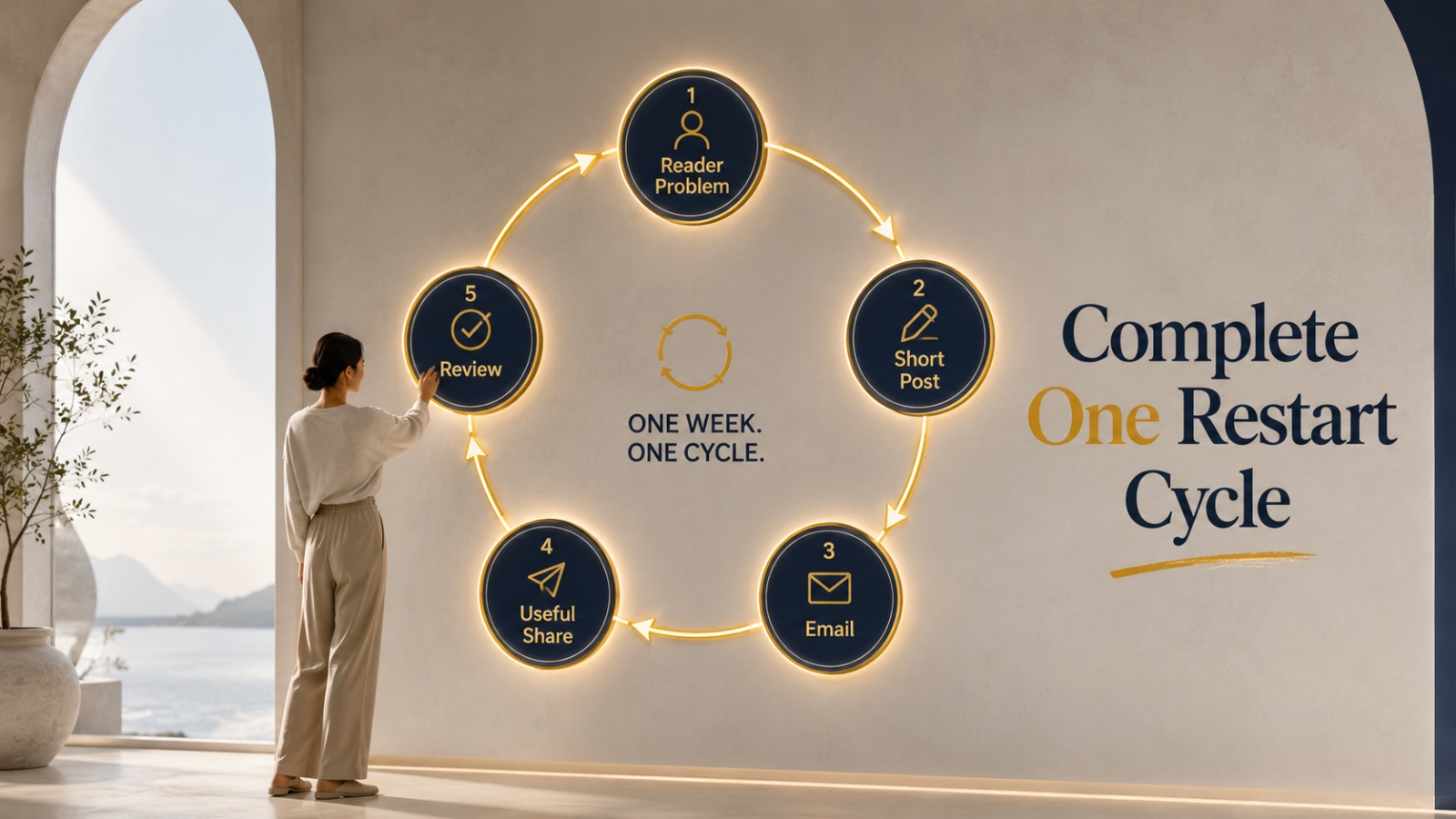
Choose one reader problem.
Write one short helpful post.
Send one email.
Share one useful takeaway.
Review what happened.
That is the easiest way to restart your blog this week.
Not with pressure.
Not with a huge relaunch.
With one clear content cycle you can actually finish.
Why a Small Content Cycle Works
When your blog has been quiet, your first goal is not to build the whole system again.
Your first goal is to create movement.
A small content cycle helps because it gives you a beginning, middle, and end.
You are not just “working on the blog.”
You are completing a clear path:
- Pick the problem
- Publish the post
- Email the reader
- Share the useful idea
- Review the response
That matters because unfinished work can feel heavy.
A half-written draft does not rebuild much confidence.
A half-planned content calendar does not reconnect with readers.
A folder full of ideas does not create momentum.
But one completed cycle does.
Even if it is small.
Especially if it is small.
The Big Mistake Bloggers Make During Restart Week
The big mistake is making restart week too complicated.
You sit down to return, but suddenly the task becomes too large.
You want to fix the website.
Update old posts.
Write a new lead magnet.
Create a new content plan.
Rebuild the email sequence.
Prepare social posts.
Maybe even rethink the offer.
All of those tasks may matter later.
But if you try to do them all this week, the restart may stall before it begins.
Restart week needs a narrow focus.
Your goal is not to fix the whole blog.
Your goal is to complete one useful content cycle.
That is enough to get the blog moving again.
The One-Week Blog Restart Plan
Here is the simple plan:
- Day 1: Choose one reader problem
- Day 2: Draft one short helpful post
- Day 3: Edit and publish the post
- Day 4: Send one reconnection email
- Day 5: Share one useful takeaway
- Day 6 or 7: Review the response and choose the next step
You can adjust the days to fit your schedule.
The sequence matters more than the exact calendar.
Let’s walk through each step.
Day 1: Choose One Reader Problem
Do not start with a broad topic.
Start with one problem your reader still has.
A broad topic creates a broad post.
A clear problem creates a useful post.
For example, instead of choosing:
Digital product creation
choose:
I have a checklist, but I do not know how to turn it into a small product.
That is much easier to write.
It also gives the reader a clear reason to care.
What Makes a Good Restart Topic?
A good restart topic should be:
- specific
- useful
- simple to explain
- easy to write this week
- connected to your blog direction
- helpful even if the post is short
You are not trying to write the biggest post on your site.
You are trying to write the post that gets the rhythm moving again.
Day 1 Questions
Ask yourself:
- What problem has my reader probably not solved yet?
- What question can I answer simply?
- What topic can I write without heavy research?
- What lesson connects to my blog’s main direction?
- What short post would still be genuinely useful?
Choose one.
Then stop choosing.
Too much choosing becomes another form of delay.
Day 2: Draft One Short Helpful Post
Now write the post.
Keep it short and useful.
A restart post does not need to be a giant guide.
It can be a focused article that helps the reader understand one idea and take one small action.
A simple restart post can follow this structure:
- Name the reader’s problem
- Explain why it matters
- Give three to five practical steps
- Show one example
- End with one next action
That is enough.
Example Restart Post Topic
Let’s use this topic:
How to Turn One Checklist Into a Small Starter Product
This post could help a reader who has a checklist, worksheet, or PLR resource sitting unused.
Simple Post Outline
Opening Problem
You have a useful checklist, but it is sitting in a folder because you are not sure whether it can become a product.
Main Lesson
A starter product does not need to solve everything. It only needs to help the buyer complete one useful task.
Simple Steps
- Choose one checklist
- Name the buyer problem
- Add a short instruction page
- Include one example
- Add a simple next-step checklist
Example
A weekly meal planning checklist could become a small starter kit by adding a short guide, sample menu, shopping list template, and simple prep steps.
Next Action
Choose one checklist you already have and write down the specific problem it helps solve.
That is a useful post.
Not huge.
Not overwhelming.
But helpful.
Day 2 Writing Rule
Do not edit too much while drafting.
Get the lesson onto the page first.
You can polish it tomorrow.
Day 3: Edit and Publish the Post
Day 3 is for making the post clear enough to publish.
Not perfect.
Clear.
Read the draft and check:
- Does the opening start with the reader’s problem?
- Is the main lesson easy to understand?
- Are the steps simple?
- Is there one clear example?
- Does the ending give the reader one action?
- Are the paragraphs easy to read?
Do one readability pass.
Shorten long paragraphs.
Improve unclear headings.
Remove repeated points.
Make the next action obvious.
Then publish.
What to Avoid on Publish Day
Do not turn publish day into a full website improvement project.
Do not redesign the blog.
Do not rewrite every old post.
Do not spend hours comparing your post with someone else’s article.
Publish the useful post.
That is the win.
Day 4: Send One Reconnection Email
Now send one email to your list.
The email should not be complicated.
It should reconnect through usefulness.
You can use this structure:
- Open with the reader’s problem
- Share one helpful idea
- Mention the new post
- Invite them to read it
You do not need a long explanation about the pause.
You can simply return with value.
Simple Reconnection Email Example
Hi {{ subscriber.first_name | capitalize }},
If you have a checklist, worksheet, or PLR resource sitting in a folder, it may not need to become a huge product.
It may only need to become one focused starter offer.
The key is to ask:
What small problem does this help someone solve?
Once that is clear, you can add a short instruction page, one example, and a simple next-step checklist.
That small package can already become useful.
I wrote a short guide showing how to turn one checklist into a small starter product.
You can read it here:
[Insert Blog Post Link]
Regards,
Peter Teo
That is enough.
Helpful.
Clear.
No drama.
Day 5: Share One Useful Takeaway
On Day 5, share one useful idea from the post.
This can be on LinkedIn, Facebook, X, a community, or wherever your readers are most likely to see it.
Do not only post the link.
Share a takeaway that helps even before someone clicks.
Useful Share Example
A small starter product does not need to solve everything.
It only needs to help the buyer complete one useful task.
If you have a checklist sitting unused, ask:
- What problem does this checklist solve?
- Who needs that result?
- What short instruction would make it easier to use?
That may be enough to turn it into a focused starter offer.
[Insert Blog Post Link]
This kind of share works because it gives value first.
The link becomes the next step, not the whole message.
Day 5 Rule
Share one idea in one place.
Do not make restart week heavier by trying to appear everywhere.
One useful share is enough.
Day 6 or 7: Review the Response
At the end of the week, do a small review.
Not a big analytics report.
Just a simple check.
Ask:
- Did I publish the post?
- Did I send the email?
- Did I share one idea?
- Did anyone click, reply, comment, or save?
- What felt easy?
- What felt hard?
- What should I do next week?
This review matters because it turns the restart into learning.
Maybe the email got clicks.
Maybe someone replied.
Maybe nobody responded yet, but you completed the cycle.
That still counts.
You restarted the rhythm.
What to Look For
Look for simple signals:
- email clicks
- reader replies
- comments
- resource clicks
- questions
- topic interest
- your own energy level
- where the process felt difficult
These clues help you choose the next step.
Worked Example: A One-Week Restart Cycle
Let’s put the full plan together.
Blog Focus
Helping beginners create simple digital products from PLR content, templates, and existing ideas.
Day 1: Choose One Reader Problem
Problem:
I have a checklist, but I do not know how to turn it into a small product.
Day 2: Draft One Short Helpful Post
Post title:
How to Turn One Checklist Into a Small Starter Product
Main points:
- a checklist can become useful when it solves one clear problem
- the product should help one buyer complete one task
- add instructions, examples, and next steps
- keep the first version small
Day 3: Edit and Publish
The post is edited for clarity.
The title is simple.
The ending gives one action:
Choose one checklist and write down the buyer problem it helps solve.
Day 4: Send One Email
Email angle:
A checklist may already be the starting point for your next small product.
The email links to the post.
Day 5: Share One Useful Takeaway
Share idea:
Before building a big product, look at one checklist you already have. If it helps someone complete one useful task, it may become a focused starter offer.
Day 6 or 7: Review the Response
Review questions:
- Did readers click?
- Did anyone reply?
- Did this topic feel useful?
- Should next week’s post show examples of small starter products?
Now you have completed one content cycle.
That is a real restart.
Why This Plan Is Different From Just “Writing Again”
Writing again is good.
But this plan does more than create a post.
It reconnects the system.
The post helps readers.
The email brings people back.
The share gives the idea another doorway.
The review helps you learn what to do next.
That is why this one-week restart plan works.
It does not only restart content.
It restarts the blogging rhythm.
What to Avoid During Restart Week
Mistake 1: Choosing a Topic That Is Too Big
Do not restart with a huge topic like:
How to Build a Full Digital Product Business
That is too heavy for restart week.
Choose a smaller topic like:
How to Turn One Checklist Into a Small Starter Product
Smaller topics are easier to finish.
Mistake 2: Waiting for the Perfect Post
Your restart post does not need to be your best article ever.
It needs to be clear, useful, and published.
You can improve it later.
Mistake 3: Turning the Email Into an Apology
A short acknowledgement is fine if needed.
But do not make the email all about the pause.
Lead with the reader’s problem.
Return with value.
Mistake 4: Sharing Only the Link
A plain link is easy to ignore.
Share one useful takeaway first.
Then add the link.
Mistake 5: Skipping the Review
If you do not review the restart cycle, you miss the lesson.
Even a quiet response teaches you something.
Review the process and choose the next step.
Your One-Week Blog Restart Worksheet
Use this worksheet this week.
Day 1: Reader Problem
The problem I will focus on is:
[Write one specific problem.]
Day 2: Short Post
My post title is:
[Write the title.]
My post will teach:
[Write one useful lesson.]
The example I will include is:
[Write one example.]
Day 3: Publish
The reader’s next action will be:
[Write one action.]
Day 4: Email
My email angle is:
[Write one email idea.]
Day 5: Share
One useful takeaway I can share is:
[Write one tip or short lesson.]
Day 6 or 7: Review
I will review:
- Did I complete the cycle?
- Did readers click, reply, or respond?
- What felt hard?
- What should I do next?
That is the plan.
Simple enough to finish.
Useful enough to matter.
Final Thought: Restart by Completing One Cycle
Restarting your blog this week does not need to be complicated.
You do not need to fix everything first.
You only need to complete one useful content cycle.
Choose one reader problem.
Write one short helpful post.
Send one reconnection email.
Share one useful takeaway.
Review the response.
That is how movement returns.
Not through a huge plan.
Through one complete cycle.
Do that once, and the next week becomes easier.
Do it again, and the rhythm starts coming back.
That is the easiest way to restart your blog this week.
Use This With Blogger’s Success Toolkit
If you already own Blogger’s Success Toolkit, log in to the Blogger Success Blueprint members area and use the planning resources to map one simple restart cycle.
Choose one reader problem, write one short helpful post, send one email, share one useful takeaway, and review what happened.
Members Login:
https://bloggersuccessblueprint.com/members/
New to Blogger’s Success Toolkit?
Blogger’s Success Toolkit gives you a beginner-friendly path to choose your direction, plan useful content, write stronger titles, and begin building your blog or product path with more structure.