A beginner-friendly guide to tracking useful progress without getting discouraged by big-number comparison.
When your blog is still small, analytics can feel a little unfair.
You open the dashboard.
The numbers are not huge.
A few readers.
A few pageviews.
Maybe one email signup.
Maybe no comments yet.
And suddenly, your brain starts whispering:
“Is this even working?”
That feeling is common.
But it can also be misleading.
Early blog growth does not always look dramatic. In the beginning, your job is not to compare your numbers with someone who has been publishing for five years.
Your job is to look for useful signals.
Are you publishing?
Are readers finding certain topics?
Are people joining your email list?
Are they clicking useful resources?
Are they replying?
Are you becoming more consistent?
Those are the numbers that matter early.
Not because they are flashy.
But because they help you make better decisions.
Why Big Numbers Can Distract Beginners
Big numbers are easy to notice.
Traffic.
Followers.
Subscribers.
Revenue.
Views.
Shares.
Those numbers can be useful later.
But when your blog is still small, focusing only on big numbers can make you miss the progress that is actually happening.
It is like planting a small herb garden and checking every morning to see if it has become a forest.
That is not how growth works.
In the early stage, you look for smaller signs:
A new leaf.
A stronger stem.
The soil staying healthy.
The plant leaning toward the light.
A small blog works the same way.
The early signs may be modest, but they still matter.
If you only look for huge numbers, you may quit before the system has time to take root.
The Big Mistake Beginners Make
The big mistake is measuring only traffic.
Traffic matters.
But traffic alone does not tell the full story.
A post with a small number of readers may still teach you something valuable.
Maybe the topic got more clicks than your other posts.
Maybe one reader replied to your email.
Maybe someone clicked a resource link.
Maybe the post helped you understand what your audience cares about.
That is useful.
A small blog needs learning signals, not just popularity signals.
When you measure the right things early, you build confidence from progress, not comparison.
The Small Blog Measurement Framework
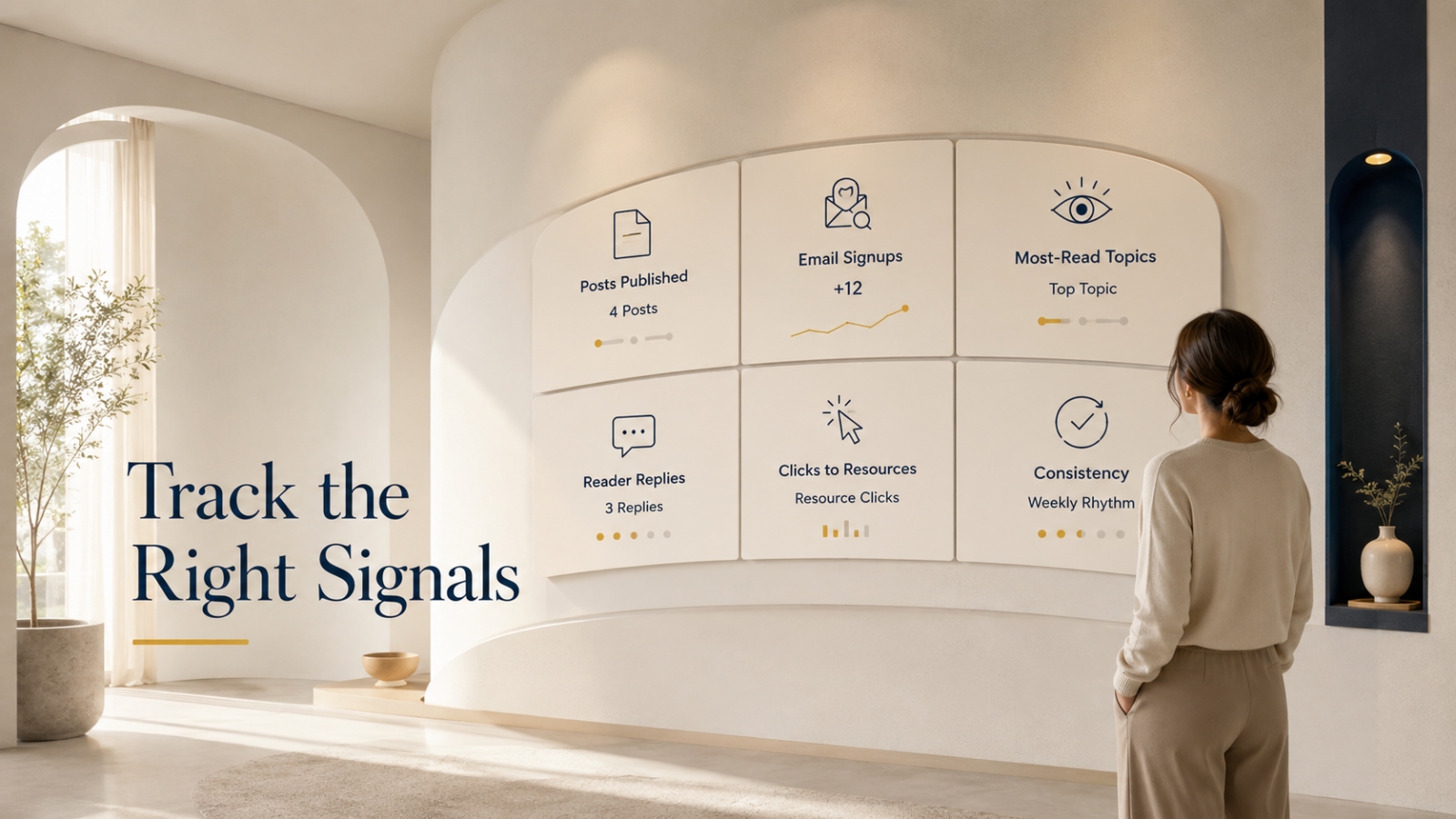
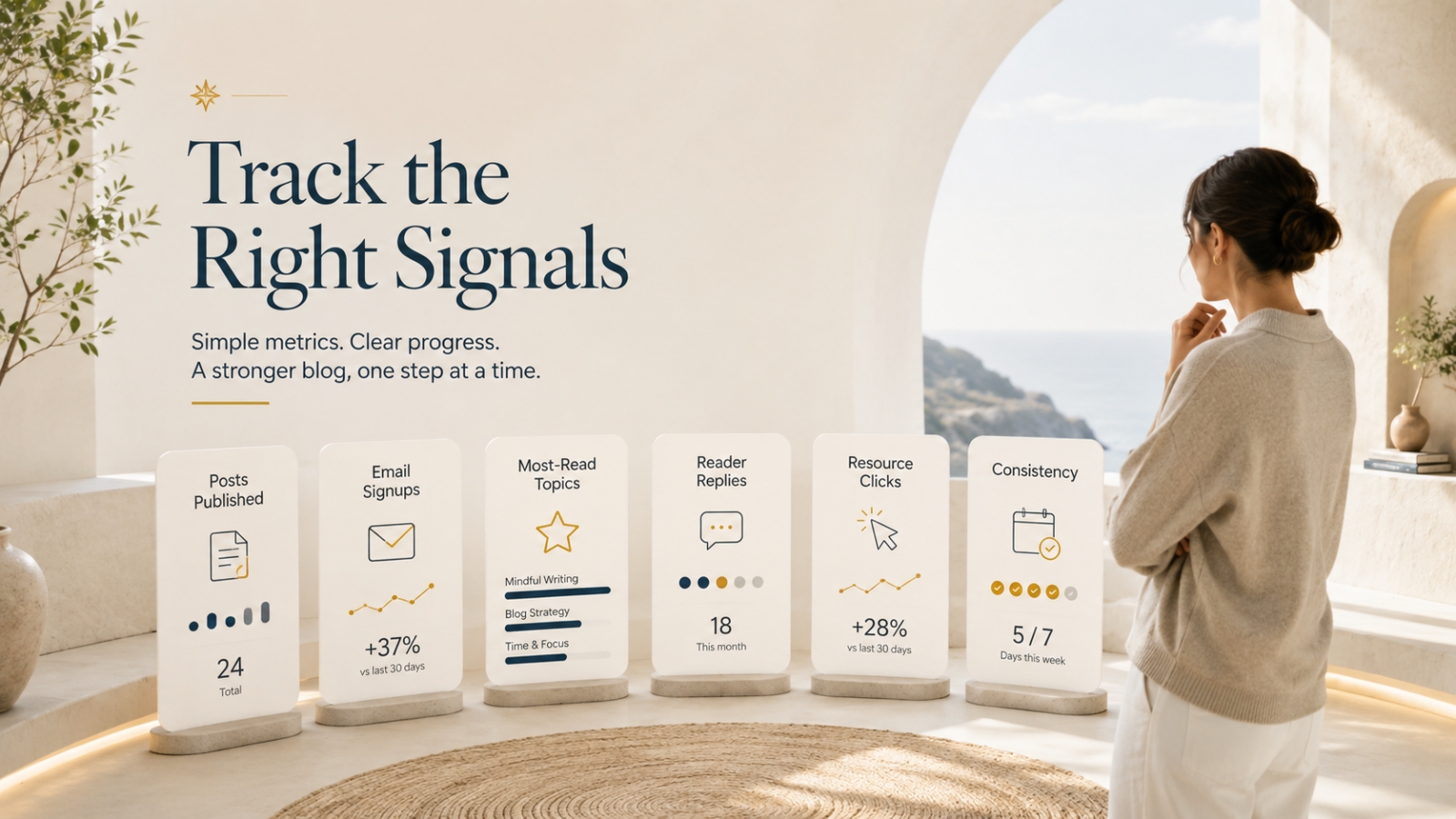
When your blog is still small, track six simple things:
- Posts published
- Email signups
- Most-read topics
- Reader replies
- Clicks to resources
- Consistency
These are simple, practical, and beginner-friendly.
They help you understand whether your blog system is starting to work.
Let’s walk through each one.
1. Posts Published
This may sound basic, but it matters.
Before your blog can grow, you need useful content on the site.
Posts published tells you whether you are building the foundation.
At the beginning, your question is not only:
How many people read this?
It is also:
Am I creating enough useful content for readers to find?
If you publish one clear post each week, that is progress.
If you publish four useful posts in a month, that is progress.
If you improve one old post and publish one new post, that is progress too.
What to Track
Track:
- how many posts you publish each month
- what topics you publish about
- whether each post has a clear reader outcome
- whether the posts connect to your blog direction
This helps you see whether you are building a content base.
Simple Question to Ask
Am I consistently creating useful posts for the reader I want to help?
If yes, you are building the foundation.
2. Email Signups
Email signups matter because they show that someone wants to stay connected.
A reader may visit your blog once and leave.
But when someone joins your email list, they are saying:
“I want more help like this.”
That is a strong early signal.
Even a small number of signups can matter.
If five people join your list from one topic, pay attention.
That topic may be touching a real problem.
What to Track
Track:
- how many people join each week or month
- which posts lead to signups
- which signup resource they choose
- whether your signup promise is clear
- whether your welcome email gets replies or clicks
You do not need a huge list right away.
You need a list-building path that makes sense.
Simple Question to Ask
Which content gives readers a reason to stay connected?
That question can guide your future content and email strategy.
3. Most-Read Topics
Your most-read topics show what readers are noticing.
Do not only look at the top number.
Look for patterns.
Are people reading beginner guides?
Product strategy posts?
PLR customization posts?
Email list posts?
Offer-building posts?
Content planning posts?
Patterns tell you what your audience may care about.
For example, if your posts about smaller offers get more attention than broad product creation posts, that may be a clue.
Your readers may need focused starter product guidance, not huge product-building systems yet.
What to Track
Track:
- your top posts each month
- repeated topic themes
- posts that keep getting views over time
- posts that lead to email signups
- posts that lead to resource clicks
This helps you understand what topics deserve more support.
Simple Question to Ask
Which topics seem to attract the right readers?
Not just the most readers.
The right readers.
4. Reader Replies
Reader replies are easy to overlook.
But they are one of the most valuable early signals.
A reply means someone cared enough to respond.
They may ask a question.
They may share a struggle.
They may tell you what confused them.
They may mention what helped.
That is gold.
A small blog with real replies can learn faster than a bigger blog that ignores its readers.
What to Track
Track:
- questions readers ask
- problems they mention
- words they use
- objections or doubts they share
- what they say helped them
- topics they ask for next
Reader replies can become future blog posts, emails, products, bonuses, or FAQs.
Simple Question to Ask
What are readers telling me in their own words?
Their words can help you write stronger content.
5. Clicks to Resources
Clicks to resources show reader interest.
For example, if you link to:
- a checklist
- a worksheet
- a members area
- a product page
- a related blog post
- a lead magnet
- a toolkit
- a guide
and people click, that tells you something.
It means the reader may want the next step.
Clicks do not always mean buyers.
But they do show curiosity and movement.
That matters.
What to Track
Track:
- which links get clicked
- which posts lead to clicks
- which CTA language works better
- whether readers click related resources
- whether product-path links get attention
This helps you see whether your content is guiding readers forward.
Simple Question to Ask
Which next steps are readers willing to explore?
That can help you improve your offers and CTAs.
6. Consistency
Consistency is one of the most important early metrics.
Not daily publishing.
Not constant posting.
A realistic rhythm.
If your plan is to publish weekly, are you doing that?
If your plan is two posts a month, are you keeping that rhythm?
If your plan is one post, one email, and one review each week, are you returning to the system?
Consistency tells you whether your blog has an operating rhythm.
Without rhythm, even good ideas can stall.
What to Track
Track:
- posts published
- emails sent
- content reviewed
- old posts improved
- weekly planning sessions completed
- after-publish routines followed
These may not look exciting in a public dashboard.
But they build the engine behind the blog.
Simple Question to Ask
Am I building a rhythm I can return to?
That matters more than a short burst of activity.
Worked Example: Measuring a Small Blog Without Panic
Let’s imagine a beginner blog that helps people create simple digital products from PLR content.
The blog is still small.
In one month, the blogger publishes four posts:
- How to Use PLR Without Sounding Generic
- When to Create a Smaller Offer Instead of a Big Product
- How to Create Bonuses That Support the Main Product
- The Content-to-Email-to-Offer Path
The traffic is not huge yet.
But let’s look at the useful signals.
Posts Published
Four posts went live.
That means the content base is growing.
Email Signups
Eight people joined the email list.
That may sound small.
But it shows that some readers wanted more help.
Most-Read Topic
The post about smaller offers received the most reads.
That suggests readers may be interested in lighter product creation.
Reader Replies
Two readers replied and said they feel overwhelmed by big product ideas.
That is a strong clue.
Clicks to Resources
Several readers clicked a worksheet link about planning a starter offer.
That shows interest in practical tools.
Consistency
The blogger published one post each week and sent one email each week.
That shows the routine is working.
What This Tells Us
The blog is still small.
But the signals are useful.
The blogger may decide to create more content around:
- starter offers
- small product ideas
- PLR product packaging
- simple offer structure
- bonus planning
- first sales page support
That is how beginner analytics should work.
Not as a scoreboard for comparison.
As a compass for better decisions.
What Not to Obsess Over Too Early
Some numbers can become discouraging if you focus on them too soon.
This does not mean they are useless.
It only means they may not be the best early focus.
Huge Traffic Numbers
Traffic takes time.
If your content base is still small, do not judge the whole blog too quickly.
Focus on publishing useful posts and learning which topics gain early interest.
Social Media Likes
Likes can be nice.
But they do not always show deep interest.
A post with fewer likes but more clicks or replies may be more useful.
Revenue Too Early
Revenue matters in a business.
But if the blog has no clear content path, email list, offer, or follow-up yet, judging too early can create pressure.
Build the system first.
Comparing With Bigger Blogs
This is one of the fastest ways to lose confidence.
A blog with 500 posts, years of history, and a large list is not the right comparison for a small blog in its early stage.
Compare your current blog with last month’s blog.
That is more useful.
Checking Analytics Every Hour
This can drain your energy.
Choose a review rhythm.
Weekly or monthly is enough for many beginners.
Do not let the dashboard become a distraction from creating and improving.
A Simple Monthly Blog Review
At the end of each month, review these six areas.
1. What Did I Publish?
List the posts you published.
Ask:
Did these posts support my blog direction?
2. What Grew the Email List?
Check which posts or resources led to signups.
Ask:
What made readers want to stay connected?
3. What Topics Got Attention?
Look at your most-read posts.
Ask:
What patterns do I see?
4. What Did Readers Say?
Review replies, comments, questions, or messages.
Ask:
What words or problems keep showing up?
5. What Did Readers Click?
Look at resource clicks, CTA clicks, and related post clicks.
Ask:
What next steps interested readers most?
6. Did I Stay Consistent?
Review your rhythm.
Ask:
Did I keep the routine, and where did it break?
This review can be simple.
One page of notes is enough.
Common Mistakes to Avoid
Mistake 1: Treating Small Numbers Like Failure
Small numbers are not failure.
They are early signals.
Look for patterns, not applause.
Mistake 2: Measuring Everything
Too many metrics can create confusion.
Start with a few useful signals.
You can add more later.
Mistake 3: Ignoring Reader Replies
A thoughtful reply from one reader can teach you more than a vague number on a dashboard.
Pay attention to real words.
Mistake 4: Tracking but Not Acting
Analytics should guide action.
If a topic gets attention, create a related post.
If readers click a resource, improve that path.
If nobody clicks a CTA, test clearer wording.
Do not only collect numbers.
Use them.
Mistake 5: Reviewing Too Often
Checking numbers too often can make you anxious.
Give your content time.
Then review calmly.
A weekly or monthly review is better than constant dashboard watching.
Quick Exercise: Create Your Small Blog Scorecard
Use this simple scorecard for the next month.
Posts Published
Goal: [Write your number.]
Actual: [Write your number.]
Email Signups
Goal: [Write your number.]
Actual: [Write your number.]
Most-Read Topics
- [Topic/post.]
- [Topic/post.]
- [Topic/post.]
Reader Replies or Questions
[Write any replies, comments, or questions.]
Clicks to Resources
[Write which links or resources people clicked.]
Consistency
Did I follow my planned rhythm?
[Yes / partly / no.]
One Thing I Learned
[Write one insight.]
One Thing I Will Improve Next Month
[Write one action.]
This keeps analytics simple.
And simple is exactly what you need in the early stage.
Final Thought: Measure Progress, Not Just Popularity
When your blog is still small, do not let huge-number comparison steal your confidence.
Measure progress.
Measure learning.
Measure connection.
Measure consistency.
Look at what you published.
Look at who joined your list.
Look at which topics attracted attention.
Look at what readers replied to.
Look at what they clicked.
Look at whether you kept showing up.
Those signals may not look dramatic yet.
But they help you build smarter.
A small blog does not need a giant dashboard.
It needs a simple review habit.
Track the right things.
Learn from them.
Then improve one step at a time.
Use This With Blogger’s Success Toolkit
If you already own Blogger’s Success Toolkit, log in to the Blogger Success Blueprint members area and use the planning resources to review your blog’s progress this month.
Track your posts published, email signups, most-read topics, reader replies, resource clicks, and consistency.
Members Login:
https://bloggersuccessblueprint.com/members/
New to Blogger’s Success Toolkit?
Blogger’s Success Toolkit gives you a beginner-friendly path to choose your direction, plan useful content, write stronger titles, and begin building your blog or product path with more structure.