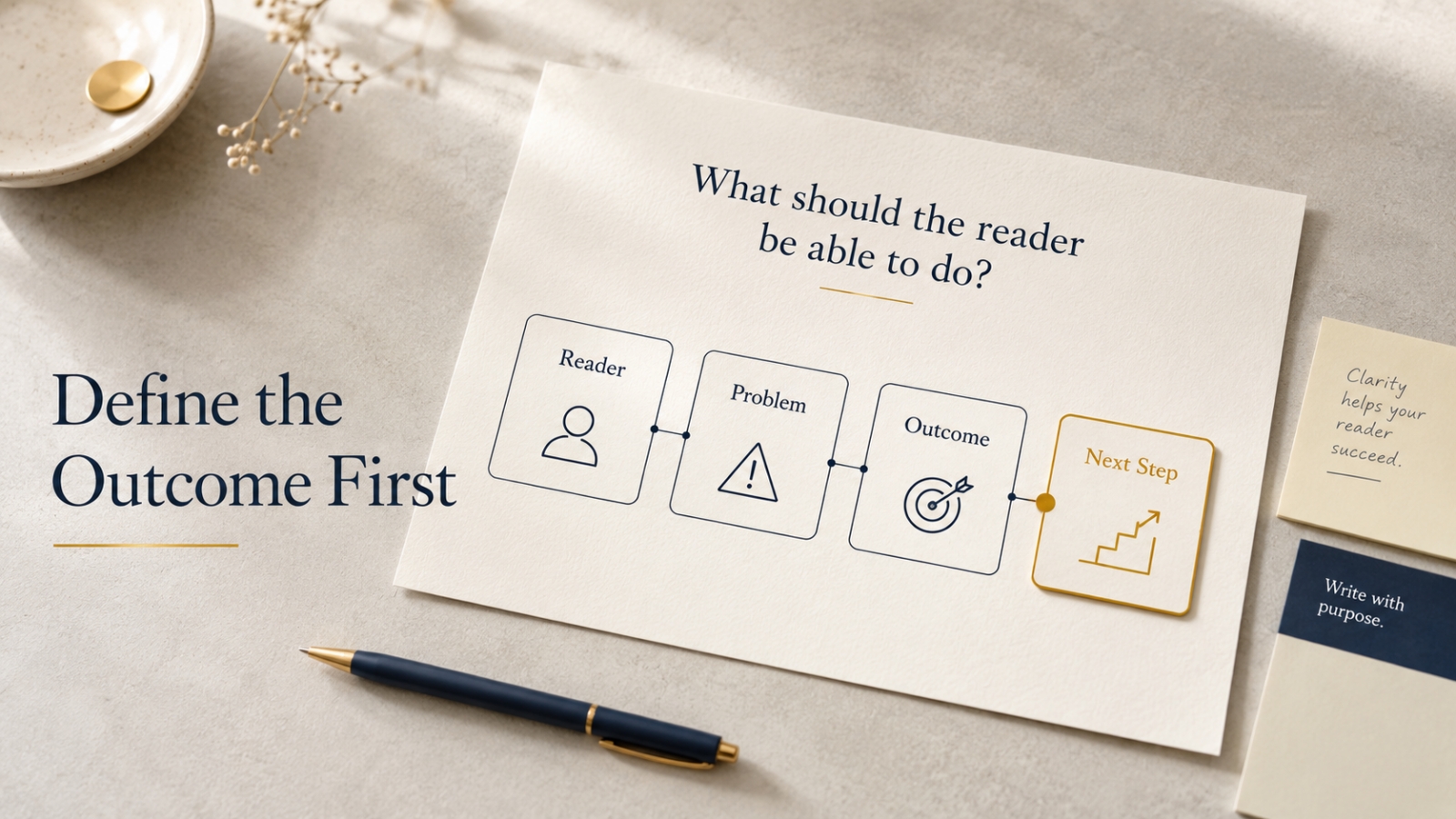
A simple reader-outcome framework for writing clearer, more useful blog posts your audience can actually act on.
You sit down to write your next blog post.
The topic sounds useful. You open a blank page. You type a few lines. Then more ideas start coming in.
A tip here. A reminder there. Maybe a story. Maybe a checklist. Maybe something you saw another creator mention.
Before long, the post has words.
But does it have direction?
That is where many beginner blog posts become weak. Not because the idea is bad. Not because the writer does not care. But because the post never had one clear outcome.
The reader may finish the article and think:
“That was helpful… but what should I do now?”
That is the problem.
A strong blog post should not only share information. It should help the reader move forward in one clear way.
Before you write your next blog post, define this first:
What should my reader be able to do after reading this?
That one question can make your writing clearer, your structure stronger, and your article more useful.
Why Many Blog Posts Feel Scattered
Most new bloggers start with a topic.
That feels normal.
You may think:
“I want to write about setting up a home office.”
That is a useful topic. But by itself, it is too wide.
A home office post could include:
- choosing a desk
- buying a chair
- lighting
- cable management
- storage
- productivity
- focus habits
- room design
- budget tips
- tools and apps
- camera setup
- work-life balance
All of those ideas may be useful.
But they do not all belong in one article.
When too many ideas fight for space, the reader has to work too hard. They are not guided. They are sorting through information.
That is why a topic alone is not enough.
A topic tells you what the post is about.
A reader outcome tells you where the post is going.
The One Question to Ask Before You Write
Before you write the first line, ask:
What should my reader be able to do after reading this?
This question forces clarity.
It helps you decide:
- what to include
- what to leave out
- how to structure the post
- what example to use
- what next step to give the reader
It also stops you from writing a post that only explains a topic.
For example, instead of writing a broad article about home office setup, you may decide:
After reading this post, my reader should be able to organize one small work corner in 30 minutes using items they already have.
Now the post has a job.
You are not teaching everything about home office design.
You are helping one reader complete one useful task.
That is easier to write.
It is also easier to read.
Topic vs. Reader Outcome
A topic is the subject of your post.
A reader outcome is the useful result your reader can get from the post.
Both matter.
But the outcome gives your post its shape.
Example 1: Home Office Setup
Topic:
Home office setup
Reader Outcome:
The reader can organize one simple work corner in 30 minutes using items they already have.
The topic is broad.
The outcome is specific.
The topic gives you an area to write about. The outcome gives the reader a destination.
Example 2: Personal Finance
Topic:
Weekly budgeting
Reader Outcome:
The reader can create a simple grocery spending plan before their next shopping trip.
Example 3: Fitness
Topic:
Beginner workouts
Reader Outcome:
The reader can choose one 20-minute workout to try three times this week.
Example 4: Pet Care
Topic:
Puppy training
Reader Outcome:
The reader can teach a puppy to sit using a short daily routine.
See the pattern?
The outcome is smaller.
But smaller is not weaker.
Smaller is clearer.
And clear content is easier for the reader to trust, follow, and use.
The Reader Outcome Framework
Use this simple framework before writing your next blog post.
It has five steps.
Step 1: Choose One Reader
Start by deciding who the post is for.
Not everyone.
One clear type of reader.
For example, if your topic is home office setup, your reader could be:
- a remote worker with a small apartment
- a parent working from the dining table
- a student studying in a shared room
- a freelancer with a small budget
- someone who feels distracted at home
Each reader has a different need.
A student may need quiet and storage.
A parent may need a flexible setup they can pack away.
A remote worker may need better lighting for calls.
When you choose one reader, your writing becomes sharper.
Ask yourself:
Who needs this post most?
Step 2: Identify One Problem
Next, name the problem your reader is facing.
Keep it specific.
Do not write:
“They need a better home office.”
That is too broad.
Write:
“They work from a small corner of the dining table and feel distracted because everything is messy and mixed together.”
Now you can feel the problem.
The reader is not looking for a full office makeover.
They need a simple way to create order.
They may not have extra space. They may not have a big budget. They may just need a small corner that feels usable.
Ask yourself:
What is the reader struggling with right before they need this article?
Step 3: Define One Outcome
Now decide what the reader should be able to do after reading.
Keep the outcome practical.
For example:
After reading this post, the reader can organize one small work corner in 30 minutes using items they already have.
That is strong because it is:
- specific
- realistic
- useful
- small enough for one post
- easy to act on
It does not promise to redesign the reader’s whole home.
It helps them take one useful step.
Ask yourself:
What should the reader be able to do when they finish reading?
Step 4: Choose One Next Action
A helpful post should end with a clear next step.
Not a vague ending.
Not a flat “hope this helped.”
Give the reader one simple action.
For the home office example, the next action could be:
Clear one surface, choose three work-only items, and set up your work corner for tomorrow.
That is doable.
It gives the reader something to act on right away.
Other next actions could be:
- remove five items from the desk
- choose one storage box
- move chargers into one place
- set up a lamp
- create a “start work” tray
- write down three distractions to remove
The action does not need to be big.
It just needs to be clear.
Ask yourself:
What is the one small action I want the reader to take next?
Step 5: Build the Post Around That Path
Once you know the reader, problem, outcome, and next action, you can build the post.
This is where writing becomes easier.
You are no longer trying to include everything.
You are only including what supports the reader outcome.
For the home office example, you may include:
- why a small work corner is enough to start
- what items to keep nearby
- what items to remove
- how to create a simple “work zone”
- how to reset the space at the end of the day
- one next action
You probably do not need to include:
- expensive desk recommendations
- full interior design advice
- advanced productivity systems
- home renovation tips
- camera lighting setups
- long lists of office gadgets
Those may be useful later.
But they do not belong in this post.
When the reader outcome is clear, your article becomes easier to control.
Worked Example: A Simple Home Office Setup Post
Let’s walk through the framework using one clear example.
Broad Topic
Home office setup.
That is a good topic.
But it is too broad by itself.
So let’s turn it into a useful blog post.
Step 1: Choose One Reader
The post is for:
A remote worker who uses a small dining table corner and feels distracted by clutter.
Now the audience is clear.
We are not writing for someone building a full home office.
We are not writing for someone buying premium furniture.
We are helping a person who needs a simple, realistic setup.
Step 2: Identify One Problem
The problem is:
They want to focus at home, but their work items are mixed with household items, so the space feels messy before they even begin.
Now the pain is specific.
They do not need a perfect office.
They need a small area that feels ready for work.
Step 3: Define One Outcome
The outcome is:
After reading this post, the reader can organize one small work corner in 30 minutes using items they already have.
This gives the post a clear purpose.
Step 4: Choose One Next Action
The next action is:
Clear one surface, keep only three work items nearby, and prepare the corner for tomorrow morning.
Simple. Practical. Easy to follow.
Step 5: Build the Post Around That Path
Now the blog post could become:
How to Organize a Simple Work Corner in 30 Minutes
The structure could look like this:
Opening
Start with the real moment.
“You sit down to work, but the table already feels crowded. A cup, a notebook, a charger, yesterday’s mail, and a few random items are all fighting for space. Before you even begin, your brain feels busy.”
That opening helps the reader feel seen.
Section 1: Why a Small Work Corner Is Enough
Explain that the reader does not need a full office to feel more focused.
They need one defined place where work begins.
Section 2: What to Remove First
Give simple removal rules:
- remove anything not needed for today’s work
- move household items to another spot
- throw away scraps or old notes
- keep the surface as clear as possible
Section 3: The Three-Item Rule
Suggest keeping only three main items nearby.
For example:
- laptop
- notebook
- pen or charger
This keeps the setup simple.
Section 4: Create a Reset Habit
Show the reader how to end the workday.
They can put the same three items into a small tray or box so the space is ready tomorrow.
Closing
Give the reader one action:
“Before tomorrow morning, clear one small work surface and choose the three items you need most.”
That is a focused post.
It does not try to teach everything.
It helps the reader complete one useful task.
What to Leave Out
One sign of a strong blog post is knowing what not to include.
This is where many new writers struggle.
They think more information makes the article better.
But more information can make the article harder to use.
If your post is about organizing one small work corner, you do not need to include every related idea.
You can leave out:
- full home office design
- expensive furniture lists
- advanced productivity systems
- video meeting setup
- color psychology
- room renovation ideas
- long equipment comparisons
- detailed cleaning routines
Those can become separate posts later.
Leaving something out does not reduce the value of your article.
It often increases the value.
Because now the reader can breathe.
They know what problem you are solving.
They know what to focus on.
They know what to do next.
A focused post quietly tells the reader:
“Stay with me. We are solving one thing together.”
That is powerful.
Common Mistakes to Avoid
Mistake 1: Starting With Only a Broad Topic
A topic gives you a starting point.
But it does not give you a direction.
If you start with “home office setup,” you may not know what to include.
If you start with “help a remote worker organize one small work corner in 30 minutes,” the post becomes much clearer.
Before writing, move from topic to outcome.
Mistake 2: Trying to Help Too Many People at Once
A post for everyone often becomes too general.
A post for one clear reader feels more useful.
A remote worker in a small apartment and a business owner setting up a studio may both care about workspace setup.
But their needs are different.
Trying to serve both in one post can make the content messy.
Choose one reader for one post.
You can always write another post later.
Mistake 3: Solving Too Many Problems in One Article
If your article solves one problem clearly, it is useful.
If it tries to solve ten problems at once, it becomes heavy.
Stay focused.
Ask:
Does this section help the reader reach the outcome?
If not, save it for another post.
Mistake 4: Using Examples That Pull the Reader Away
Examples should make the lesson easier.
They should not send the reader in a new direction.
If the post is about organizing a small work corner, do not suddenly add examples about full office renovations, expensive equipment, or advanced productivity apps.
Those examples may be interesting.
But they do not support the outcome.
Keep your examples close to the reader’s real situation.
Mistake 5: Ending Without a Clear Next Step
A strong post should leave the reader with one simple action.
Do not end only with:
“Hope this helped.”
Guide them.
For example:
“Clear one small surface today. Keep only three work items nearby. Then prepare that same corner for tomorrow.”
That kind of ending feels useful.
It helps the reader move.
Quick Exercise: Plan Your Next Post in 5 Lines
Before writing your next blog post, complete this simple exercise.
You can use it for any niche.
Fill in these five lines:
My reader is:
[Describe one type of reader.]
Their problem is:
[Describe one specific problem.]
After reading, they should be able to:
[Describe one clear outcome.]
Their next action is:
[Describe one simple step.]
My post title could be:
[Write one focused title.]
Here is the home office example:
My reader is:
A remote worker using a small dining table corner.
Their problem is:
They feel distracted because work items and household clutter are mixed together.
After reading, they should be able to:
Organize one small work corner in 30 minutes using items they already have.
Their next action is:
Clear one surface, keep only three work items nearby, and prepare the corner for tomorrow.
My post title could be:
How to Organize a Simple Work Corner in 30 Minutes
Now the post has direction.
You know who it is for.
You know what problem it solves.
You know what result the reader should get.
You know how to end the article.
That is a much stronger starting point than a broad topic alone.
Final Encouragement
You do not need to write the biggest article.
You need to write the clearest next-step article.
That is an important difference.
A useful blog post does not need to explain everything about a topic. It only needs to help the reader make progress in one clear way.
So before you write your next post, do not only ask:
“What topic should I write about?”
Ask:
What should my reader be able to do after reading this?
That question will help you write with more focus, more purpose, and more confidence.
One reader.
One problem.
One useful step.
That is how clearer blog content is built.
Use This With Blogger’s Success Toolkit
If you already own Blogger’s Success Toolkit, log in to the Blogger Success Blueprint members area and use the content planning resources inside Blogger’s Success Toolkit to apply this lesson to your next article.
Members Login:
https://bloggersuccessblueprint.com/members/
New to Blogger’s Success Toolkit?
Blogger’s Success Toolkit gives you a beginner-friendly path to choose your niche, plan useful content, write stronger titles, and begin building your blog with more structure.