
How to plan your first few blog posts without feeling buried under a huge content calendar.
Many new bloggers get stuck before they write a single post.
Not because they have no ideas.
Usually, they have too many.
They open a blank document and start thinking they need everything ready first.
A full content calendar.
A long list of topics.
A posting schedule.
A keyword plan.
A social media plan.
Maybe even a full year of content.
That sounds organized.
But when you are just starting, it can feel like trying to build the whole house before you have even found the front door.
You do not need to plan your entire blog before you begin.
You only need enough clarity to take the next few steps.
That is why a simple 3-post plan works so well.
It gives you direction without overwhelm. It helps you stop guessing what to write next. And it gives your blog a stronger starting point than posting random ideas whenever they pop into your head.
Why Three Posts Are Enough to Start
Three posts will not build your whole blog.
But they can do something very important.
They can create your first small content path.
That path helps your reader move from one useful idea to the next. Instead of finding one isolated article, they begin to see that your blog has direction.
It also helps you as the writer.
You are no longer asking:
“What should I write today?”
You are asking:
“What simple path can I create for my reader?”
That small shift matters.
A blog grows better when posts are connected by purpose, not scattered by mood.
The Big Mistake Beginners Make
The big mistake is planning random topics.
For example, someone starting a plant-care blog might write down ideas like:
- best indoor plants
- why plants die
- plant pots
- watering tips
- sunlight
- soil types
- plant shelves
- fertilizer
- decorating with plants
Some of those topics may be useful.
But together, they feel loose.
The reader may not understand what the blog is helping them do. The writer may also feel confused because there is no clear path.
A stronger approach is to plan three posts around one reader, one problem area, and one simple journey.
For example, instead of writing random posts about plants, you could create a small path for a beginner who keeps buying houseplants but struggles to keep them alive.
That path might look like this:
- How to Save a Drooping Houseplant Before It Gets Worse
- A Simple Weekly Watering Routine for Beginner Plant Owners
- Why Are My Plant Leaves Turning Yellow?
Now the posts feel connected.
They support the same reader.
They solve related problems.
They give the blog a clearer starting point.
The 3-Post Foundation Plan
Your first three posts do not need to be complicated.
They only need to be useful and connected.
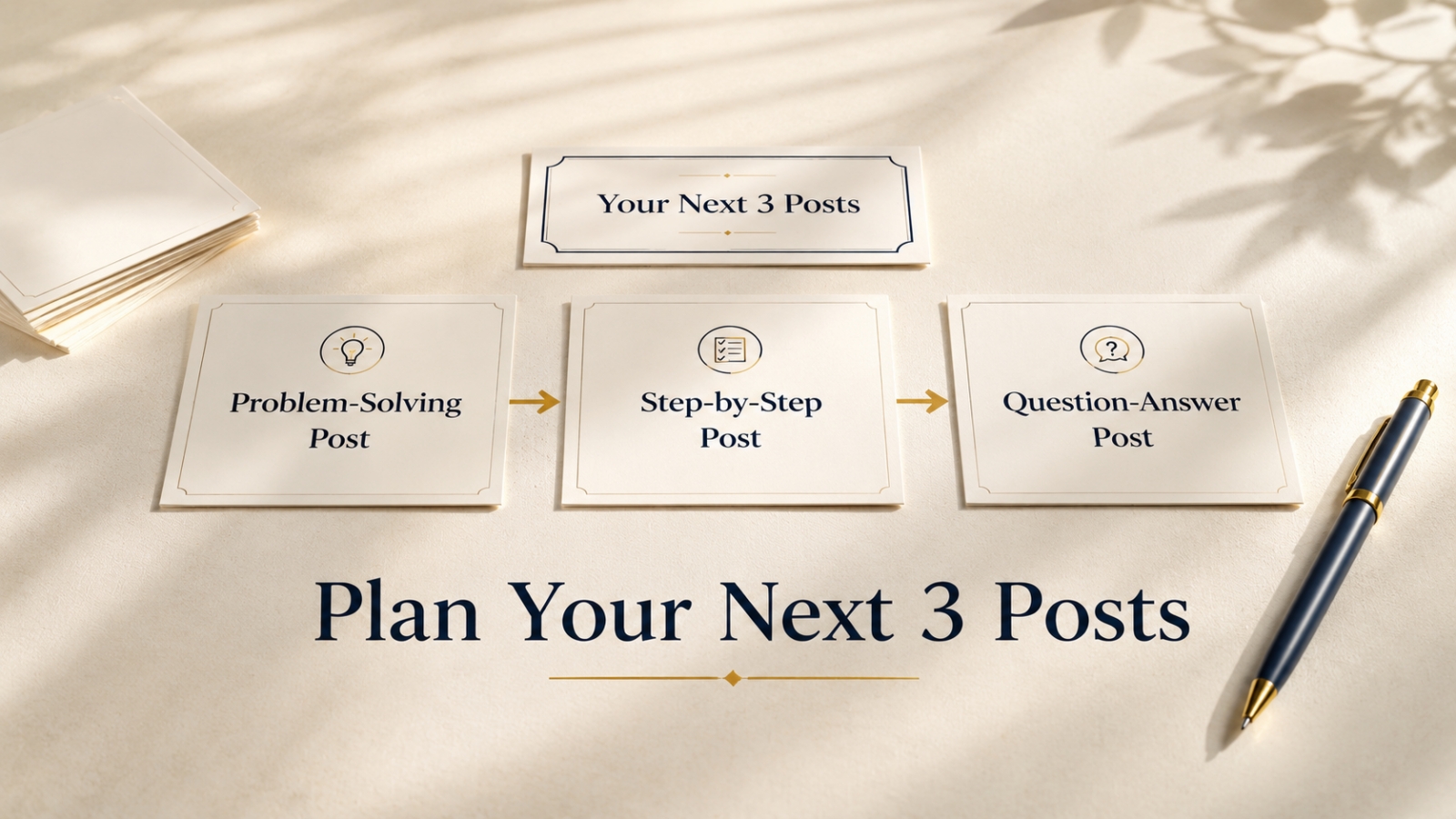
A strong beginner plan usually includes:
- The Problem-Solving Post
- The Step-by-Step Post
- The Question-Answer Post
Together, these three posts give your blog a simple foundation.
Let’s walk through each one.
Post 1: The Problem-Solving Post
The first post should solve a clear problem your reader already knows they have.
This matters because readers usually do not arrive at your blog looking for “content.”
They arrive because something feels unclear, frustrating, confusing, or unfinished.
A problem-solving post says:
“I understand what you are struggling with, and here is a simple way forward.”
For example, in a beginner plant-care niche, the problem might be:
“My plant is drooping, and I don’t know if I can still save it.”
A useful post could be:
How to Save a Drooping Houseplant Before It Gets Worse
This post works because it meets the reader in a real moment.
They are not asking for a complete plant-care course.
They want to know what to do right now.
Use This Prompt
Ask yourself:
What is one problem my reader wants to solve soon?
Then turn that problem into a helpful article.
Post 2: The Step-by-Step Post
The second post should teach a simple process.
This type of post is powerful because many beginners want guidance, not just ideas.
They want to know:
“What do I do first?”
“What comes next?”
“How do I avoid making this too complicated?”
A step-by-step post gives them a path.
For the beginner plant-care example, the process might be watering.
A useful post could be:
A Simple Weekly Watering Routine for Beginner Plant Owners
This post could walk the reader through:
- checking the soil before watering
- noticing how the leaves look
- choosing one weekly check-in day
- watering slowly
- avoiding overwatering
- tracking what happens after a few days
The reader finishes with something practical.
They now have a simple routine to try.
Use This Prompt
Ask yourself:
What simple process would make my reader’s life easier?
Then write the process in clear steps.
Post 3: The Question-Answer Post
The third post should answer a question your reader is likely asking.
This works well because people often search, click, and read based on questions.
They may not know the full solution yet.
But they know what they are wondering.
For example, a beginner plant owner may ask:
“Why are my plant leaves turning yellow?”
That could become:
Why Are My Plant Leaves Turning Yellow?
This post could explain simple causes such as:
- too much water
- too little water
- not enough light
- stress after moving the plant
- old leaves naturally changing
- what to check first
This article feels helpful because it meets the reader in a real moment.
They see the yellow leaves.
They feel unsure.
They want a simple answer before they make the problem worse.
Use This Prompt
Ask yourself:
What question is my reader likely asking when they feel stuck?
Then answer that question clearly.
Worked Example: A 3-Post Plan for a Beginner Plant-Care Blog
Let’s put the framework together.
Imagine your blog helps beginner plant owners care for simple houseplants without feeling confused or guilty every time a leaf changes color.
Your reader is not trying to become a plant expert.
They simply want to stop feeling like every plant they buy is doomed.
Here is a simple 3-post plan.
Reader
A beginner plant owner who wants to keep houseplants alive but feels unsure about basic care.
Main Problem
They do not know what to check when a plant starts looking unhealthy.
Post 1: Problem-Solving Post
Title
How to Save a Drooping Houseplant Before It Gets Worse
Purpose
Help the reader respond calmly when a plant starts drooping.
What the Post Should Cover
- what drooping can mean
- how to check the soil
- how to look for light problems
- when to water and when to wait
- one simple recovery step
Reader Outcome
The reader can check a drooping plant and choose one sensible next step.
Post 2: Step-by-Step Post
Title
A Simple Weekly Watering Routine for Beginner Plant Owners
Purpose
Help the reader build a basic care rhythm instead of watering randomly.
What the Post Should Cover
- choose one weekly plant-check day
- touch the soil before watering
- notice leaf changes
- water only when needed
- keep a simple plant note
Reader Outcome
The reader can follow a simple weekly plant-care routine.
Post 3: Question-Answer Post
Title
Why Are My Plant Leaves Turning Yellow?
Purpose
Help the reader understand a common plant-care warning sign.
What the Post Should Cover
- common reasons leaves turn yellow
- what to check first
- how overwatering can show up
- how light affects leaves
- when yellow leaves are normal
- what simple action to take next
Reader Outcome
The reader can identify the most likely reason for yellow leaves and decide what to check first.
Why This 3-Post Plan Works
This plan works because the posts are connected.
They all help the same reader.
They all support the same goal.
They each solve one clear problem.
Together, they create a simple learning path:
- Notice a plant problem
- Build a weekly care habit
- Understand a common warning sign
That is much stronger than writing three unrelated posts.
A connected plan helps your blog feel more useful.
It also gives readers a reason to move from one article to the next.
How to Create Your Own 3-Post Plan
Now let’s apply this to your niche.
Use the same simple process.
Step 1: Choose One Reader
Start with one type of reader.
Not everyone.
One clear person with one clear situation.
Examples:
- a new parent trying to create a bedtime routine
- a beginner who wants to exercise at home
- a working adult trying to manage money better
- a pet owner training a new puppy
- a student trying to study more consistently
- a small business owner organizing daily tasks
The clearer your reader, the easier your plan becomes.
Use this sentence:
My blog helps [type of reader] who wants to [desired result].
Example:
My blog helps beginner plant owners who want to keep simple houseplants alive without feeling confused.
Step 2: Name One Problem Area
Next, choose one problem area to focus on.
Do not try to solve everything at once.
Examples:
- watering houseplants
- bedtime struggles
- home workouts
- grocery spending
- puppy obedience
- study routines
- home office clutter
A problem area gives your three posts a common direction.
Use this sentence:
The problem area I want to help with is [specific problem area].
Example:
The problem area I want to help with is basic houseplant care.
Step 3: Plan One Problem-Solving Post
Ask:
What problem does my reader want to solve soon?
Then turn that into your first post.
Examples:
- How to Organize One Kitchen Drawer in 15 Minutes
- How to Choose a 20-Minute Workout You Can Actually Finish
- How to Set a Weekly Grocery Budget Without Overcomplicating It
- How to Help Your Puppy Learn One Simple Command
- How to Create a Calm Bedtime Routine for Your Child
This post should help the reader solve one immediate problem.
Step 4: Plan One Step-by-Step Post
Ask:
What simple process would help my reader move forward?
Then turn that into your second post.
Examples:
- How to Build a Simple Morning Routine in 4 Steps
- How to Plan 3 Easy Dinners Before You Go Grocery Shopping
- How to Clean Your Desk Without Spending the Whole Afternoon
- How to Start a Beginner Workout Routine at Home
- How to Create a Weekly Study Plan That Feels Manageable
This post should give the reader a clear process.
Step 5: Plan One Question-Answer Post
Ask:
What question is my reader likely asking?
Then turn that into your third post.
Examples:
- What Should I Do When My Child Refuses Bedtime?
- What If I Only Have 10 Minutes to Exercise?
- Why Does My Grocery Budget Keep Failing?
- What Should I Keep on My Desk and What Should I Remove?
- How Often Should I Practice Puppy Training?
This post should answer one real question clearly.
The 3-Post Planning Template
Use this template before you write.
My reader is:
[Describe one type of reader.]
The problem area is:
[Describe one specific problem area.]
Post 1: Problem-Solving Post
Title:
[Write title.]
Reader outcome:
[What can the reader do after reading?]
Post 2: Step-by-Step Post
Title:
[Write title.]
Reader outcome:
[What can the reader do after reading?]
Post 3: Question-Answer Post
Title:
[Write title.]
Reader outcome:
[What can the reader do after reading?]
Common Mistakes to Avoid
Mistake 1: Choosing Three Unrelated Topics
If your three posts do not connect, your blog may feel scattered.
Try to keep them connected by reader, problem, or goal.
Three connected posts are more useful than three random posts that only sound interesting.
Mistake 2: Making Every Post Too Broad
A post like How to Take Better Care of Plants is too wide for a beginner content plan.
A post like How to Save a Drooping Houseplant Before It Gets Worse is clearer.
Specific posts are easier to write.
They are also easier for readers to use.
Mistake 3: Writing Only What Interests You
Your interests matter.
But your reader’s problem matters more.
The best content sits in the middle:
- what you can help with
- what your reader actually needs
- what gives them a clear next step
That is where useful blog content begins.
Mistake 4: Planning Too Far Ahead Too Soon
You do not need 50 ideas before you begin.
Start with three.
Write them. Publish them. Learn from the process.
A simple plan you use is better than a large plan you never touch.
Quick Exercise: Plan Your Next Three Posts
Take five minutes and fill in this simple plan.
Do not overthink it.
You are not planning your whole blog.
You are only creating your next small path.
My blog helps:
[Type of reader.]
The problem area is:
[Specific problem area.]
Post 1: Problem-Solving Post
My reader needs help with:
[Problem.]
My post title is:
[Title.]
After reading, my reader can:
[Outcome.]
Post 2: Step-by-Step Post
My reader needs a process for:
[Process.]
My post title is:
[Title.]
After reading, my reader can:
[Outcome.]
Post 3: Question-Answer Post
My reader is asking:
[Question.]
My post title is:
[Title.]
After reading, my reader can:
[Outcome.]
When you finish this exercise, you should feel lighter.
Not because your whole blog is planned.
But because your next three steps are clearer.
Final Thought
If you are not sure what to write next, do not force yourself to create a huge content calendar.
Start with three posts.
One problem-solving post.
One step-by-step post.
One question-answer post.
That is enough to create direction.
It gives your reader a simple path. It gives your blog a stronger foundation. And it gives you a manageable place to begin.
Start small.
Stay clear.
Build from there.
Use This With Blogger’s Success Toolkit
If you already own Blogger’s Success Toolkit, log in to the Blogger Success Blueprint members area and use the content planning resources inside Blogger’s Success Toolkit to map your next three blog posts.
Members Login:
https://bloggersuccessblueprint.com/members/
New to Blogger’s Success Toolkit?
Blogger’s Success Toolkit gives you a beginner-friendly path to choose your direction, plan useful content, write stronger titles, and begin building your blog with more structure.