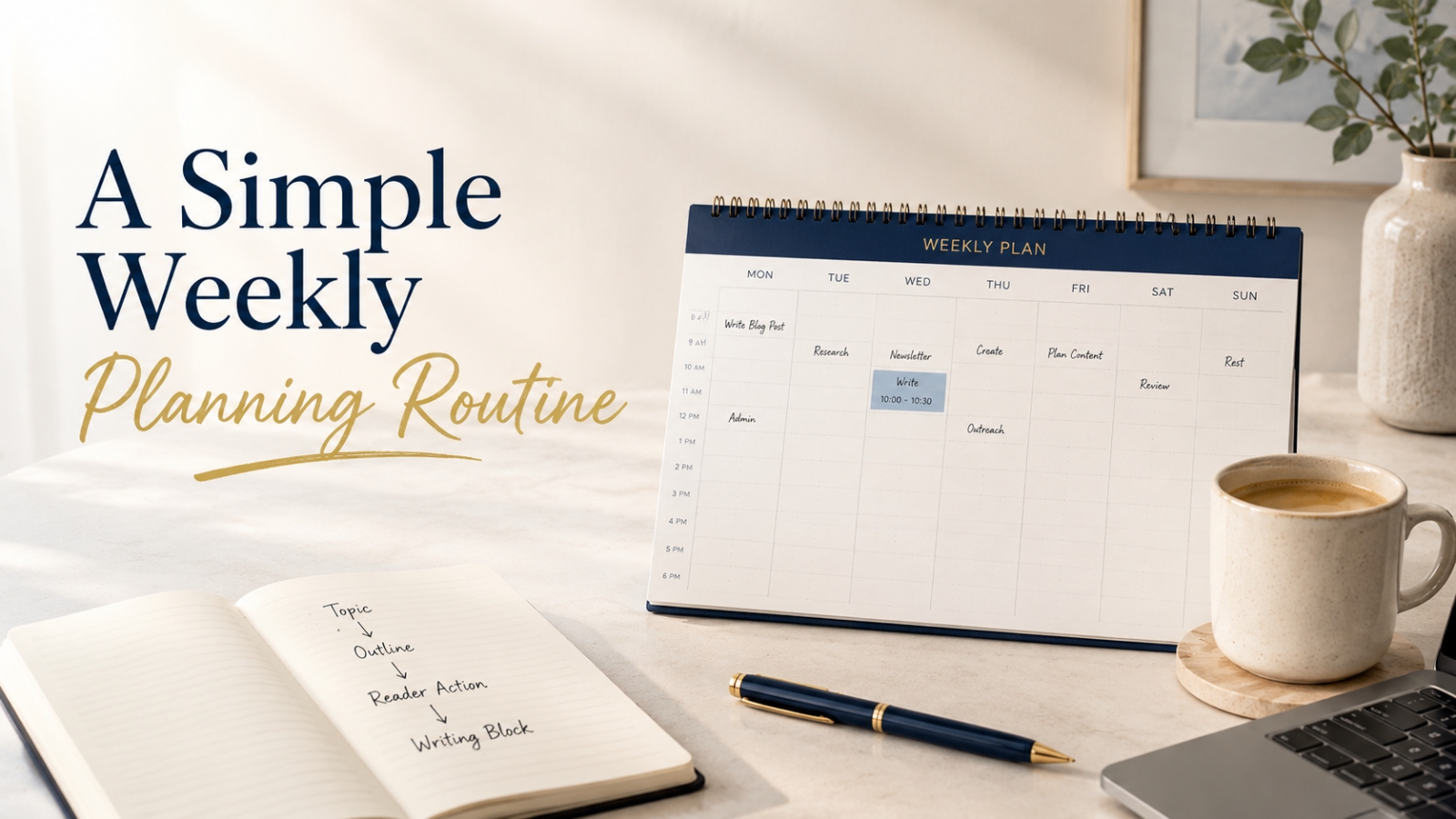
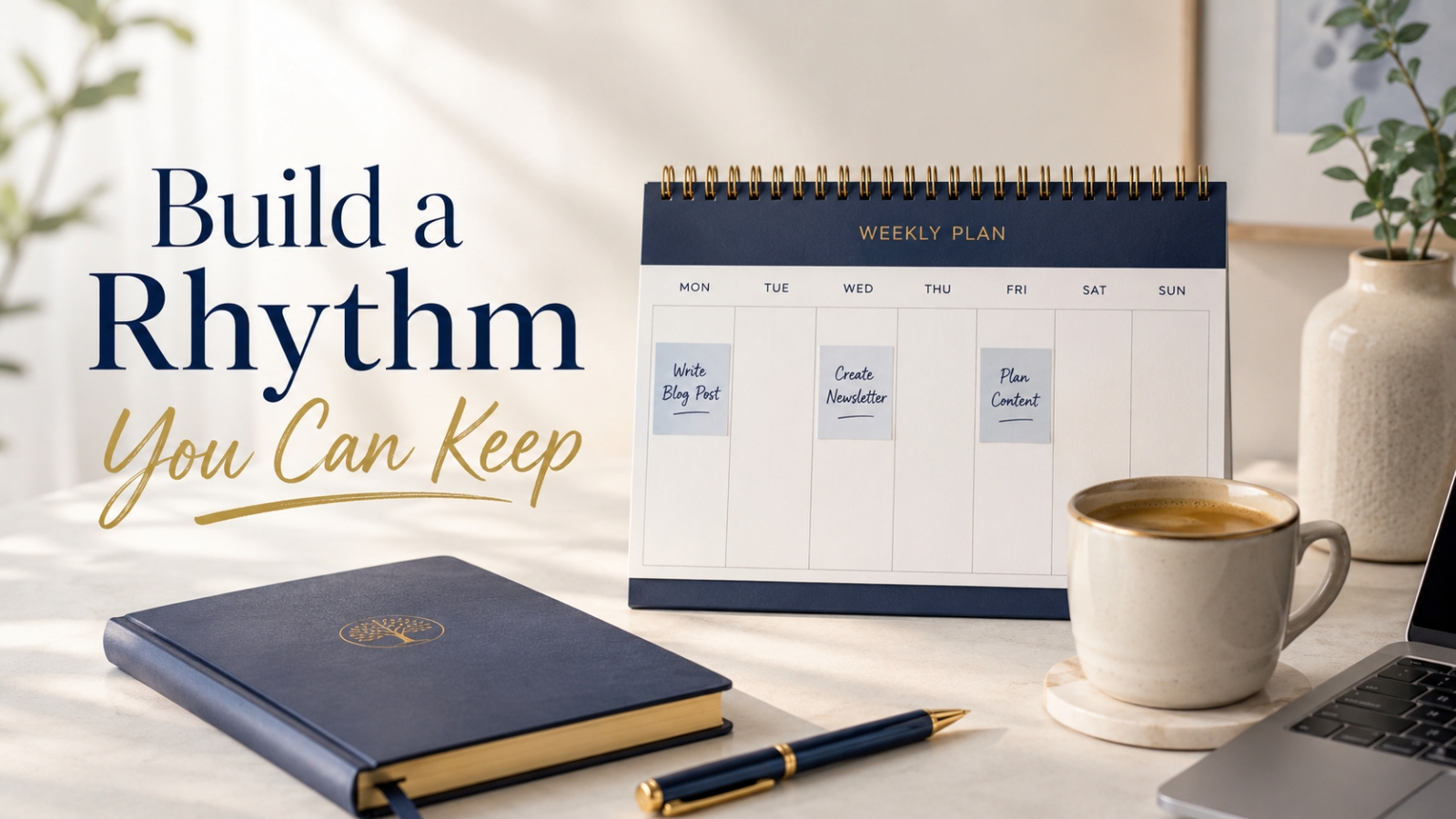
A calmer way to build a blogging rhythm you can actually keep.
The word “consistency” can feel heavy.
For many new bloggers, it sounds like a quiet alarm bell.
Publish more.
Show up more.
Write faster.
Do not miss a day.
That pressure can creep in before you even open your draft.
You sit down to plan your content, but instead of feeling focused, you feel behind.
Behind whom?
That part is not always clear.
But the feeling is real.
Here is the truth you may need to hear:
Consistency does not mean publishing every day.
It means building a rhythm you can actually return to.
A rhythm that supports your life, your energy, your goals, and your readers.
Not a schedule that looks impressive for one week and then quietly collapses.
Why Daily Publishing Feels So Tempting
Daily publishing sounds powerful.
It feels serious.
It gives you the sense that you are taking action.
And yes, some people can publish every day because they have the time, systems, support, and experience to do it well.
But that does not mean daily publishing is the right starting point for everyone.
For many beginners, daily publishing creates pressure before the foundation is ready.
You may start strong for a few days.
Then life happens.
Work gets busy. Family needs attention. Energy dips. Ideas feel thin.
The post you thought would take one hour takes four.
Suddenly, the schedule that was meant to help you becomes one more thing to feel guilty about.
That is not a sustainable rhythm.
That is a trap dressed up as discipline.
The Big Mistake Beginners Make
The big mistake is confusing frequency with consistency.
Frequency is how often you publish.
Consistency is whether you can keep showing up in a reliable way.
A person who publishes once a week for six months is more consistent than someone who publishes daily for six days and then disappears for six weeks.
That is the difference.
Consistency is not about proving how much you can do in a burst.
It is about building trust over time.
Think of fitness.
If someone has not exercised in years, a daily intense workout plan may sound inspiring on Monday.
By Friday, their knees hurt, their schedule is messy, and the plan feels like punishment.
But three short walks a week?
That may not sound dramatic.
But it is repeatable.
And repeatable is powerful.
Your publishing rhythm should work the same way.
The Sustainable Publishing Framework
Before choosing a publishing schedule, use this simple framework.
- Choose a rhythm you can keep on a normal week
- Separate writing from publishing
- Build a small content buffer
- Give each post a simple after-publish step
- Create a return plan for missed weeks
This framework helps you build a rhythm that feels realistic instead of stressful.
Step 1: Choose a Rhythm You Can Keep on a Normal Week
Do not build your schedule around your best week.
Build it around a normal week.
A normal week includes interruptions.
It includes tired evenings, unexpected errands, work that runs late, family responsibilities, and days when your brain feels like it left the room without telling you.
That is real life.
So ask:
What can I publish consistently during an ordinary week?
For many beginners, that may be one blog post per week.
For others, it may be one post every two weeks.
That is fine.
A realistic rhythm beats an impressive plan you cannot maintain.
Step 2: Separate Writing From Publishing
Many people struggle because they try to write and publish in one sitting.
That can work sometimes.
But it can also make the process feel rushed.
A calmer rhythm separates the work into smaller parts.
For example:
- Day 1: choose the topic
- Day 2: outline the post
- Day 3: write the draft
- Day 4: edit and format
- Day 5: publish or schedule
This makes publishing feel less like climbing a wall.
It becomes a staircase.
One step at a time.
You do not need to finish the whole post in one perfect writing session.
You only need to keep moving through the process.
Step 3: Build a Small Content Buffer
A content buffer simply means you have something prepared before you need it.
It does not need to be huge.
Even one extra draft can reduce stress.
If your post is due on Friday and you start writing on Friday morning, every delay becomes a problem.
But if you already have one outline, one rough draft, or one nearly finished post ready, the pressure drops.
You have breathing room.
A small buffer can look like:
- one finished post scheduled ahead
- two outlines ready
- three title ideas prepared
- one older post ready to refresh
- one email draft started
A buffer is not about perfection.
It is about making your rhythm easier to keep.
Step 4: Give Each Post a Simple After-Publish Step
Consistency is not only about publishing the post.
It is also about helping the post reach people.
A simple rhythm might include:
- publish the blog post
- send one short email
- share one useful social tip
- add one internal link from an older post
- check one reader clue later
This does not need to become complicated.
But if you publish and immediately rush to the next post, your content may not get enough support.
A slower rhythm that includes sharing can be more useful than a faster rhythm that leaves every post sitting quietly on your site.
Step 5: Create a Return Plan for Missed Weeks
You will fall behind at some point.
That is not failure.
That is life.
The important thing is what you do next.
Do not restart the whole plan.
Do not tell yourself you ruined everything.
Do not create an even harder schedule to “catch up.”
Just return to the rhythm.
If you planned to publish weekly and missed one week, publish the next useful post.
That is enough.
Consistency is not never missing.
Consistency is returning without turning one missed week into a full stop.
Think of brushing your teeth.
If you miss one night, you do not throw away the toothbrush.
You continue the next morning.
Treat your content rhythm the same way.
Worked Example: A Sustainable Fitness-Habit Blog Rhythm
Let’s use a simple example.
Imagine your blog helps beginners build realistic fitness habits.
Your reader is not training for a marathon.
They are trying to move more, feel better, and stop starting over every Monday.
You could try to publish every day.
But that may quickly become too much.
Instead, you create a realistic rhythm.
Reader
A beginner who wants to build a simple walking habit.
Content Goal
Help the reader start small and stay consistent without feeling guilty.
Sustainable Publishing Rhythm
One useful post per week.
Weekly Workflow
Monday: Choose the Topic
Example topic:
How to Start Walking Three Times a Week Without Overthinking It
Tuesday: Create the Outline
The outline may include:
- why daily exercise feels too hard at first
- why three walks can be enough to begin
- how to choose walking days
- what to do if you miss one walk
- one simple action for this week
Wednesday: Draft the Post
Write the first rough version.
Do not polish every sentence yet.
Just get the lesson onto the page.
Thursday: Edit and Format
Make the post easier to read.
Shorten paragraphs.
Improve subheads.
Add one clear example.
Give the reader one next step.
Friday: Publish and Share
Publish the post.
Then send one short email or share one useful tip from it.
That rhythm is not dramatic.
But it is repeatable.
And repeatable is the point.
What a Sustainable Blogging Rhythm Can Look Like
There is no single perfect schedule.
The right rhythm depends on your time, energy, skill level, and goals.
Here are a few options.
Option 1: One Post Per Week
This works well if you can set aside a few smaller writing blocks during the week.
Example rhythm:
- Monday: topic and outline
- Tuesday or Wednesday: draft
- Thursday: edit
- Friday: publish and share
This is a good starting rhythm for many bloggers because it is steady without being extreme.
Option 2: One Post Every Two Weeks
This works well if you have limited time or are still learning the process.
Example rhythm:
- Week 1: plan and draft
- Week 2: edit, format, publish, and share
This gives you more breathing room.
It can also help you write better posts because you are not rushing every week.
Option 3: Two Posts Per Month Plus One Update
This works well if you also want to improve older content.
Example rhythm:
- publish two new posts
- refresh one older post
- send two short emails
- share each post more than once
This rhythm balances creation and improvement.
It also helps your blog become stronger over time.
Option 4: One Main Post Plus Repurposed Content
This works well if you want one idea to travel further.
Example rhythm:
- publish one main post
- send one email about it
- create two short social posts
- turn one section into a checklist or quick tip
This is often better than rushing to create more posts.
One useful post can support several smaller content pieces.
How to Know If Your Schedule Is Too Heavy
Sometimes the problem is not discipline.
Sometimes the schedule is simply too heavy.
Here are a few signs:
- You feel tense every time you think about publishing.
- You rush posts just to meet the schedule.
- You rarely have time to edit properly.
- You stop enjoying the writing process.
- You keep missing the schedule and feeling guilty.
- You avoid opening your draft because it feels too big.
- You publish, but do not share or review the post.
If several of these feel familiar, reduce the pressure.
A lighter schedule you can keep is better than a heavier schedule that drains you.
What to Avoid When Building Your Publishing Rhythm
Mistake 1: Copying Someone Else’s Schedule
Someone else may publish daily.
Good for them.
But their life, team, experience, and goals may be different from yours.
Choose a rhythm that fits your stage.
You are not behind because your schedule looks different.
You are building your own system.
Mistake 2: Treating a Missed Week as Failure
Missing one week does not mean you are inconsistent forever.
Return to the next step.
Do not dramatize the pause.
A missed week is not a broken identity.
It is just a missed week.
Mistake 3: Writing Only When You Feel Inspired
Inspiration is helpful.
But it is not reliable.
A rhythm helps you write even when the spark is low.
You do not need to feel inspired to outline one section.
You only need to take the next small step.
Mistake 4: Planning More Than You Can Edit
Writing is only part of the process.
You also need time to edit, format, publish, and share.
If your schedule does not leave room for those steps, the work will feel rushed.
A good rhythm includes the whole workflow.
Mistake 5: Forgetting to Review the Rhythm
A schedule should serve you and your readers.
If it keeps breaking, adjust it.
Do not keep forcing a plan that clearly does not fit.
Your rhythm can grow as your skill, systems, and confidence grow.
Quick Exercise: Choose Your Sustainable Publishing Rhythm
Take a few minutes and answer these questions.
How Much Time Can I Realistically Give Each Week?
[Write your honest answer.]
What Is My Current Writing Speed?
[Fast / moderate / slow / still learning.]
What Publishing Rhythm Feels Realistic?
[Weekly / every two weeks / twice a month / other.]
Which Days Can I Use for Each Step?
Topic planning: [Day]
Outlining: [Day]
Drafting: [Day]
Editing: [Day]
Publishing: [Day]
Sharing: [Day]
What Is My Backup Plan If I Fall Behind?
[Write a simple return plan.]
Example:
If I miss a week, I will publish the next useful post instead of trying to catch up with two posts.
That one sentence can save you from a lot of guilt.
Final Thought: Choose a Rhythm You Can Return To
Consistency is not about proving you can do everything.
It is about building a rhythm you can return to again and again.
A sustainable rhythm gives you room to write better posts.
It gives you time to think.
Time to edit.
Time to share.
Time to rest.
That matters.
Because a blog is not built in one intense week.
It is built through steady, useful work over time.
So do not ask:
How often should I publish to look serious?
Ask:
What rhythm can I keep while still creating helpful content?
Start there.
Build from there.
A realistic rhythm may look smaller at first.
But if you can keep it, it can carry you much further.
Use This With Blogger’s Success Toolkit
If you already own Blogger’s Success Toolkit, log in to the Blogger Success Blueprint members area and use the planning resources to choose a publishing rhythm you can realistically keep.
Start with one clear rhythm, then adjust as you learn what works for your week.
Members Login:
https://bloggersuccessblueprint.com/members/
New to Blogger’s Success Toolkit?
Blogger’s Success Toolkit gives you a beginner-friendly path to choose your direction, plan useful content, write stronger titles, and begin building your blog with more structure.