A simple routine to choose, shape, and schedule your next post without overthinking it
Planning can feel heavier than writing sometimes.
You sit down with good intentions.
You open your notes.
You scan your ideas.
You think about what you should publish next.
Then one idea becomes five.
Five becomes twenty.
And somehow, what was supposed to be a quick planning session turns into a foggy afternoon of second-guessing.
Should you write the practical post?
The personal one?
The beginner guide?
The one you saw someone else publish?
The one that sounds “strategic” but feels boring?
This is where many beginners get stuck.
Not because they lack ideas.
Because they do not have a simple routine for choosing the next useful one.
That is what this 30-minute planning routine is for.
It will not plan your entire year.
It will not solve every content question.
It simply helps you choose, shape, and schedule your next post so writing feels easier when you sit down.
Why Weekly Planning Helps
A weekly planning routine gives your writing a softer landing.
Instead of arriving at your writing block with a blank page and a vague idea, you arrive with a small plan.
You already know:
- what topic you are writing about
- who the post is for
- what problem it helps solve
- what sections may be included
- what the reader should do next
- when you will write the draft
That removes a lot of friction.
It is like preparing ingredients before cooking.
If everything is still in the cupboard, dinner feels harder.
But if the vegetables are washed, the sauce is ready, and the pan is on the stove, starting feels easier.
Your blog post works the same way.
A little planning before writing can save a lot of staring later.
The Big Mistake: Trying to Plan Too Much at Once
Many beginners turn planning into a huge project.
They try to plan:
- the next post
- the next month
- every category
- every email
- every social post
- every possible content idea
That sounds productive.
But it can quickly become too much.
A weekly planning routine should not feel like building a control tower.
It should feel like choosing the next clear step.
For this routine, the goal is simple:
Plan one useful blog post for the week.
That is enough.
One useful post planned well is better than twenty ideas floating around with no clear direction.
The 30-Minute Weekly Planning Routine
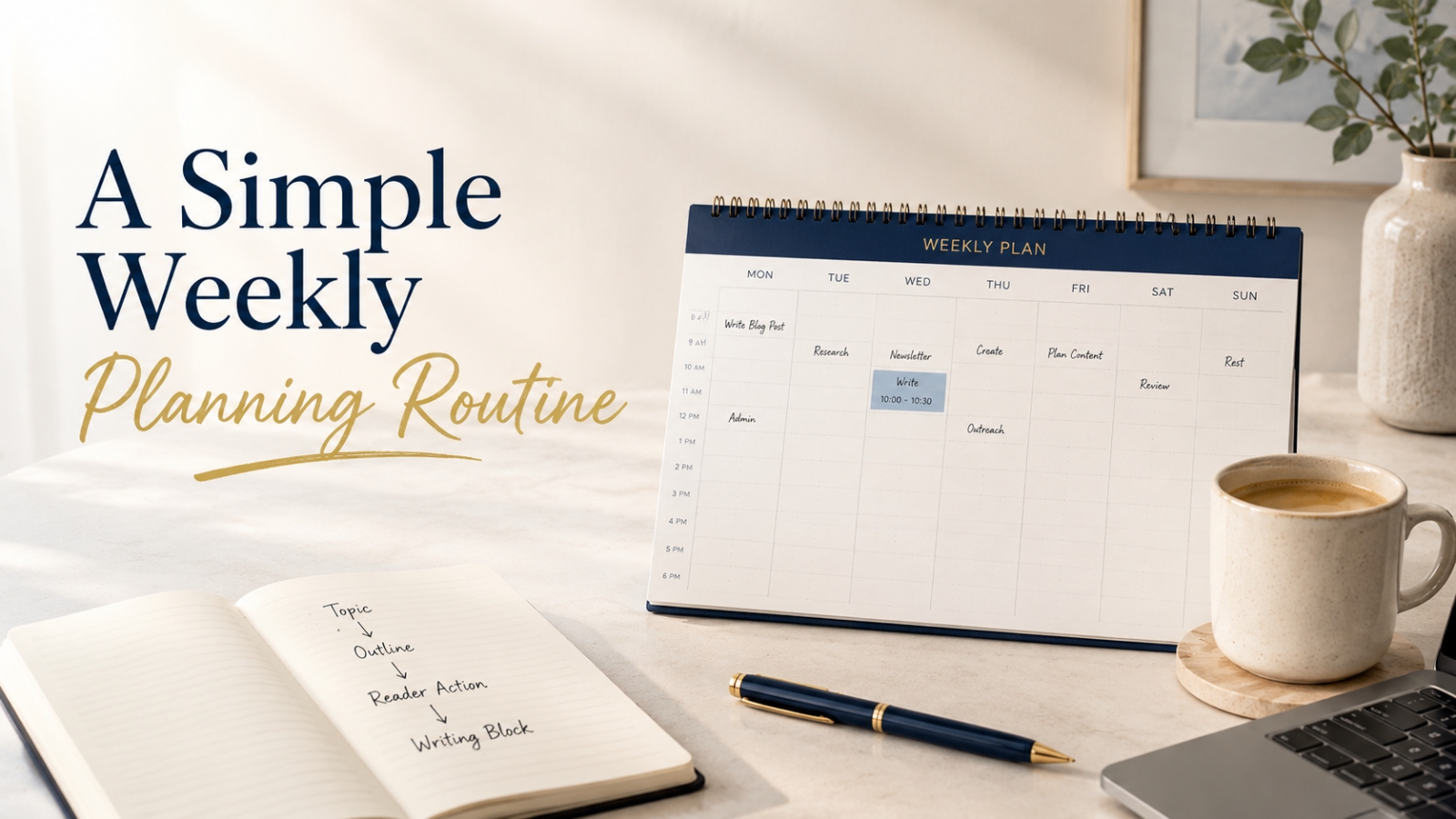
Set a timer for 30 minutes.
Not because you must rush.
But because a timer keeps planning from becoming endless.
Here is the routine:
- Review your ideas
- Choose one topic
- Outline the post
- Decide the reader action
- Schedule one writing block
Let’s walk through each step.
Step 1: Review Your Ideas
Time: 5 minutes
Start by reviewing your saved ideas.
These might come from:
- reader questions
- your own notes
- common beginner problems
- product lessons
- old posts that need a follow-up
- conversations with your audience
- mistakes you keep seeing
- topics you have wanted to explain simply
Do not judge every idea right now.
Just scan them.
Look for one idea that feels useful, timely, and realistic to write this week.
You are not choosing the best idea forever.
You are choosing the best idea for now.
That takes pressure off your shoulders.
Quick Question
Which idea would help my reader take one clear step this week?
Step 2: Choose One Topic
Time: 5 minutes
Now choose one topic.
Only one.
This is where the routine can fall apart if you keep comparing every possible option.
Do not let ten good ideas block one useful post.
For example, let’s use a non-blogging topic:
Creating a simple family meal plan
That is still broad, so we need to sharpen it.
A clearer topic might be:
How to plan three simple dinners for a busy school week
Now the post has direction.
It is not about every meal.
It is not about advanced nutrition.
It is not about a perfect monthly plan.
It is about three simple dinners for a busy week.
That is manageable.
And manageable gets written.
Quick Question
Can I make this topic smaller and more specific?
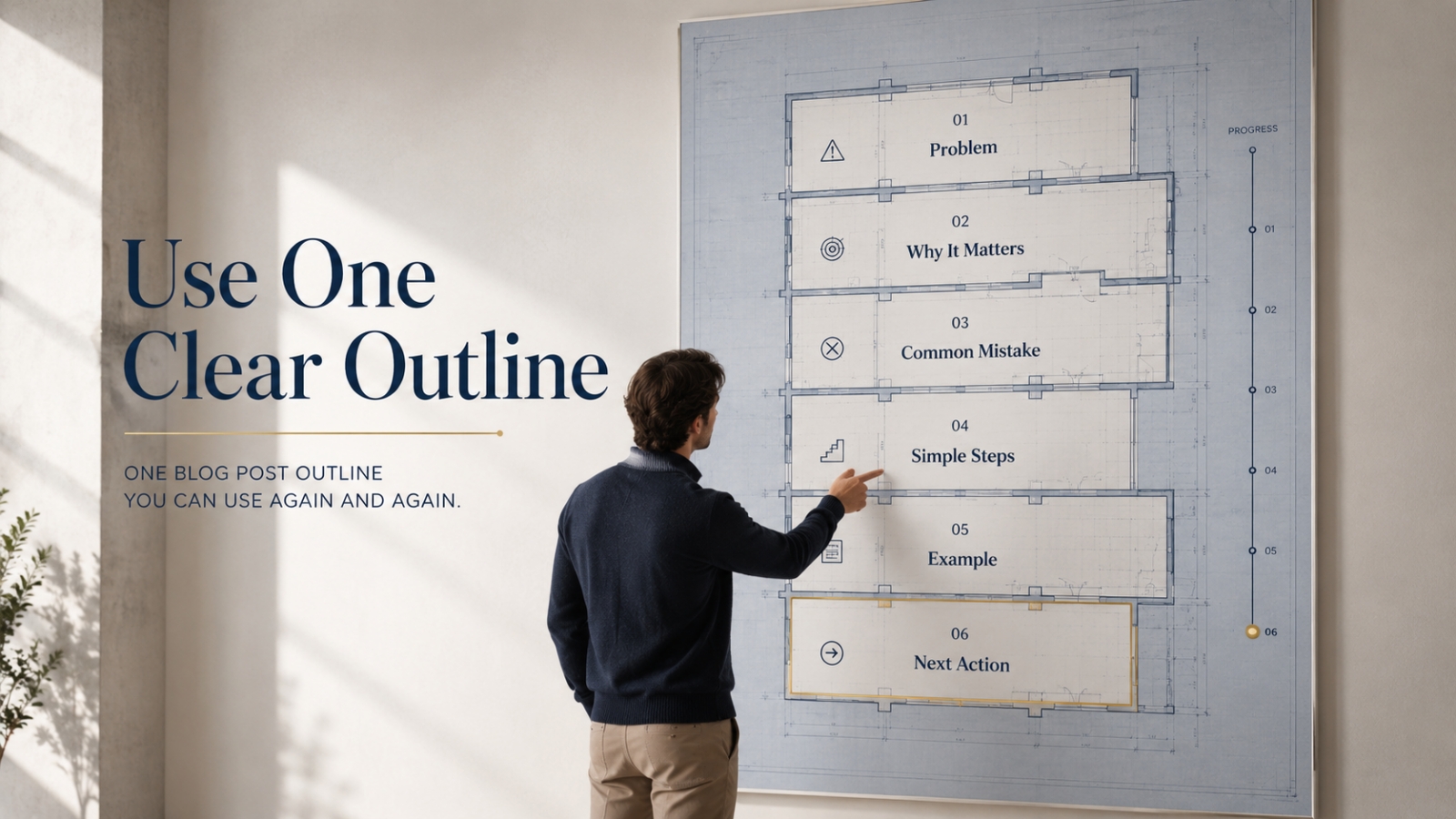
Step 3: Outline the Post
Time: 10 minutes
Now create a simple outline.
Do not write the full post yet.
Just map the path.
For the family meal planning example, the outline could look like this:
Working Title
How to Plan 3 Simple Dinners for a Busy School Week
Opening Problem
Weeknights feel rushed, and dinner decisions happen too late.
Why It Matters
When dinner is not planned, the evening feels more stressful and last-minute food choices become easier.
Simple Steps
- Check your weekly schedule
- Choose three easy dinners
- Reuse one ingredient
- Write a short shopping list
- Prepare one item ahead
Example
A simple week could include pasta night, rice bowl night, and soup-and-toast night.
Next Action
Choose three dinners before the next grocery trip.
That is enough for a first outline.
It does not need to be perfect.
It only needs to give the draft a path.
Quick Question
What are the 4 to 6 main sections this post needs?
Step 4: Decide the Reader Action
Time: 5 minutes
This step is easy to skip.
But it matters.
Before you write, decide what the reader should do after reading.
This keeps the post practical.
For the meal planning example, the reader action could be:
Choose three dinners and write one short grocery list.
That is clear.
It is small enough to do.
And it matches the purpose of the post.
A good reader action does not need to be big.
It just needs to help the reader move.
Other examples could be:
- clear one drawer
- choose one workout
- write one budget number
- prepare one morning routine
- set one phone boundary
- list three supplies needed for a project
When you know the next action, the whole post becomes easier to shape.
Quick Question
What should the reader do within 10 minutes after finishing the post?
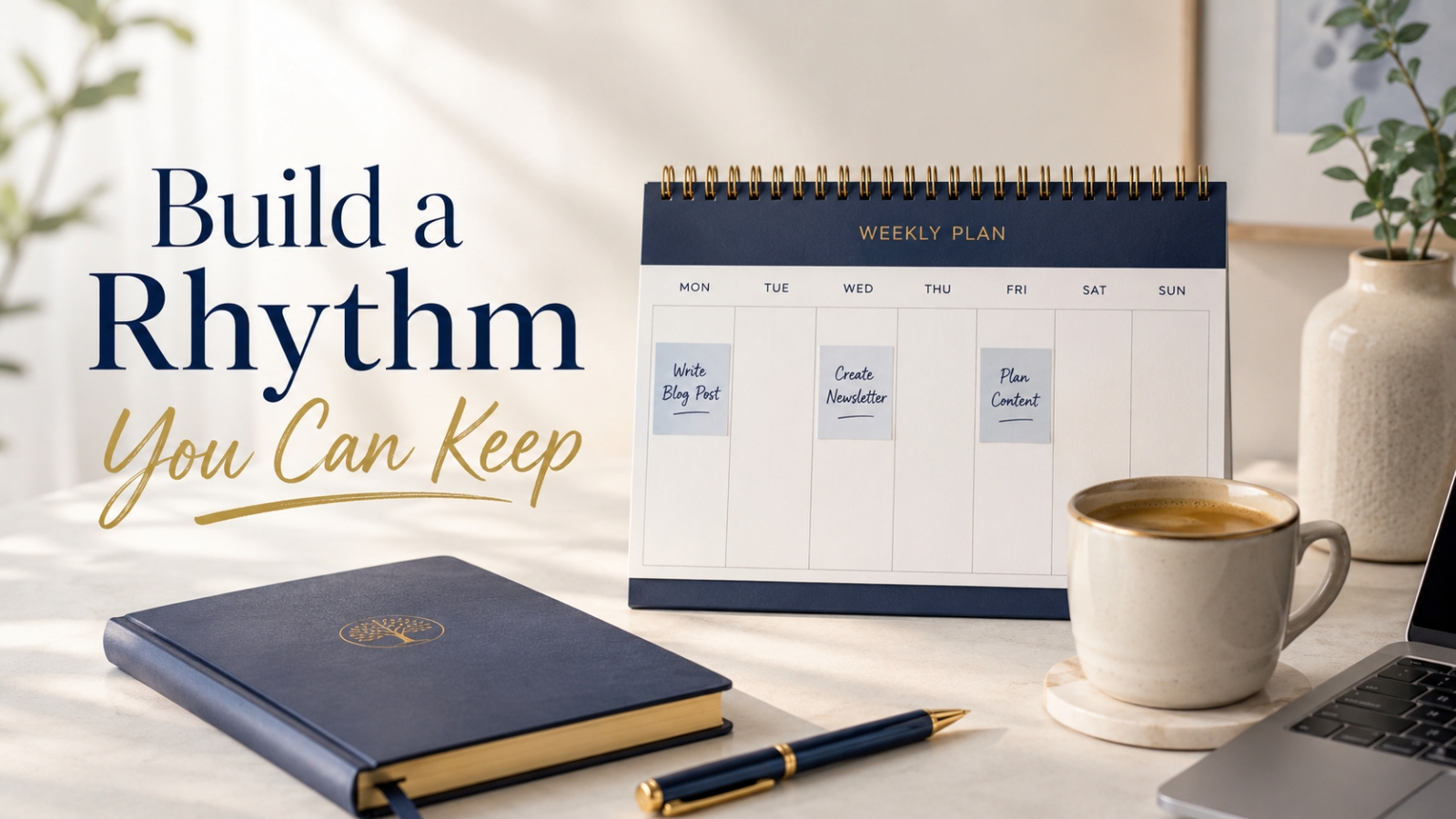
Step 5: Schedule One Writing Block
Time: 5 minutes
Planning is not complete until the writing has a place to happen.
A planned post with no writing block can still drift away.
So choose one specific writing time.
Not “sometime this week.”
A real block.
For example:
- Tuesday, 8:00–9:00 pm
- Wednesday morning, 7:00–8:00 am
- Saturday, 10:00–11:30 am
- Friday lunch break, 45 minutes
Keep it realistic.
If you only have 45 minutes, schedule 45 minutes.
If you need two writing blocks, schedule two.
The point is to give the post a home in your week.
Quick Question
When will I write the first draft?
Worked Example: Planning One Post in 30 Minutes
Let’s put the routine together.
Topic Area
Family meal planning
Step 1: Review Ideas
Saved ideas include:
- quick dinners
- lunchbox ideas
- grocery shopping
- picky eaters
- leftovers
- meal planning for busy weeks
Step 2: Choose One Topic
Chosen topic:
Planning three simple dinners for a busy school week
Step 3: Outline the Post
Working outline:
- Open with the weeknight dinner rush
- Explain why planning only three dinners is enough to start
- Step 1: check the weekly schedule
- Step 2: choose three easy dinners
- Step 3: reuse one ingredient
- Step 4: write a short shopping list
- Step 5: prepare one item ahead
- End with one simple action
Step 4: Decide the Reader Action
Reader action:
Choose three dinners and write a short grocery list before the next shopping trip.
Step 5: Schedule the Writing Block
Writing block:
Wednesday, 8:00–9:00 pm
Now the post is no longer a vague idea.
It has a topic, outline, reader action, and writing time.
That is what a good planning session should do.
What to Keep Out of the 30-Minute Routine
This routine works because it stays focused.
So do not try to do everything inside it.
Do Not Research Too Deeply
A quick check is fine, but deep research can swallow the whole session.
Save research for a separate block if needed.
Do Not Write the Full Draft
This is planning time.
If you start drafting and lose the structure, pause and return to the outline.
Do Not Redesign Your Whole Content Strategy
That is a bigger task.
This routine is for planning the next post.
Do Not Keep Switching Topics
Choose one topic and move forward.
You can save the other ideas for later.
Do Not Wait for the Perfect Idea
A useful idea written this week is better than a perfect idea you keep postponing.
Common Mistakes to Avoid
Mistake 1: Planning Too Many Posts
Planning ten posts may sound productive, but it can leave you with no clear next step.
Start with one post.
Finish the planning.
Then write it.
Mistake 2: Choosing a Topic That Is Too Broad
Broad topics create broad drafts.
Make the topic smaller before you outline.
Mistake 3: Forgetting the Reader Action
If you do not know what the reader should do next, the post may end weakly.
Decide the action before you draft.
Mistake 4: Planning Without Scheduling
If you do not schedule a writing block, the post may stay in your notes.
Give the writing a place in your calendar.
Mistake 5: Turning Planning Into Procrastination
Planning should help you write.
If you keep planning to avoid drafting, stop and schedule the writing block.
At some point, the post needs words on the page.
Your 30-Minute Planning Worksheet
Use this before your next writing session.
Minute 0–5: Review Ideas
What ideas are already in my notes?
[Write 3 to 5 ideas]
Minute 5–10: Choose One Topic
Which topic will I write this week?
[Write one topic]
Can I make it more specific?
[Rewrite it smaller]
Minute 10–20: Outline the Post
Working title:
[Write title]
Opening problem:
[Write reader problem]
Main sections:
- [Section 1]
- [Section 2]
- [Section 3]
- [Section 4]
- [Section 5]
Minute 20–25: Decide the Reader Action
After reading, the reader should:
[Write one clear action]
Minute 25–30: Schedule the Writing Block
I will write the first draft on:
[Day and time]
That is your plan.
Simple. Clear. Done.
Final Thought: A Small Plan Can Make Writing Feel Lighter
You do not need a giant content calendar to move forward.
You need a clear next post.
That starts with 30 focused minutes.
Review your ideas.
Choose one topic.
Outline the path.
Decide the reader action.
Schedule the writing block.
That is enough.
A small plan gives your writing somewhere to go.
It turns the blank page from a wall into a doorway.
And once the doorway is open, the next step feels much easier.
Use This With Blogger’s Success Toolkit
If you already own Blogger’s Success Toolkit, log in to the Blogger Success Blueprint members area and use the planning resources to map your next post before you write.
Start with one topic, one outline, one reader action, and one writing block.
Members Login:
https://bloggersuccessblueprint.com/members/
New to Blogger’s Success Toolkit?
Blogger’s Success Toolkit gives you a beginner-friendly path to choose your direction, plan useful content, write stronger titles, and begin building your blog with more structure.