
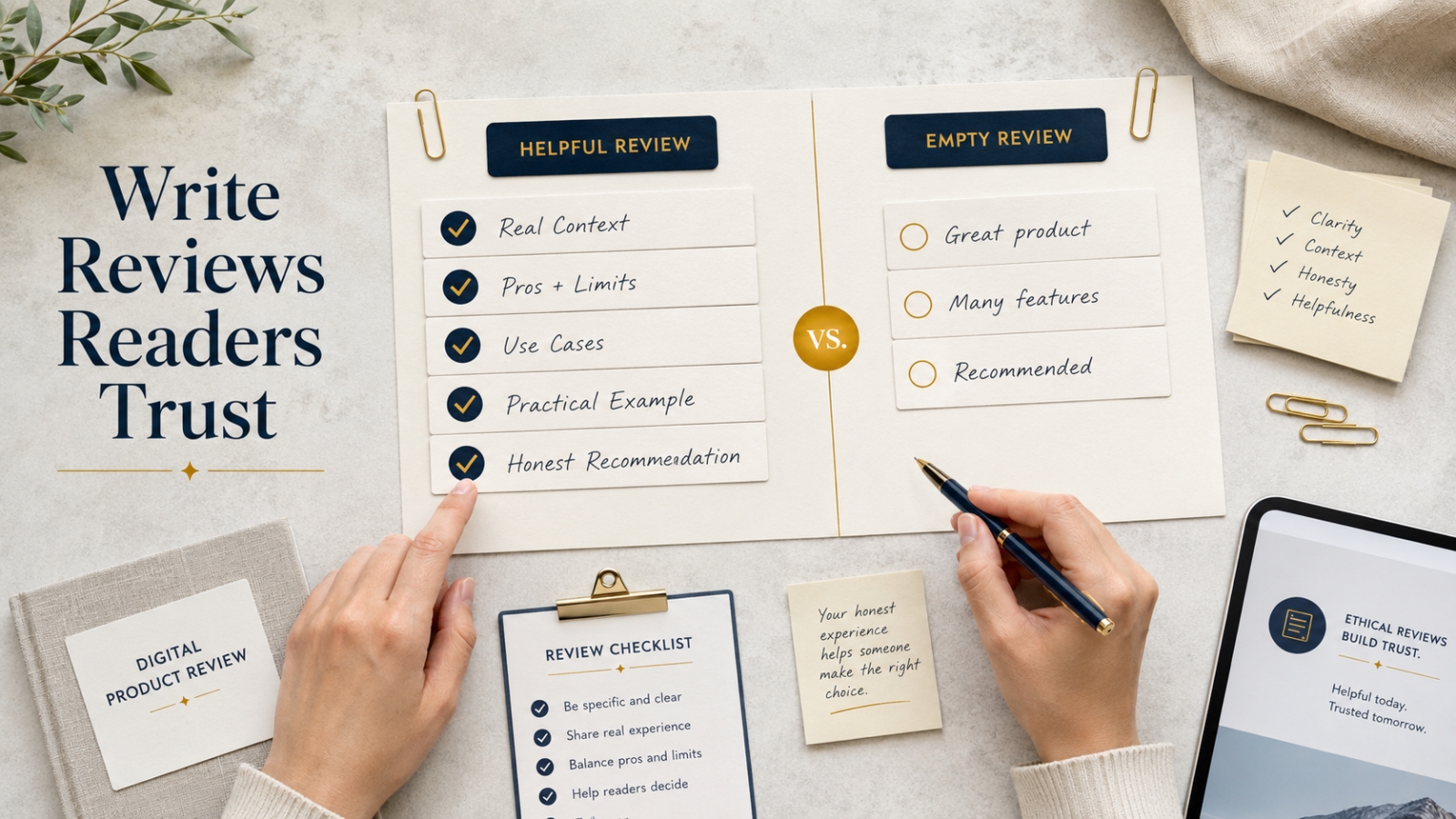
How to write product reviews that guide readers clearly, build trust, and support better buying decisions.
You click on a product review because you want help.
Maybe you’re thinking about buying a digital training course.
Maybe you’re comparing two affiliate tools.
Maybe you’re wondering if a PLR package is actually useful, or just another folder full of files you’ll forget about.
So you open the review.
And then you see this:
“This product is amazing. It has many great features. I highly recommend it.”
That’s when the disappointment hits.
The words are positive.
But they don’t help.
You still don’t know who the product is for. You don’t know where it works best. You don’t know what the limits are. You don’t know whether it fits your situation.
That is the difference between an empty review and a helpful review.
A helpful review does not just praise the product.
It helps the reader think.
Why Review Quality Matters
Review posts are one of the most common ways bloggers and affiliate marketers introduce products.
But not every review builds trust.
Some reviews feel thin because they only repeat the product page.
Some feel too excited because they ignore the limits.
Some feel unclear because they never explain how the product works in real life.
Your reader can sense that.
They may not say it out loud, but they feel it.
And once a review feels one-sided, trust starts to weaken.
A good review does not need to be harsh. It does not need to be negative. It simply needs to be useful.
That means the reader should finish the review with a clearer answer to this question:
“Is this right for me?”
The Big Mistake Beginners Make With Reviews
The biggest mistake is writing a review like a product announcement.
That usually sounds like this:
- Here is the product.
- Here are the features.
- Here is why it is good.
- Here is my recommendation.
That structure is easy to write.
But it often feels flat.
Why?
Because the reader does not only want to know what the product includes.
They want to know what the product means for them.
Will it help them move faster?
Will it reduce confusion?
Will it fit their current stage?
Will it require more work than expected?
Will it suit a beginner, or is it better for someone with more experience?
A helpful review answers those quiet questions.
An empty review skips them.
The Helpful Review Framework
A strong review needs five simple parts:
- Real context
- Pros and limits
- Use cases
- Practical examples
- Honest recommendation
Let’s walk through each one.
1. Give Real Context
A helpful review starts with context.
Not just product details.
Context explains why the product matters, who may care about it, and what problem it is trying to solve.
For example, let’s say you’re reviewing a digital product launch checklist.
An empty review might begin like this:
“This launch checklist is a useful resource for digital product creators.”
That is not wrong.
But it is too thin.
A more helpful version would say:
“If you already have a small digital product prepared, but you feel unsure about what needs to happen before launch day, a launch checklist can help you see the missing pieces before you start promoting.”
That gives the reader a situation.
They can picture the problem.
They may think, “Yes, that’s exactly where I am.”
That is what real context does.
It puts the product into the reader’s world.
Ask this before writing
Before you review any product, ask:
- What problem is the reader trying to solve?
- What stage is the reader likely in?
- Why would this product matter at that moment?
- What confusion does it help reduce?
If you can answer those questions, your review will already be stronger than most.
2. Share the Pros and the Limits
A helpful review does not only list the good points.
It also explains the limits.
That does not mean you need to be negative.
It means you need to be fair.
Let’s continue with the digital product launch checklist example.
Possible pros:
- It gives structure before launch.
- It helps you organize important steps.
- It reduces the chance of forgetting key items.
- It can make the launch process feel less scattered.
Possible limits:
- It will not build the product for you.
- It will not replace your own planning.
- It may feel too simple for advanced marketers.
- It still requires you to complete the tasks.
That balance matters.
When you mention reasonable limits, your positive points feel more believable.
Readers trust you more when you are willing to say, “This helps with this, but not with that.”
A simple phrase you can use
“Where this helps most is…”
Then follow with:
“Where it may not be enough is…”
That simple pairing gives your review balance.
3. Explain the Use Cases
A use case shows when and how someone might use the product.
This is where many reviews become more practical.
Instead of saying, “This is useful,” show the situation where it becomes useful.
For the launch checklist, possible use cases might include:
- before setting up a sales page
- before writing launch emails
- before giving affiliates product details
- before checking delivery links
- before planning a short promotion window
Now the reader can imagine how the checklist fits into their work.
That makes the review easier to understand.
It also stops the product from feeling abstract.
Helpful review wording
You could write:
“This checklist is most useful when you are close to launching, but your pieces still feel scattered. For example, you may have the product file ready, but you still need to check the sales page, email sequence, download page, and support details.”
That is practical.
It gives the reader a real moment.
4. Use Practical Examples
A practical example turns your review from opinion into guidance.
This is especially important with digital products.
Many digital products sound similar on the surface.
Templates. Checklists. Training. Swipe files. Planners. Guides.
The reader needs to see how the product might actually be used.
Let’s use the launch checklist again.
An empty review might say:
“The checklist saves time and helps you stay organized.”
A helpful review might say:
“Let’s say you are preparing a simple digital guide. Before sharing it with your list, you can use the checklist to confirm that your product file is ready, your delivery page opens correctly, your support contact is visible, and your email follow-up points people to the right place.”
That example is much clearer.
It shows the product in action.
It also helps the reader imagine using it.
One example is usually enough
You do not need ten examples.
One clear example is better than five shallow ones.
Choose one situation and walk the reader through it.
That makes your review feel grounded.
5. Give an Honest Recommendation
A helpful review ends with a clear, honest recommendation.
Not a loud push.
Not a vague “this is great.”
A real recommendation explains who should consider the product, who may not need it, and why.
For example:
“This launch checklist may suit beginner digital product creators who have a product idea or product file ready, but feel unsure about the steps needed before sharing it with buyers. It may not suit someone looking for advanced funnel strategy, paid advertising training, or full launch management. The main reason it may help is that it gives you a simple structure to check your launch pieces before you move forward.”
That feels useful.
It respects the reader.
It gives them room to decide.
Helpful Reviews vs Empty Reviews
Let’s compare the two styles side by side in plain language.
Empty review
An empty review usually says:
- The product is good.
- It has useful features.
- The reviewer likes it.
- The reader should consider it.
That may sound positive, but it leaves too many gaps.
The reader still wonders:
- Is it right for my stage?
- How would I use it?
- What are the limits?
- Is this just a promotion?
- What should I do next?
Helpful review
A helpful review says:
- Here is the problem this product addresses.
- Here is who may find it useful.
- Here is where it works well.
- Here is where it may not be enough.
- Here is a practical example.
- Here is my honest recommendation.
That is far more useful.
It helps the reader make a decision with more confidence.
A Simple Review Template You Can Use
Use this structure when writing your next product review.
Review Quality Template
1. Context
“This product is designed to help [specific person] with [specific problem].”
2. Best fit
“It may suit you if [situation or stage].”
3. Pros
“The strongest parts are [benefit 1], [benefit 2], and [benefit 3].”
4. Limits
“It may not be enough if [situation where it does not fit].”
5. Practical example
“For example, you could use it to [specific use case].”
6. Honest recommendation
“My honest view: this is worth considering if [clear fit], but you may want to skip it if [clear non-fit].”
That structure keeps the review useful and balanced.
It also keeps you from slipping into empty praise.
Worked Example: Reviewing a Digital Product Launch Checklist
Here is a simple review section using the template.
Context
“This digital product launch checklist is designed to help beginner creators organize the basic pieces needed before sharing a product with their audience.”
Best fit
“It may suit you if you already have a product idea, guide, template pack, or training resource prepared, but you’re not sure what to check before launch.”
Pros
“The strongest part is the structure. It helps you look at your product file, sales page, delivery setup, email follow-up, and support details in one place.”
Limits
“It may not be enough if you need advanced funnel building, copywriting support, paid traffic training, or someone to review your offer strategy.”
Practical example
“For example, before telling your email list about a new guide, you could use the checklist to confirm that the download link works, the welcome email is ready, and the support contact is easy to find.”
Honest recommendation
“My honest view: this is worth considering if your main problem is launch organization. But if your bigger challenge is creating the product itself or writing the sales message, you may need a different resource first.”
That review feels much stronger.
It is not trying to impress the reader.
It is trying to help them.
What to Add to Improve a Weak Review
If you already wrote a review and it feels too thin, do not throw it away.
Improve it.
Look for these missing pieces.
Add the reader’s situation
Instead of only describing the product, describe when someone would need it.
Ask:
“What is happening in the reader’s world right before they need this?”
That question often gives your review a stronger opening.
Add one practical example
Show how the product might be used in a real moment.
This makes the review easier to picture.
Add one honest limit
Mention what the product does not do.
This makes the review feel fair.
Add a clearer final recommendation
Do not end with vague praise.
End with fit.
Say who should consider it and who should skip it.
Common Mistakes to Avoid
Mistake 1: Repeating the product page
If your review only repeats the product creator’s sales page, it will not feel personal or useful.
Add your own explanation.
Translate the product into reader-friendly language.
Mistake 2: Only writing positive points
A review with no limits can feel one-sided.
Even a good product has boundaries.
Mention them fairly.
Mistake 3: Using vague praise
Words like “great,” “powerful,” and “useful” are not enough by themselves.
Explain why.
Mistake 4: Forgetting use cases
Readers need to know when they would use the product.
Give them a situation.
Mistake 5: Ending without guidance
A review should not leave the reader hanging.
Give a clear, honest closing recommendation.
Quick Exercise: Strengthen Your Next Review
Before publishing your next review, answer these five questions:
- What problem does this product help with?
- Who is it best suited for?
- What are the strongest benefits?
- What are the honest limits?
- What is one practical example of using it?
Then write your closing recommendation using this sentence:
“This may suit you if ______. It may not be right if ______. The reason it may help is ______.”
That one sentence can sharpen the whole review.
Final Encouraging Thought
A helpful review is not about sounding clever.
It is about being useful.
Your reader does not need empty praise.
They need context, clarity, examples, and honesty.
When your review explains the real situation, the pros and limits, the use cases, and your honest recommendation, it becomes more than content.
It becomes guidance.
And guidance is what builds trust.
Use This With Blogger’s Success Toolkit
If you already own Blogger’s Success Toolkit, log in to the Blogger Success Blueprint members area and use the relevant planning tools, worksheets, or resources to apply this lesson.
Open one product.
Choose one section.
Complete one small task.
If you already own the core products or one of the lighter support paths, use what you already have before looking for anything else.
Members Login:
https://bloggersuccessblueprint.com/members/
New to Blogger’s Success Toolkit?
Blogger’s Success Toolkit gives you a beginner-friendly path to choose your direction, plan useful content, write stronger titles, and begin building your blog with more structure.




1 Response to "The Difference Between Helpful Reviews and Empty Reviews"
[…] For a fuller framework, see The Difference Between Helpful Reviews and Empty Reviews. […]