Turn ready-made content into useful blog assets, clearer offers, and a more structured path for your readers
The Folder Full of Files Problem
You download a PLR package.
At first, it feels exciting.
There are guides, templates, graphics, emails, maybe even sales materials. It looks like something useful is finally sitting in front of you.
Then a few days pass.
The files stay in the folder.
You open them again and think, “Where do I even begin?”
That is where many people get stuck with PLR.
Not because PLR has no value.
But because they do not know where it fits.
They see it as “content I bought” instead of “raw material I can shape into something useful.”
That one shift matters.
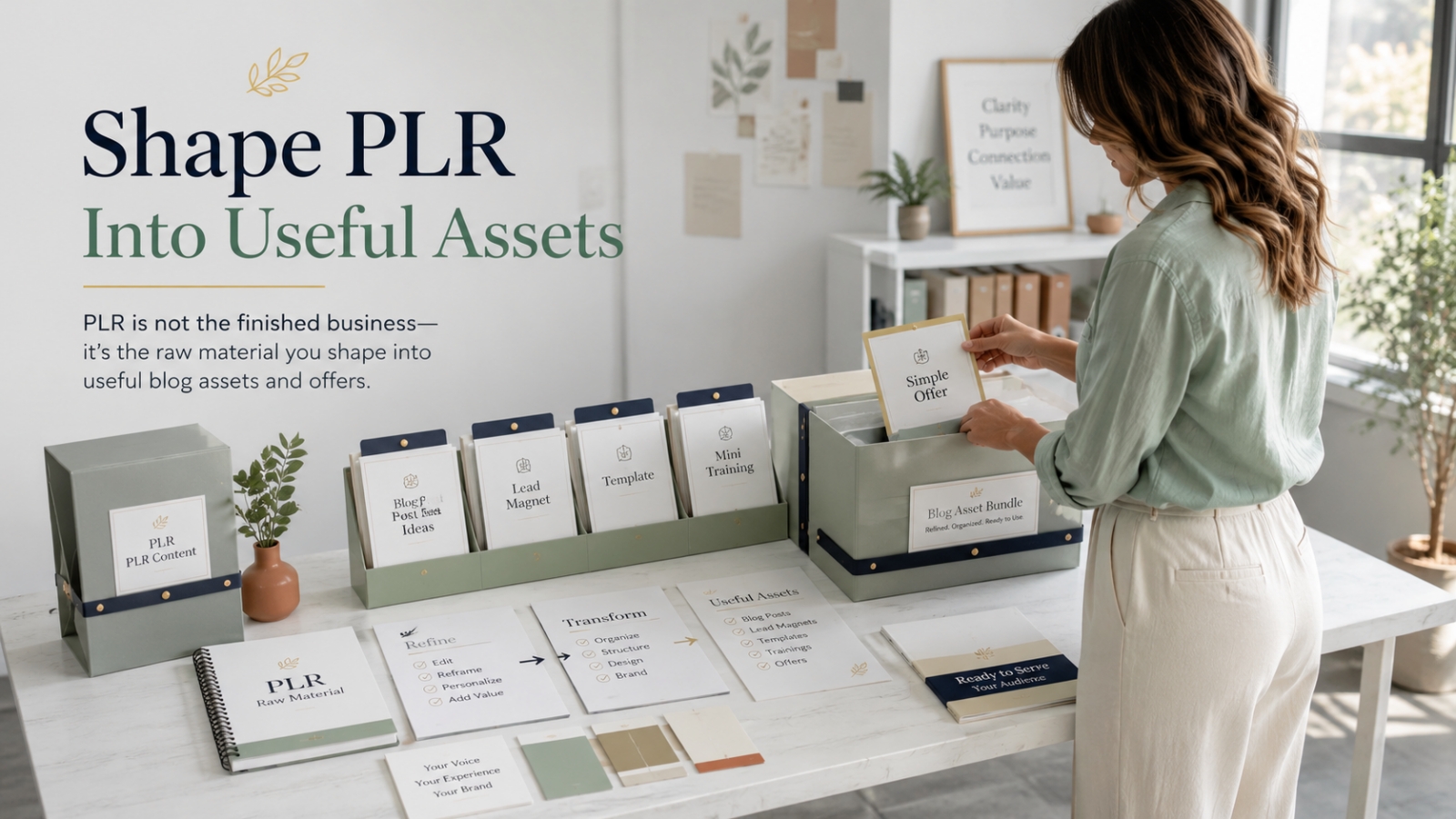
PLR is not the business by itself.
It is a building material.
And when you use it with purpose, it can support your blog, your email list, your lead magnets, your templates, your training, and your product offers.
Why This Topic Matters
Many bloggers want to create more helpful content.
They want to grow their audience.
They want to build trust.
They want to create products one day.
But they often run into the same problem.
Everything takes time.
Writing from scratch takes time.
Creating templates takes time.
Planning lead magnets takes time.
Building product offers takes time.
That is where PLR can help.
It gives you a starting structure, so you are not staring at a blank screen every time.
But it only works well when you know how to use it properly.
PLR should help you create with more structure, not publish something generic.
The Big Mistake Beginners Make With PLR
The biggest mistake is treating PLR as finished content.
A beginner may buy a PLR guide, add their name to it, upload it, and hope it works.
But readers can usually feel when something is not shaped for them.
The content may sound flat.
The examples may feel distant.
The offer may not connect to the blog.
The tone may not match the blogger’s voice.
That is why PLR should not be used as a copy-and-paste business model.
It works better as a foundation.
You take the structure.
You keep what is useful.
You remove what does not fit.
You add your examples, your style, your reader’s problem, and your next-step guidance.
That is when PLR starts to become valuable.
The PLR Placement Framework
Here is a simple way to think about where PLR fits into a blogging business.
Use PLR in four places:
1. Content Support
PLR can help you shape blog ideas, outlines, article sections, checklists, and teaching points.
It can give you a starting map.
But your blog post should still sound like you.
For example, if your blog is about simple home budgeting, you might use a PLR guide about personal finance as a base.
You could pull out one useful topic, such as “planning a weekly grocery budget.”
Then you rewrite it in your own voice, add a real-life example, simplify the steps, and connect it to your reader’s daily problem.
Now the content is no longer generic.
It is guided.
It is useful.
It fits your audience.
2. List-Building Support
PLR can also help you create lead magnets.
A lead magnet does not need to be huge.
It can be a checklist, short guide, worksheet, planner, cheat sheet, or mini workbook.
Let’s continue with the home budgeting example.
A PLR finance guide might include many topics:
- Grocery planning
- Bill tracking
- Emergency fund basics
- Spending habits
- Budget categories
Instead of using the whole guide, you could turn one small section into a simple lead magnet:
“Weekly Grocery Budget Planner”
That is much easier for the reader to use.
It also connects naturally to a blog post about grocery planning.
This is how PLR helps you build your email list with more structure.
3. Product Packaging Support
PLR can help bloggers package simple offers faster.
A product offer does not need to be complicated.
It can be a focused resource that helps your reader solve one clear problem.
Using the same budgeting example, you could create a small starter product such as:
“Simple Family Budget Starter Kit”
Inside, you might include:
- A quick-start guide
- A weekly expense tracker
- A grocery planning worksheet
- A bill payment checklist
- A short training script or video outline
Some of those pieces can begin from PLR.
But they should be edited, organized, renamed, improved, and connected into one useful path.
That is the difference between “a pile of files” and “a packaged offer.”
A pile of files feels confusing.
A packaged offer feels helpful.
4. Training Support
PLR can also help you create training content.
Many PLR products include written guides, outlines, checklists, or scripts.
These can become:
- Short video lessons
- Audio lessons
- Workshop outlines
- Slide scripts
- Step-by-step tutorials
- Mini training modules
But again, the goal is not to read the PLR word for word.
The goal is to use it as a structure.
You can turn a written guide into a simple training by asking:
“What does my reader need to understand first?”
“What action should they take next?”
“What example will make this easier?”
“What mistake should they avoid?”
That is how PLR becomes teaching material instead of just text.
PLR Is a Starting Point, Not the Whole Strategy
PLR is helpful, but it still needs direction.
Think of it like buying ingredients.
The ingredients matter.
But they are not the meal yet.
You still need to choose the recipe, prepare the food, adjust the seasoning, and serve it in a way people enjoy.
PLR works the same way.
The files are the ingredients.
Your audience needs the finished experience.
That means your role is to shape the material.
You decide:
- Who is this for?
- What problem does it solve?
- What should the reader do first?
- What should be removed?
- What should be rewritten?
- What should be added?
- What next step should this lead to?
This is where your value comes in.
Not in owning the file.
But in turning the file into something useful.
How PLR Connects to a Blogging Business
A blogging business needs more than posts.
It needs connected assets.
That may include blog content, an email list, lead magnets, product offers, templates, swipe files, and training.
PLR can support each part when used carefully.
Blog Posts
PLR can help you create outlines, teaching points, and topic ideas.
But your finished posts should be rewritten for your audience.
Email List
PLR can help you build welcome emails, educational emails, or short follow-up sequences.
But your emails should feel personal, warm, and relevant.
Lead Magnets
PLR can help you create checklists, worksheets, and short guides.
But the lead magnet should solve one specific reader problem.
Product Offers
PLR can help you build small products faster.
But the offer needs clear positioning, a useful outcome, and a simple structure.
Templates
PLR can help you create practical tools your readers can use.
But templates should be cleaned up, simplified, and branded clearly.
Swipe Files
PLR can help you collect examples, prompts, scripts, and starting points.
But the swipe file should be organized so readers can use it quickly.
Training
PLR can help you create lessons, slides, and scripts.
But the training should include your explanation, pacing, and practical examples.
That is where PLR fits.
It supports the system.
It does not replace the system.
A Worked Example: Turning PLR Into a Small Budgeting Offer
Let’s say you have PLR content about personal budgeting.
The raw PLR includes a guide, a checklist, a few worksheets, and some email content.
Used poorly, you might upload everything as-is and call it done.
Used wisely, you could build a simple path.
Step 1: Choose One Reader Problem
Instead of trying to cover all of personal finance, choose one problem:
“I want to plan my weekly spending without feeling overwhelmed.”
That is clear.
It is specific.
It gives the offer direction.
Step 2: Select Only the Useful Pieces
You may not need the full PLR package.
You might keep:
- Weekly budget worksheet
- Spending category checklist
- Grocery planning section
- Simple tracking habit tips
You might remove:
- Advanced investment content
- Long theory sections
- Unrelated finance topics
- Generic filler
This keeps the product focused.
Step 3: Rewrite the Teaching Content
Now you rewrite the guide in your own voice.
Make it simpler.
Make it warmer.
Use short examples.
Add a clear first step.
You are not trying to sound like a finance textbook.
You are helping a tired reader sit down on Sunday evening and plan the week without stress.
That small emotional detail makes the content feel more human.
Step 4: Package It Into a Clear Offer
Now the offer becomes:
“Weekly Budget Reset Kit”
Inside, you include:
- Quick-start guide
- Weekly spending planner
- Grocery budget worksheet
- Bill reminder checklist
- Simple money habit tracker
This feels much stronger than a generic “budgeting PLR guide.”
Why?
Because it has a clear promise.
It has a clear reader.
It has a clear use.
Step 5: Connect It to Your Blog
You could then write a blog post called:
“How to Plan Your Weekly Spending in 20 Minutes”
At the end, you invite readers to download a checklist or learn more about the starter kit.
Now your blog post, lead magnet, email list, and product offer connect.
That is how PLR fits into a blogging business.
What to Improve Before Using PLR
Before you use any PLR content, run it through a simple improvement pass.
Improve the Title
Generic titles are easy to ignore.
Make the title clearer and more outcome-focused.
Instead of:
“Budgeting Guide”
Try:
“Weekly Budget Reset Kit”
That feels more specific.
Improve the Structure
Readers need order.
Group the content into a simple path:
- Start here
- Understand the problem
- Take the first step
- Use the worksheet
- Build the habit
Structure makes the content easier to use.
Improve the Examples
Generic examples can make content feel distant.
Use examples your reader understands.
A weekly grocery plan.
A messy kitchen table.
A Sunday evening budget review.
A bill reminder stuck to the fridge.
Simple scenes help the lesson feel real.
Improve the Voice
PLR may sound stiff.
Rewrite it in your own tone.
Use shorter sentences.
Add warmth.
Remove robotic phrases.
Make the reader feel guided, not lectured.
Improve the Next Step
Every asset should guide the reader somewhere useful.
After reading, what should they do?
Download something?
Use a worksheet?
Watch a lesson?
Start a simple plan?
Make the next step clear.
Common Mistakes to Avoid
PLR can help you move faster, but it can also create problems if used carelessly.
Mistake 1: Publishing Without Editing
This is the fastest way to make your content feel generic.
Always adapt PLR before using it.
Mistake 2: Keeping Too Much
More content does not always mean more value.
Sometimes the best improvement is removing what does not fit.
Mistake 3: Ignoring Your Audience
PLR is usually created for a broad market.
Your blog serves a specific reader.
Adjust the content for that person.
Mistake 4: Creating a Product With No Clear Outcome
A product should help the buyer achieve something clear.
If the offer is just “a bundle of files,” it may feel confusing.
Give it a purpose.
Mistake 5: Forgetting Trust
Your readers trust you to guide them.
Use PLR in a way that strengthens trust, not weakens it.
Be thoughtful.
Be clear.
Be useful.
A Simple PLR Action Exercise
Choose one PLR resource you already have or plan to use.
Then answer these questions.
What is the main reader problem?
Write it in one sentence.
Keep it specific.
Which parts of the PLR actually support that problem?
List only the useful pieces.
Do not keep everything just because it is included.
What should you remove?
Remove anything that feels off-topic, outdated, too advanced, too generic, or confusing.
What should you rewrite?
Rewrite titles, introductions, examples, transitions, and any section that does not sound like your voice.
What simple asset could this become?
Choose one:
- Blog post
- Lead magnet
- Template
- Swipe file
- Email sequence
- Mini training
- Starter product
What is the reader’s next step?
Make the action simple.
Do not leave the reader wondering what to do.
This exercise helps you treat PLR like a useful building material instead of a finished product.
How to Use PLR Without Losing Your Voice
Your voice matters.
Your examples matter.
Your reader understanding matters.
PLR should support those things, not cover them up.
Here is a simple rule:
Keep the structure if it is useful.
Rewrite the message so it sounds like you.
That means you can use PLR to save time, but you still need to bring your judgment.
Add your angle.
Add your reader’s problem.
Add your examples.
Add your practical next step.
That is how PLR becomes part of your brand instead of something that feels pasted on.
Final Encouragement
PLR is not magic.
It will not build the business by itself.
But it can help you move faster when you use it with purpose.
It can help you create blog content with more structure.
It can help you build lead magnets without starting from zero.
It can help you package templates, swipe files, training, and product offers.
Most of all, it can help you turn scattered ideas into something your reader can actually use.
So do not ask, “Can I just use this PLR as it is?”
Ask a better question:
“How can I shape this into something more helpful for my audience?”
That is where the value begins.
Use This With Blogger’s Success Toolkit
If you already own Blogger’s Success Toolkit, log in to the Blogger Success Blueprint members area and use the relevant planning tools, worksheets, or resources to apply this lesson.
Start with what you already have.
Open one product.
Choose one section.
Complete one small task.
If you also own Blogger’s Success Accelerator System, use it for consistency and growth support.
If you own Blogger’s Success Ultimate Launch Kit, use it for setup and deployment support.
And if you own one of the lighter support paths, such as QuickGrow or QuickStart, begin there before adding anything else.
Members Login:
https://bloggersuccessblueprint.com/members/
New to Blogger’s Success Toolkit?
Blogger’s Success Toolkit gives you a beginner-friendly path to choose your direction, plan useful content, write stronger titles, and begin building your blog with more structure.