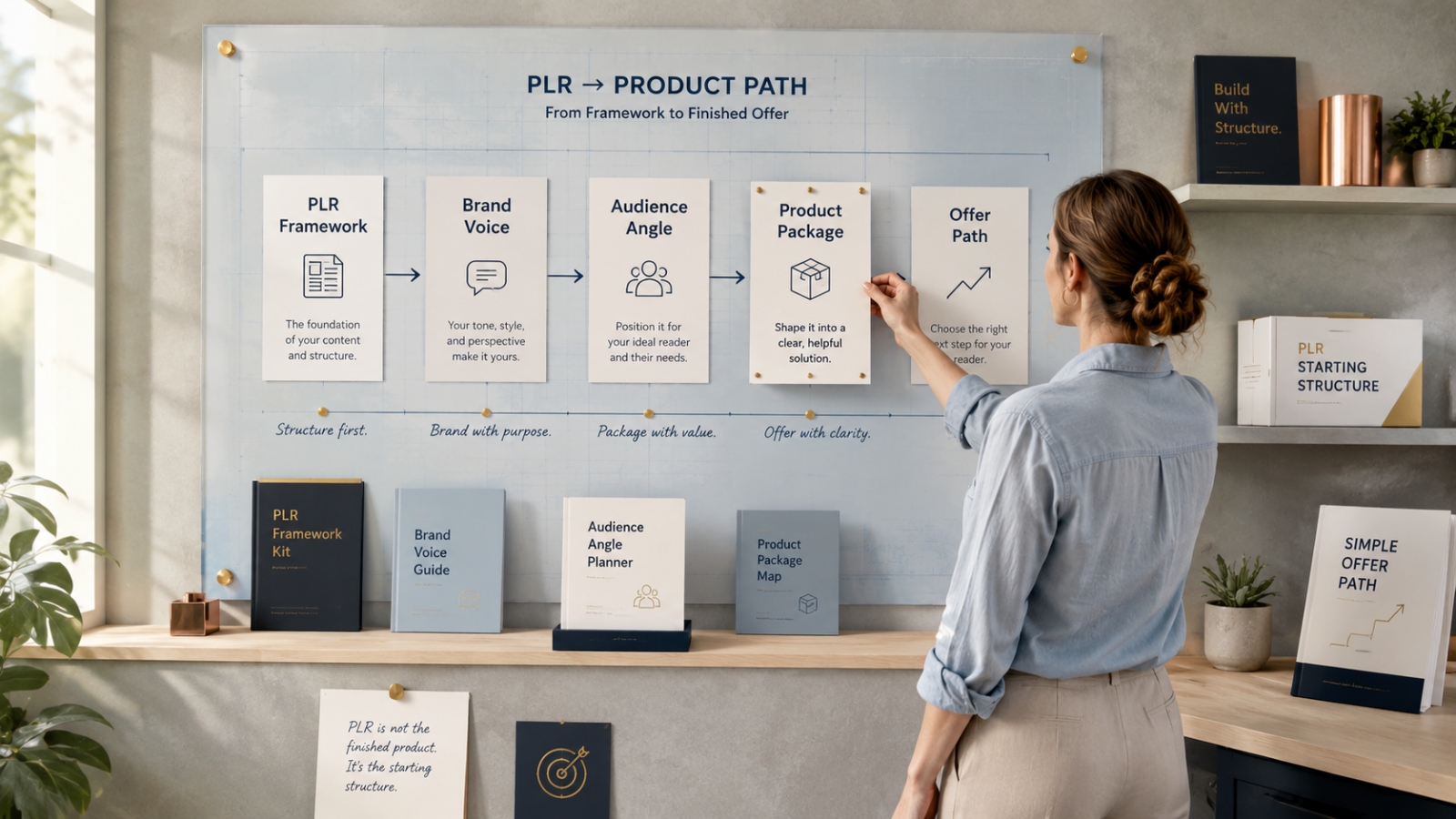
Use PLR as a flexible framework you can adapt, brand, package, and build into something useful.
The Real Reason PLR Often Sits Unused
You buy a PLR product.
At first, it feels like progress.
There are files, guides, graphics, maybe emails, maybe a sales page. It looks like you have something ready to use.
Then you open the folder.
Suddenly, it feels less simple.
You see a lot of pieces. But you are not sure what to do first, what to change, what to keep, or how to turn it into something that feels like your own.
So the folder stays there.
Not because the PLR is useless.
But because you are looking at it as content, not structure.
That small shift changes everything.
Good PLR is not just a pile of words.
It is a starting framework you can adapt, brand, package, and build around.
Why This Matters for PLR Buyers
If you are interested in rebranding and reselling digital products, this lesson is important.
Because PLR is not only about owning files.
It is about owning the ability to shape those files into a clearer offer.
That means you need to think beyond:
“What content did I receive?”
A better question is:
“What structure can I build from this?”
When you think this way, you start seeing more value inside the same package.
A guide is not just a guide.
It can become a training script.
A checklist is not just a checklist.
It can become a bonus.
A sales page is not just a sales page.
It can become a positioning map.
An email sequence is not just emails.
It can become your launch communication path.
That is the power of seeing PLR as structure.
The Big Mistake Beginners Make With PLR
Many beginners treat PLR in one of two ways.
The first group does almost nothing with it.
They download it, skim it, feel overwhelmed, and leave it untouched.
The second group does too little with it.
They change the name, add a logo, and assume it is ready.
Both approaches miss the real value.
PLR works best when you treat it like a starting blueprint.
You do not have to invent everything.
But you still need to shape it.
You need to make it clear for your audience.
You need to add your own angle.
You need to improve the flow.
You need to package the pieces so the buyer understands what they are receiving and why it matters.
That is where PLR becomes a real product asset.
The Starting Structure Method
Here is a simple way to work with PLR more strategically.
Use this method before you rebrand, resell, or build around any PLR package.
1. Study the Core Promise
Before editing anything, ask:
“What is this product really helping someone do?”
Do not only look at the title.
Look at the outcome.
For example, let’s say you have a PLR package about simple productivity planning.
The title might be:
“Productivity Planner Pack”
But the real promise might be:
“Help busy beginners organize their week without feeling overwhelmed.”
That is more useful.
Why?
Because it tells you who it helps, what problem it solves, and what result the buyer wants.
Once you understand the promise, your rebranding becomes easier.
2. Identify the Main Framework
Most good PLR has some kind of structure inside it.
It may be:
- A step-by-step guide
- A checklist system
- A module sequence
- A template collection
- A launch plan
- A training path
- A toolkit structure
Your job is to find that framework.
Using the productivity example, the PLR may include:
- Goal setting
- Weekly planning
- Daily task tracking
- Distraction control
- Review and reset
That is not just content.
That is a path.
You can turn that path into a product experience.
3. Remove What Does Not Fit
Good product building is not only about adding more.
Sometimes it is about removing what weakens the offer.
PLR can include sections that are too broad, too generic, too advanced, or not aligned with your audience.
You do not need to keep everything.
If your audience is beginners, remove advanced language.
If your offer is about weekly planning, remove unrelated time-management theories.
If your product is meant to be simple, remove extra clutter.
A clearer offer is often stronger than a bigger one.
4. Add Your Audience Angle
This is where the product starts to feel like yours.
Your audience has a specific problem.
Your brand has a specific tone.
Your offer has a specific purpose.
Add those things.
For the productivity planner example, you could angle it toward:
- Busy parents planning around family routines
- Home-based business owners managing scattered tasks
- Students balancing assignments and study blocks
- New digital product creators planning their first small launch
The content may begin from the same PLR.
But the angle changes the offer.
And the angle is what makes it feel more relevant.
5. Package the Pieces Into a Clear Path
A buyer does not want to open a folder and feel lost.
They want to know where to begin.
So package your PLR into a simple path.
For example:
- Start Here Guide
- Weekly Planning Worksheet
- Daily Focus Template
- Distraction Reset Checklist
- 7-Day Planning Challenge
- Quick Training Video
Now the buyer sees progress.
They are not just receiving files.
They are receiving a guided experience.
That is what turns PLR into a stronger offer.
A Worked Example: Turning PLR Into a Clear Starter Product
Let’s continue with the productivity planning example.
Imagine you have a PLR package called:
“Productivity Planner Pack”
Inside, you find:
- A short guide
- A weekly planner
- A daily task sheet
- A goal-setting worksheet
- A habit tracker
- A few emails
- A simple sales page
At first, it looks like a collection of files.
But with the Starting Structure Method, you can turn it into something clearer.
Step 1: Define the Buyer
Instead of selling it to everyone, choose one clear audience.
For this example:
“New digital product creators who feel scattered and need a simple weekly planning rhythm.”
Now the product has a direction.
Step 2: Rename the Offer
The original title may feel generic.
You could reframe it as:
“Creator Weekly Focus Kit”
That title feels more specific.
It tells the buyer this is about weekly focus, not general productivity.
Step 3: Organize the Product Path
Next, arrange the files into a simple order.
- Start Here: Your Weekly Focus Reset
- Step 1: Choose Your Main Weekly Outcome
- Step 2: Plan Your Three Priority Tasks
- Step 3: Use the Daily Focus Sheet
- Step 4: Track Distractions
- Step 5: Review and Reset Each Week
Now the buyer can follow the product.
The PLR has become a guided structure.
Step 4: Add Your Voice
Rewrite the opening.
Make the language warmer.
Add small moments your reader recognizes.
For example:
“You sit down with the best intention to work on your product. Then the messages, files, ideas, and unfinished tasks start pulling at you from every direction.”
That feels more human than:
“Productivity is important for achieving goals.”
Same topic.
Very different experience.
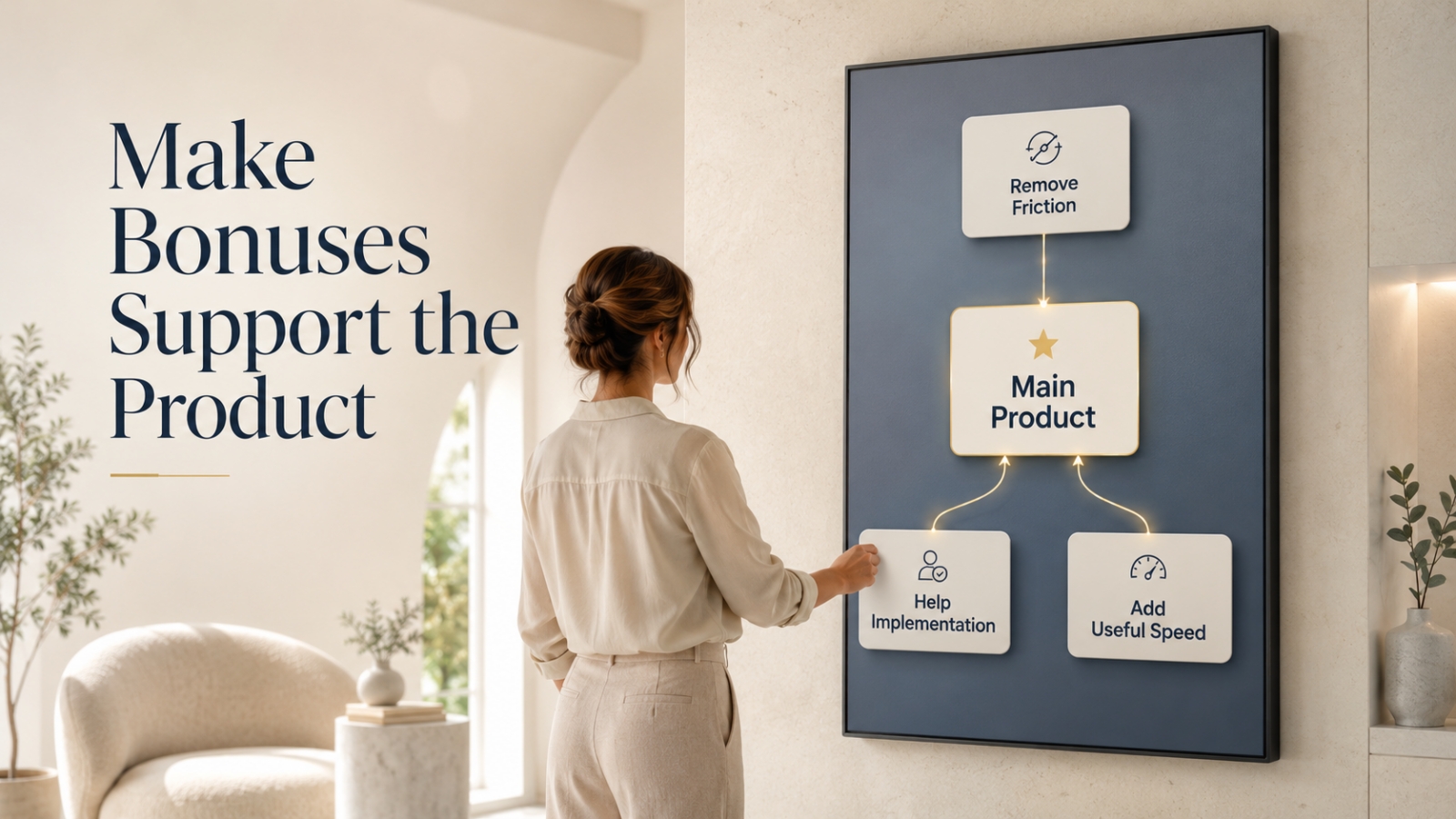
Step 5: Add a Useful Bonus
You could add a simple bonus that strengthens the offer:
“7-Day Creator Focus Challenge”
This bonus does not need to be huge.
It simply helps the buyer apply the product.
Now the offer feels more complete.
Step 6: Connect It to a Simple Sales Message
Your sales message could be:
“Plan your week, choose your next product task, and move forward without feeling scattered.”
That is clear.
It does not overpromise.
It speaks to a real problem.
That is what good PLR packaging can do.
What PLR Can Become When You See the Structure
Once you stop seeing PLR as “just content,” you start seeing many product possibilities.
A Guide Can Become a Training
A written guide can become a video lesson, slide script, workshop, or short audio training.
You can use the structure as your teaching path.
Then add your own explanation and examples.
A Checklist Can Become a Bonus
A checklist can support a bigger offer.
It can help buyers take action faster.
It can also become a lead magnet if it solves one small problem clearly.
A Template Can Become a Toolkit
Several related templates can become a practical toolkit.
The key is to organize them by use case.
Do not just give buyers templates.
Show them when and how to use each one.
A Swipe File Can Become an Implementation Resource
A swipe file gives people examples they can adapt.
It is especially useful when buyers feel stuck.
But it should be organized clearly.
Group examples by situation, purpose, or stage.
A Sales Page Can Become Positioning Support
Even if you rewrite the sales page completely, it can show you how the offer is positioned.
Look for:
- The main promise
- The buyer problem
- The objections
- The value stack
- The offer structure
- The CTA flow
That gives you a stronger starting point.
Emails Can Become a Launch Path
Email swipes are not just messages.
They show the communication sequence.
You can study how the offer is introduced, explained, supported, and followed up.
Then you can rewrite the emails in your own voice.
What to Change Before You Rebrand PLR
Rebranding is more than changing a logo.
A strong rebrand should improve the buyer experience.
Here are the areas to review.
Title
Does the title clearly show the outcome?
If not, make it more specific.
Subtitle
Does the subtitle explain who it helps and how?
A good subtitle can make the offer easier to understand.
Introduction
Does the opening feel human?
Does it speak to a real moment your buyer understands?
Examples
Are the examples relevant to your audience?
If not, replace them.
Structure
Is the content arranged in a logical order?
If the buyer opens the product, will they know what to do first?
Design
Does the visual style match your brand?
Does it feel clean, readable, and trustworthy?
CTA
Does the product guide the buyer toward the next useful step?
If not, add a simple action instruction.
Common Mistakes to Avoid
PLR can be powerful, but only when you use it with care.
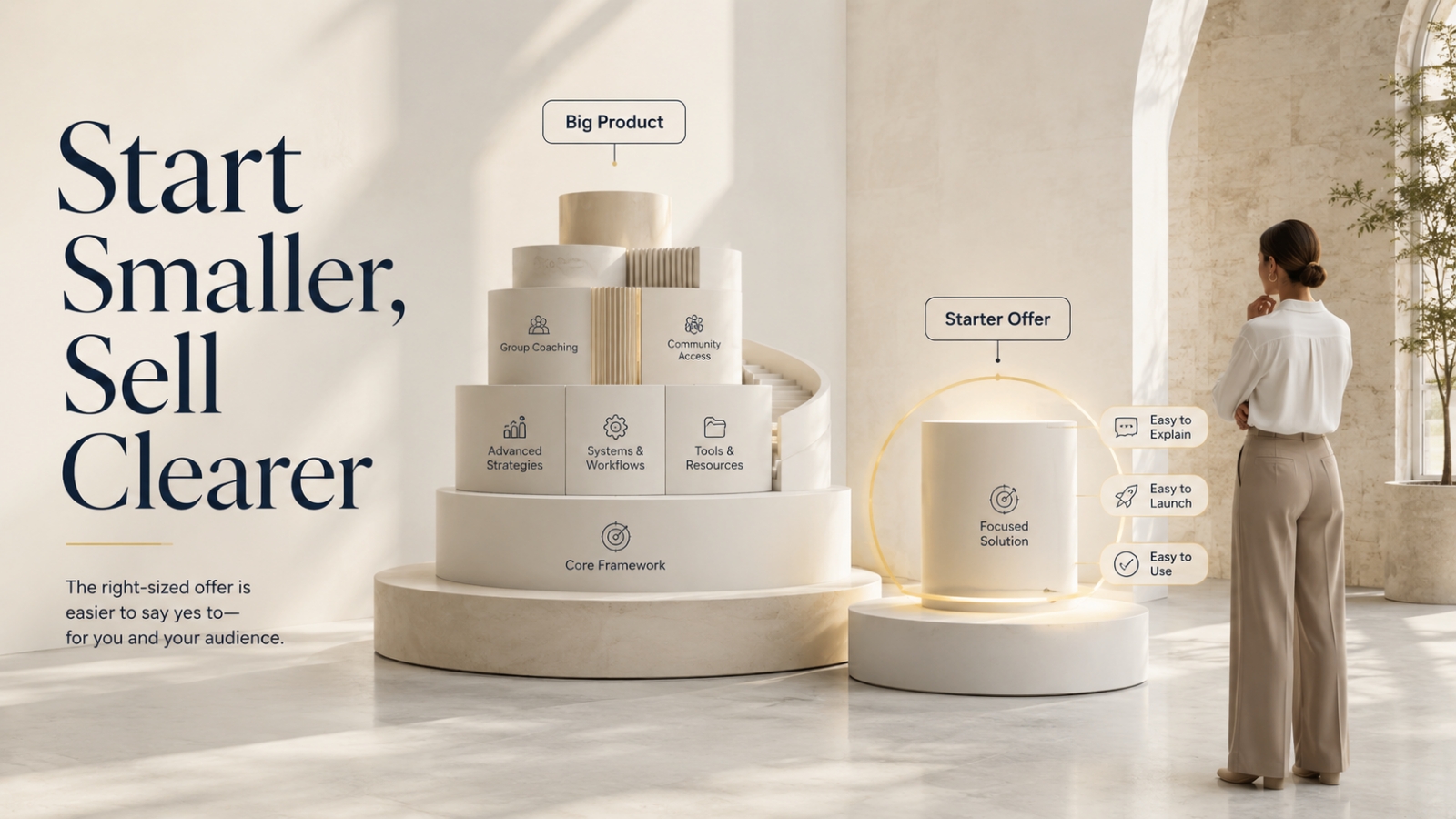
Mistake 1: Thinking Bigger Means Better
A large product can still feel weak if it has no clear path.
A small product can feel valuable if it solves one real problem well.
Do not keep extra content just to make the product look bigger.
Keep what helps.
Mistake 2: Only Changing the Cover
A new cover is useful.
But it is not enough.
The content, structure, examples, title, and buyer path also need attention.
Mistake 3: Selling Files Instead of Outcomes
People do not buy files because they love folders.
They buy because they want help.
Make the outcome clear.
What will this help them do?
What problem does it reduce?
What task becomes easier?
Mistake 4: Leaving the Buyer to Figure It Out
If the buyer opens your product and feels lost, the offer is not packaged well enough.
Add a Start Here guide.
Create a recommended order.
Explain how the pieces fit together.
A little guidance can increase the perceived value.
Mistake 5: Making the Product Sound Like Everyone Else’s
If many people have access to the same PLR, your angle matters.
Your voice matters.
Your packaging matters.
Your audience focus matters.
That is what separates a generic rebrand from a useful product.
Quick PLR Structure Exercise
Choose one PLR product you own or plan to use.
Then answer these questions.
What is the main promise?
Write the real outcome in one sentence.
Who is the best-fit buyer?
Choose one clear audience.
Do not say “everyone.”
What is the hidden framework?
List the steps, modules, tools, or path inside the PLR.
What should be removed?
Cut anything that does not support the main promise.
What should be adapted?
Look at the title, introduction, examples, worksheets, emails, and sales message.
What can be added?
Add one useful support piece.
It could be a checklist, quick-start guide, bonus worksheet, short training, or implementation plan.
What is the buyer’s first step?
Make it obvious.
Tell them where to begin.
This exercise helps you move from “I have PLR” to “I have a product structure.”
That is a big difference.
How This Helps You Build Offers With More Confidence
Offer building feels hard when you start with nothing.
You have to decide the topic, flow, modules, resources, sales message, and buyer path.
That is a lot.
Good PLR reduces the blank-page problem.
It gives you raw structure.
It gives you pieces to work with.
It gives you a starting point for building.
But you still bring the strategy.
You still bring the audience understanding.
You still bring the brand.
You still decide what the product becomes.
That is why PLR is not only useful for speed.
It is useful for structure.
Final Encouragement
Do not judge PLR only by the number of files inside the package.
Look deeper.
Ask:
“What structure is already here?”
“What can I adapt?”
“What can I improve?”
“What can I package into a clearer offer?”
Good PLR is not the finished business.
It is the starting structure.
Your job is to shape it into something your audience can understand, trust, and use.
That is where the real value begins.
Use This With Blogger’s Success Toolkit
If you already own Blogger’s Success Toolkit, log in to the Blogger Success Blueprint members area and use the relevant planning tools, worksheets, or resources to apply this lesson.
Start with what you already have.
Open one product.
Choose one section.
Complete one small task.
If you also own Blogger’s Success Accelerator System, use it for consistency and growth support.
If you own Blogger’s Success Ultimate Launch Kit, use it for setup and deployment support.
And if you own one of the lighter support paths, such as QuickGrow or QuickStart, begin there before adding anything else.
Members Login:
https://bloggersuccessblueprint.com/members/
New to Blogger’s Success Toolkit?
Blogger’s Success Toolkit gives you a beginner-friendly path to choose your direction, plan useful content, write stronger titles, and begin building your blog with more structure.