Turn one PLR product into multiple useful assets without starting from zero each time.
The Folder You Keep Meaning to Use
You bought the PLR product because it looked useful.
Maybe it came with a guide, worksheets, emails, graphics, or a sales page. At first, you could see the potential.
“This could help me build something.”
Then life got busy.
The folder stayed on your computer.
Every now and then, you open it, look through the files, and think, “I really should use this.”
But then another question appears.
“How exactly?”
That question stops many people.
Not because the PLR has no value.
But because they only see one possible use.
They think, “I either sell it as it is, or I don’t use it.”
That is too limited.
One PLR product can become more than one asset when you look at it with a little strategy.
Why One PLR Product Can Have More Than One Purpose
Good PLR gives you raw material.
It may include teaching content, examples, checklists, templates, email swipes, product graphics, or sales copy.
That means it can support more than one part of your business.
It can help you:
- Build a product
- Improve an offer
- Add more value to another product
- Grow your email list
- Create helpful content
- Teach your audience in a new format
The value is not only in the files.
The value is in how you shape them.
When you understand this, you stop asking, “What do I do with this whole PLR package?”
You start asking a better question:
“What is the best use for this product right now?”
That question makes PLR feel much easier to apply.
The Big Mistake: Trying to Use Everything at Once
A beginner may open a PLR product and feel pressure to use every file.
The guide.
The checklist.
The emails.
The graphics.
The sales page.
The templates.
Everything.
But using everything at once can create confusion.
You may end up with a messy product, a weak bonus, or a lead magnet that feels too big.
More is not always better.
A good PLR strategy starts with purpose.
Before you use the files, decide what you need most.
Do you need something to sell?
Do you need a bonus?
Do you need email content?
Do you need a lead magnet?
Do you need a simple training?
Once you know the purpose, choosing the right pieces becomes easier.
The One-PLR, Five-Use Method
Here is a simple way to look at one PLR product.
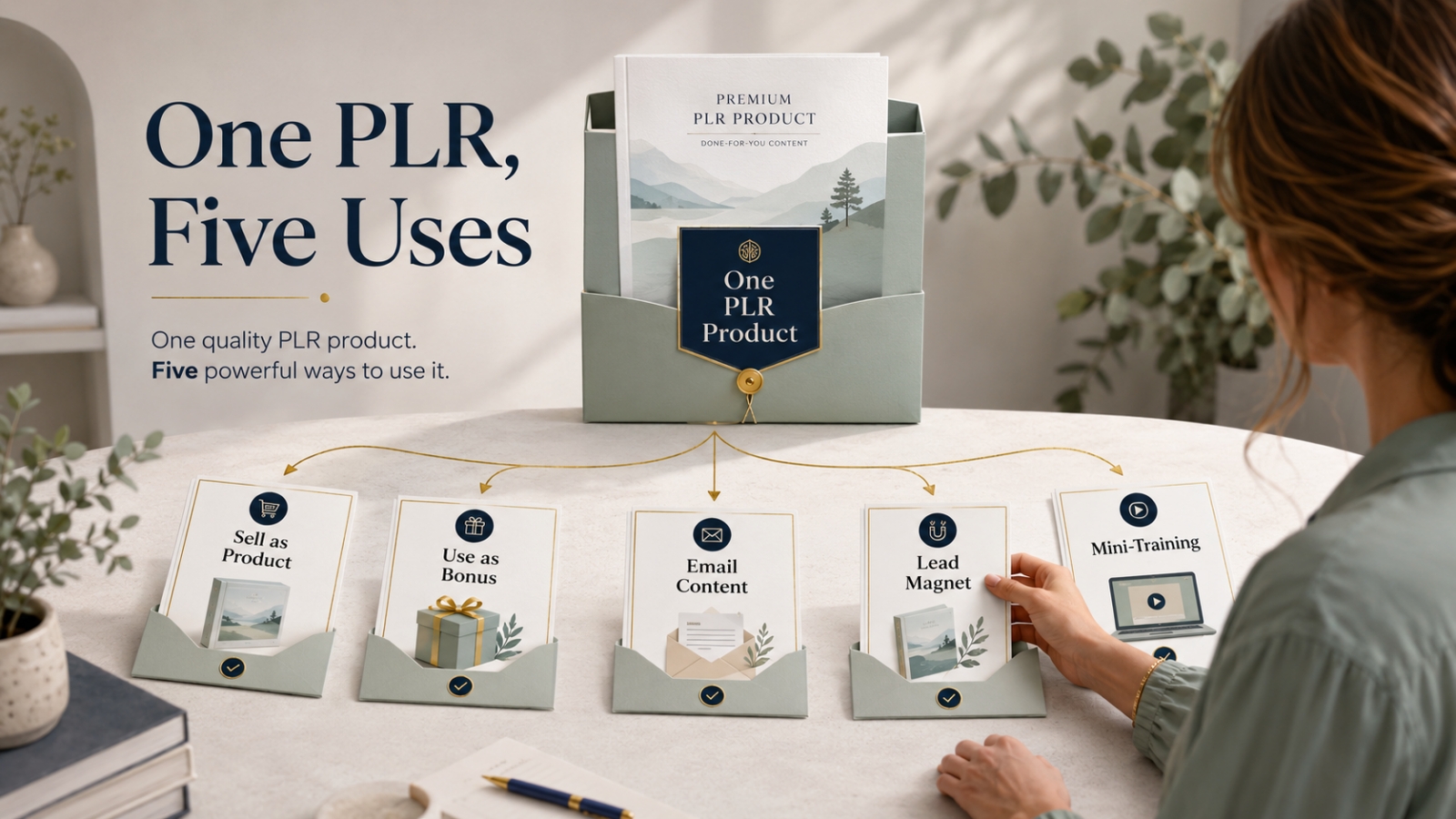
You can use it in five practical ways:
- Sell it as a product
- Use it as a bonus
- Turn it into email content
- Create a lead magnet
- Build a mini-training from it
You do not need to do all five at once.
Choose the path that fits your audience, offer, and current stage.
1. Sell It as a Product
The most obvious way to use PLR is to turn it into a product you can sell.
But this does not mean uploading the files untouched.
A product should feel organized, branded, and easy to use.
Let’s say you have a PLR package about creating simple email newsletters.
The raw package includes:
- A short guide
- A checklist
- A few email templates
- A worksheet
- A sales page
You could rebrand it into:
Simple Newsletter Starter Kit
That is clearer than leaving it as a generic PLR guide.
Then you could organize the product like this:
- Start Here Guide
- Newsletter Planning Worksheet
- First Email Template
- Weekly Email Checklist
- Subject Line Idea Sheet
Now the buyer sees a path.
They are not just getting files.
They are getting help starting a simple newsletter.
That is what makes the product feel more valuable.
When This Option Works Best
Selling it as a product works best when the PLR already has enough useful pieces to stand alone.
It should solve a clear problem.
It should have a specific audience.
It should guide the buyer toward one useful result.
If the PLR feels too broad, narrow it.
If it feels too generic, adjust the angle.
If it feels too scattered, organize the pieces into a simple order.
2. Use It as a Bonus
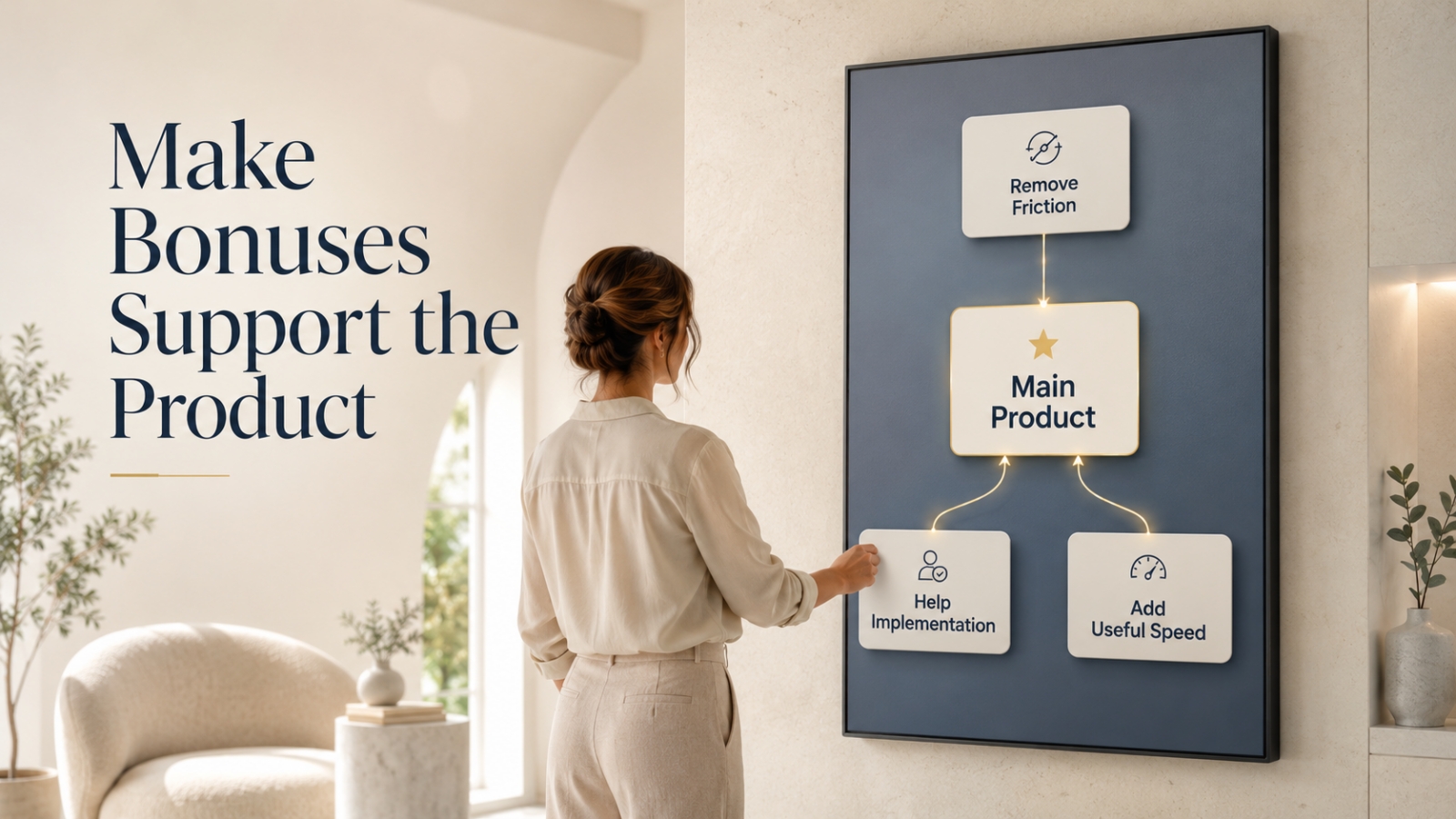
A PLR product can also become a bonus that makes another offer stronger.
This is one of the easiest ways to use PLR.
Why?
Because the PLR does not always need to carry the whole sale.
It can support the main offer.
For example, suppose your main product teaches people how to create digital products.
You have a PLR package about email newsletters.
You could use it as a bonus called:
Bonus: Simple Newsletter Starter Kit
Now it supports the buyer after they create their product.
They can use the bonus to start communicating with their audience.
That makes the main offer feel more complete.
How to Choose a Good Bonus
A good bonus should connect naturally to the main product.
It should help with one of these:
- Getting started faster
- Saving time
- Avoiding a common mistake
- Applying the main lesson
- Reaching the next step
Do not add PLR as a bonus just because you have it.
A random bonus can make an offer feel cluttered.
A relevant bonus makes the offer feel more helpful.
3. Turn It Into Email Content
PLR can also help you create email content.
This is especially useful if the PLR includes teaching points, tips, checklists, or short lessons.
You do not need to paste the PLR into emails as-is.
Instead, pull out one idea at a time.
For example, from the Simple Newsletter Starter Kit, you could create emails such as:
- Why your first newsletter does not need to be perfect
- The simple structure of a helpful weekly email
- What to write when you do not know what to say
- How to make your email feel useful instead of pushy
- The mistake of sending only promotional messages
Each email teaches one idea.
That is important.
Email content should feel light and easy to read.
Do not try to squeeze a full guide into one message.
Use PLR as the source, then rewrite it in your own voice.
When This Option Works Best
Turning PLR into email content works well when you want to:
- Stay in touch with your list
- Educate readers before an offer
- Build trust around a topic
- Create a nurture sequence
- Explain why a product matters
Emails are not just “messages.”
They are relationship-building assets.
PLR can help you create them faster when you use it thoughtfully.
4. Create a Lead Magnet
A lead magnet is a free resource that helps people take one small step.
PLR can be a great starting point for lead magnets because many PLR products include guides, checklists, worksheets, and templates.
But here is the key:
A lead magnet should be small and focused.
Do not give away the entire PLR product unless that is your strategy.
Instead, choose one useful piece.
From the newsletter PLR product, you could create:
The First Newsletter Checklist
This could help readers plan and send their first simple email.
It might include:
- Choose one topic
- Write a short opening
- Teach one useful idea
- Add one simple next step
- Review before sending
That is enough.
A lead magnet should not overwhelm the reader.
It should help them feel a quick sense of progress.
When This Option Works Best
Creating a lead magnet works well when you want to grow your email list.
It works best when the lead magnet connects to:
- A blog post
- A social media topic
- A product offer
- A welcome email sequence
- A problem your audience already cares about
The lead magnet should feel like the next natural step.
Not a random download.
5. Build a Mini-Training From It
A PLR product can also become a mini-training.
This is useful because some people learn better by watching or listening.
A written guide can become:
- A short video lesson
- A slide-based training
- A workshop outline
- An audio lesson
- A screen-recorded walkthrough
Using the newsletter example, you could create a mini-training called:
How to Write Your First Simple Newsletter
The training could include:
- Lesson 1: Choose one useful topic
- Lesson 2: Use a simple email structure
- Lesson 3: Write a friendly opening
- Lesson 4: Add one clear next step
- Lesson 5: Review and send
This does not need to be long.
A mini-training should be simple and focused.
The PLR gives you the teaching structure.
Your job is to add your explanation, examples, and voice.
When This Option Works Best
A mini-training works well when the topic needs explanation or demonstration.
It can be used as:
- A product
- A bonus
- A lead magnet
- A workshop
- A member area resource
- A training upgrade
Training can make your offer feel more personal because the buyer gets guided through the idea.
A Quick Before-and-After Example
Before:
A PLR package called Email Newsletter Guide sits in a folder.
After as a product:
Simple Newsletter Starter Kit
After as a bonus:
Bonus: First Newsletter Quick-Start Pack
After as email content:
A five-part email sequence about writing helpful weekly emails
After as a lead magnet:
The First Newsletter Checklist
After as mini-training:
How to Write Your First Simple Newsletter
Same PLR product.
Five different uses.
That is the power of thinking beyond the folder.
How to Choose the Best Use First
You do not need to turn one PLR product into all five assets immediately.
Start with your current need.
If You Need Something to Sell
Turn it into a focused product.
Rename it.
Improve the promise.
Organize the files.
Add a Start Here guide.
If You Need to Strengthen an Offer
Use it as a bonus.
Make sure it supports the main product.
Give the bonus a clear title and simple purpose.
If You Need to Communicate With Your List
Turn it into email content.
Pull out one idea per email.
Rewrite everything in your voice.
If You Need to Build Your Email List
Create a lead magnet.
Choose one small piece that solves one small problem.
Keep it easy to consume.
If You Need a More Personal Teaching Asset
Build a mini-training.
Use the PLR as the outline.
Add your examples and explanation.
The best use is the one that helps you move your business forward right now.
What to Improve Before Using the PLR
No matter which path you choose, do a simple improvement pass first.
Improve the Name
Make the title more specific.
A good name helps people understand what the resource does.
Improve the Promise
What does this help the reader or buyer do?
Keep the promise clear and believable.
Improve the Examples
Replace generic examples with situations your audience understands.
Improve the Voice
Rewrite stiff or formal wording.
Make it sound like your brand.
Improve the Structure
Arrange the content in a useful order.
Do not make the reader guess where to begin.
Improve the Delivery Experience
If this becomes a product, bonus, lead magnet, or training resource, make the files easy to access.
Check:
- Are the files named clearly?
- Is there a Start Here guide if needed?
- Are downloads arranged in the right order?
- Are formats labeled clearly?
- Does the buyer or subscriber know what to open first?
A smooth delivery experience can make a simple asset feel much more professional.
Common Mistakes to Avoid
Mistake 1: Using the Whole Product When One Piece Is Enough
A lead magnet does not need the entire guide.
An email does not need a full chapter.
A bonus does not need every file.
Choose what supports the purpose.
Mistake 2: Making the PLR Feel Random
If the PLR does not connect to your audience or offer, it may confuse people.
Always connect the asset to a real problem or next step.
Mistake 3: Forgetting to Rebrand the Message
Changing the cover is not enough.
Adjust the title, promise, examples, and tone.
Make it feel shaped for your audience.
Mistake 4: Turning Every PLR Product Into a Paid Offer
Some PLR works better as a bonus.
Some works better as content.
Some works better as a lead magnet.
Not every package needs to become a product for sale.
Mistake 5: Overbuilding Before Testing
Do not spend weeks turning one PLR product into a huge system before you know whether your audience cares.
Start smaller.
Create one focused asset.
See how people respond.
Then improve.
Quick Action Exercise
Choose one PLR product you already own.
Then answer these questions.
Step 1: What is the main topic?
Write the topic in one simple sentence.
Step 2: Who could this help?
Choose one audience group.
Be specific.
Step 3: What is your current business need?
Choose one:
- I need a product
- I need a bonus
- I need email content
- I need a lead magnet
- I need a mini-training
Step 4: Which pieces support that need?
List only the files or sections that help.
Ignore the rest for now.
Step 5: What should this become first?
Name the asset.
For example:
- Simple Newsletter Starter Kit
- First Newsletter Quick-Start Bonus
- Five-Day Newsletter Confidence Email Series
- First Newsletter Checklist
- How to Write Your First Simple Newsletter
Now you have a direction.
That is much better than staring at a folder and wondering where to begin.
Final Encouragement
One PLR product can do more than sit in a folder.
It can become a product.
It can become a bonus.
It can become email content.
It can become a lead magnet.
It can become a mini-training.
But the goal is not to use every option at once.
The goal is to choose one useful path and shape the PLR into something your audience can understand, trust, and use.
That is how PLR becomes more than content.
It becomes a flexible business asset.
Use This With Blogger’s Success Toolkit
If you already own Blogger’s Success Toolkit, log in to the Blogger Success Blueprint members area and use the relevant planning tools, worksheets, or resources to apply this lesson.
Start with what you already have.
Open one product.
Choose one section.
Complete one small task.
Apply what you already own before adding anything else.
If you also own Blogger’s Success Accelerator System, use it for consistency and growth support.
If you own Blogger’s Success Ultimate Launch Kit, use it for setup and deployment support.
And if you own one of the lighter support paths, such as QuickGrow or QuickStart, begin there before adding anything else.
Members Login:
https://bloggersuccessblueprint.com/members/
New to Blogger’s Success Toolkit?
Blogger’s Success Toolkit gives you a beginner-friendly path to choose your direction, plan useful content, write stronger titles, and begin building your blog with more structure.