Turn generic PLR into content that sounds more human, more useful, and more clearly shaped for your audience.
The Moment PLR Sounds “Almost Right” But Not Quite
You open a PLR guide and start reading.
At first, it looks helpful.
The topic is right. The sections make sense. The information is usable.
But after a few pages, something feels a little flat.
The writing is not wrong.
It just does not sound like you.
The examples feel broad. The opening feels plain. The advice could belong to almost anyone in almost any market.
That is the problem with unedited PLR.
It may be useful, but it has not been shaped yet.
And if it has not been shaped, your audience may feel it too.
They may not say, “This sounds like PLR.”
But they may feel that it is generic.
That is why originality is not only about avoiding copied wording.
It is about making the content feel specific, human, and connected to the people you want to help.
Why Making PLR Feel Original Matters
PLR gives you a starting structure.
That is the value.
You do not have to begin with a blank page, plan every section from scratch, or build every worksheet from nothing.
But your audience does not need raw material.
They need guidance.
They need a product that feels like it was prepared for their problem, their level, and their next step.
When PLR feels generic, the product may seem forgettable.
But when you add your stories, examples, structure, voice, and point of view, it starts to feel more purposeful.
That is where trust grows.
Not because you made the product bigger.
But because you made it feel more relevant.
The Big Mistake: Only Changing the Words
Many people think making PLR original means rewriting every sentence.
That can help.
But it is not enough by itself.
You can rewrite every sentence and still end up with content that feels generic.
Why?
Because originality is not only about wording.
It is also about:
- the angle
- the structure
- the examples
- the stories
- the point of view
- the promise
- the buyer experience
If all you do is swap words, the content may look different but still feel the same.
A stronger approach is to reshape the content.
That means you do not just ask:
“How can I say this differently?”
You ask:
“How can I make this more useful for my audience?”
That question leads to better edits.
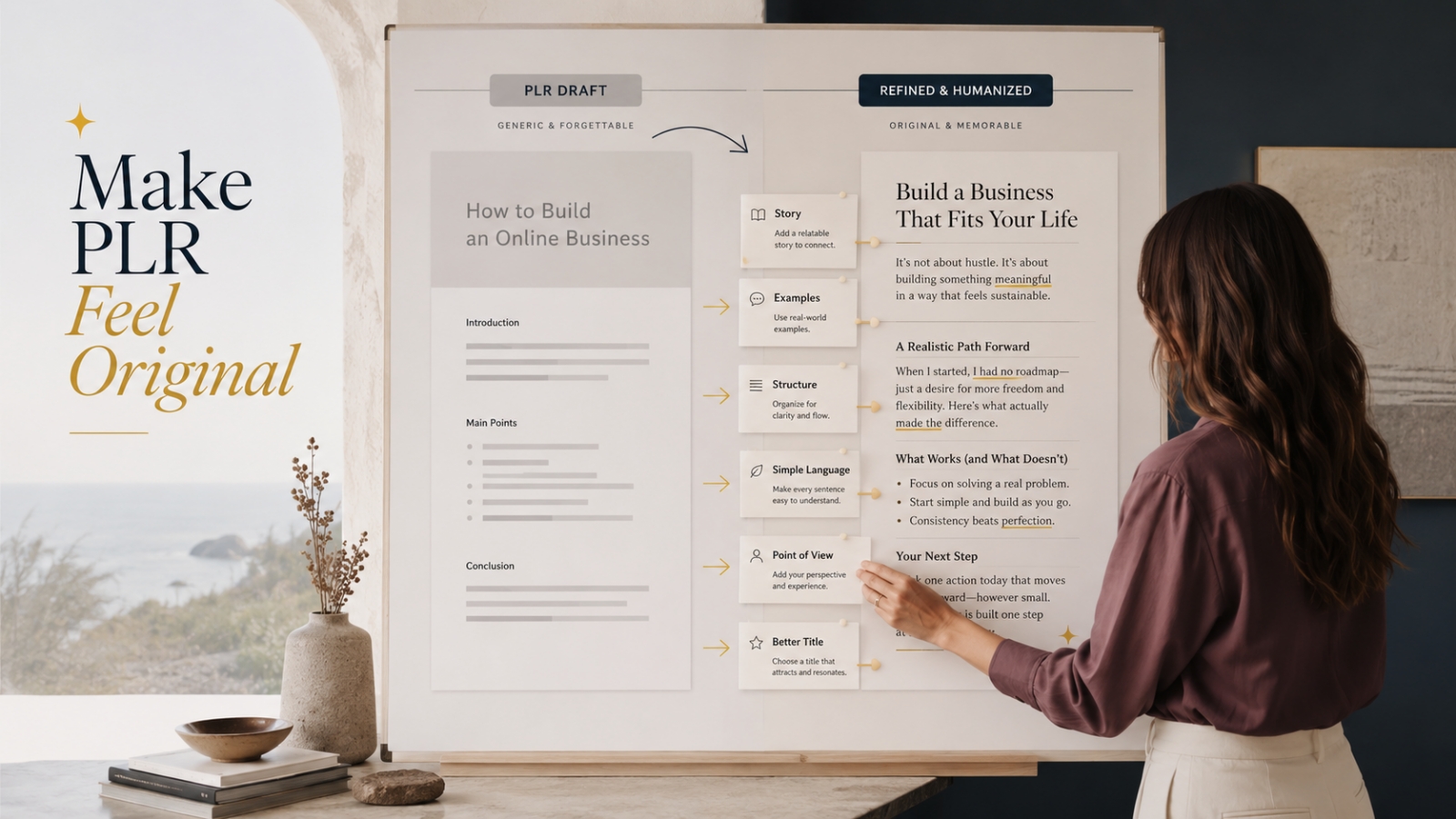
The Originality Layer Method
Use this simple method when you want to make PLR feel more original, more human, and less generic.
The goal is not to rewrite everything for the sake of rewriting.
The goal is to add the layers that make the content feel more like yours.
1. Add Stories
Stories make content feel alive.
They do not need to be long.
They do not need to be dramatic.
A story can be a simple moment your reader recognizes.
Let’s say you have a PLR product about creating simple digital products.
The original PLR might begin like this:
“Digital products are a great way to share knowledge and create value online.”
That is fine.
But it is also broad.
You could make it more human with a short scene:
“You open your product folder and see five unfinished pieces. The guide is half-edited, the checklist needs formatting, and the sales page still feels rough. You know the idea has potential, but you are not sure what to finish first.”
Now the content feels closer to the reader’s real experience.
They can see the problem.
They can feel the friction.
That is what stories do.
They help the reader think, “Yes, that is me.”
2. Add Better Examples
Generic examples are one of the fastest ways PLR loses personality.
A broad example might explain the idea, but it may not connect with your audience.
If your readers are beginner digital product creators, use examples they understand.
Instead of saying:
“Create a useful resource for your audience.”
Say:
“Turn one section of your guide into a quick checklist, such as a launch-prep checklist, email planning sheet, or product download page checklist.”
That is more specific.
The reader can picture it.
They can act on it.
Examples make advice easier to use.
The better the example, the more original the content feels.
3. Change the Structure
Sometimes PLR feels generic because the structure is too predictable.
It may follow a common pattern:
- Introduction
- Why it matters
- Tips
- Summary
That is not wrong.
But it may feel flat.
You can improve originality by changing the structure into a clearer learning path.
For example, instead of keeping a section called:
“Tips for Creating Digital Products”
You could reorganize it as:
- Choose one problem
- Turn it into one promise
- Build one useful resource
- Add one simple delivery path
- Invite the buyer to take one next step
Now the content feels more guided.
The structure itself teaches.
That is much stronger than a loose list of tips.
4. Simplify the Language
PLR often sounds formal because it is written for a broad market.
That can make it feel distant.
Simplifying the language makes the content easier to read and more human.
For example, a stiff PLR sentence might say:
“Implementing a consistent content repurposing strategy can increase the perceived value of your digital asset ecosystem.”
That sounds heavy.
You could rewrite it as:
“When you reuse one strong piece of content in several smart ways, your product starts to feel more complete.”
Same idea.
Much easier to understand.
Simple language does not make the product weaker.
It makes the product easier to use.
And when people can use it, they value it more.
5. Add Your Point of View
Your point of view is what separates your version from everyone else’s.
PLR usually teaches information.
Your point of view adds judgment.
It tells the reader what matters, what to avoid, and how to think about the topic.
For example, if the PLR says:
“You can create many different products from one piece of content.”
You could add your point of view:
“But do not turn every idea into a product too quickly. Start with one clear buyer problem. A small focused resource is often more useful than a large product that feels scattered.”
That line adds guidance.
It shows your thinking.
It helps the reader make a better decision.
Point of view makes the content feel owned.
6. Improve the Title and Positioning
Sometimes the content feels generic because the title is generic.
A title shapes how the whole product is understood.
For example:
Before:
Digital Product Creation Guide
That is broad.
After:
Simple Product Starter Kit
That feels more approachable.
Another option:
First Offer Builder
That gives the product a clearer purpose.
Positioning goes deeper than the title.
It answers:
- Who is this for?
- What problem does it solve?
- What result does it help create?
- Why is this different from a random guide?
- What should the buyer do first?
When the positioning is stronger, the same content can feel more valuable.
A Quick Before-and-After Example
Let’s imagine you have a PLR product called:
Digital Product Creation Guide
It is helpful, but broad.
Here is how you could make it feel more original.
Before title:
Digital Product Creation Guide
After title:
First Offer Builder
Before promise:
Learn how to create digital products.
After promise:
Turn one clear idea into a simple first offer your audience can understand and use.
Before example:
Create a worksheet or checklist for your customers.
After example:
Turn one chapter of your guide into a “First Product Planning Sheet” that helps buyers choose their topic, promise, and first three sections.
Before structure:
Ten general tips for creating digital products.
After structure:
Idea → Promise → Simple Asset → Delivery → Next Step
Before voice:
“Digital product creation is an effective online business strategy.”
After voice:
“You do not need a huge product to begin. You need one useful resource that solves one clear problem.”
Same PLR foundation.
Very different feeling.
That is what originality work can do.
What to Improve First
You do not need to edit everything at once.
Start with the areas readers notice most.
Improve the Opening
The opening sets the tone.
If the PLR begins with a dry definition, rewrite it.
Start with the reader’s real moment.
What are they struggling with?
What are they trying to finish?
What feels confusing?
A strong opening makes the product feel more personal right away.
Improve the Section Titles
Section titles guide the reader.
Instead of generic headings like:
“Step 1”
“Benefits”
“Tips”
“Conclusion”
Use headings that show movement:
“Choose the Problem Your Product Will Solve”
“Turn the Idea Into a Clear Promise”
“Make the First Step Easy to Take”
The reader should feel guided through the product.
Improve the Examples
Examples should match the buyer’s world.
If your product is for PLR buyers, use examples about guides, checklists, email swipes, product boxes, download pages, bonuses, sales pages, and member areas.
That makes the content feel more relevant.
Improve the Instructions
PLR often explains what to do but not how to start.
Add small instructions.
Tell the reader:
- What to open first
- What to fill in
- What to skip for now
- What to complete before moving on
- What to do after finishing
Instructions make the product easier to use.
Improve the Delivery Experience
Originality is not only in the writing.
It is also in how the product is presented.
If the files are messy, the product feels less polished.
Check:
- Are files named clearly?
- Is there a Start Here guide?
- Are downloads arranged in the right order?
- Are formats labeled properly?
- Does the buyer know what to open first?
- Does the product feel organized?
A clean delivery experience makes your rebranded PLR feel more intentional.
Common Mistakes to Avoid
Mistake 1: Rewriting Without Repositioning
You can change every sentence and still have a generic product.
Before rewriting, decide the angle.
Who is it for?
What does it help them do?
Why does it matter?
Mistake 2: Adding Too Much
Original does not mean bigger.
Do not stuff the product with extra sections just to make it look more complete.
Add what helps.
Remove what distracts.
Mistake 3: Keeping Generic Examples
Examples are where generic content often shows.
Replace broad examples with practical situations your audience understands.
Mistake 4: Making the Language Too Fancy
Simple language is stronger when the goal is teaching.
Do not make PLR sound more polished by making it harder to read.
Make it clearer.
Mistake 5: Hiding Your Point of View
If you have a belief about the topic, include it.
Maybe you believe small products are better for beginners.
Maybe you believe simple delivery matters more than a large file count.
Maybe you believe PLR should be shaped before it is sold.
Those beliefs help your content stand apart.
The PLR Originality Checklist
Use this checklist before publishing, selling, or sharing your edited PLR.
Story
- Does the content include a relatable moment?
- Does the opening make the reader feel understood?
- Is there at least one human example?
Examples
- Are examples specific?
- Do they match the audience?
- Can the reader picture what to do?
Structure
- Does the content follow a helpful path?
- Are headings clear?
- Does each section move the reader forward?
Language
- Is the writing simple?
- Are stiff lines rewritten?
- Are long sentences shortened?
Point of View
- Does the content include your judgment?
- Do you explain what matters and what to avoid?
- Does it sound like guidance, not just information?
Title and Positioning
- Is the title specific?
- Is the promise clear?
- Is the audience obvious?
- Does the product feel different from a generic guide?
Delivery Experience
- Are files organized?
- Is there a Start Here guide?
- Does the buyer know what to open first?
- Are the download pieces clearly labeled?
Quick Action Exercise
Choose one PLR product or one PLR section.
Then work through these steps.
Step 1: Rewrite the Title
Make it more specific.
Focus on the result.
Step 2: Add One Short Story
Write a simple opening scene your reader recognizes.
Keep it natural.
Step 3: Replace One Generic Example
Choose one broad example and make it specific to your audience.
Step 4: Improve One Section Heading
Change a plain heading into a helpful action-based heading.
Step 5: Simplify One Paragraph
Shorten the sentences.
Remove stiff words.
Make it easier to read.
Step 6: Add One Point of View
Add a short line that shows what you believe the reader should do, avoid, or focus on.
Do these six things, and your PLR will already feel more original.
Final Encouragement
Making PLR feel more original does not mean pretending it started from nothing.
It means taking the starting structure and shaping it with care.
Add the story.
Add the example.
Change the structure.
Simplify the language.
Share your point of view.
Improve the title and positioning.
That is how generic content starts to feel more like a useful product.
Not because you changed every word.
But because you made the content easier to trust, easier to follow, and easier for your audience to use.
Use This With Blogger’s Success Toolkit
If you already own Blogger’s Success Toolkit, log in to the Blogger Success Blueprint members area and use the relevant planning tools, worksheets, or resources to apply this lesson.
Start with what you already have.
Open one product.
Choose one section.
Complete one small task.
Apply what you already own before adding anything else.
If you also own Blogger’s Success Accelerator System, use it for consistency and growth support.
If you own Blogger’s Success Ultimate Launch Kit, use it for setup and deployment support.
And if you own one of the lighter support paths, such as QuickGrow or QuickStart, begin there before adding anything else.
Members Login:
https://bloggersuccessblueprint.com/members/
New to Blogger’s Success Toolkit?
Blogger’s Success Toolkit gives you a beginner-friendly path to choose your direction, plan useful content, write stronger titles, and begin building your blog with more structure.