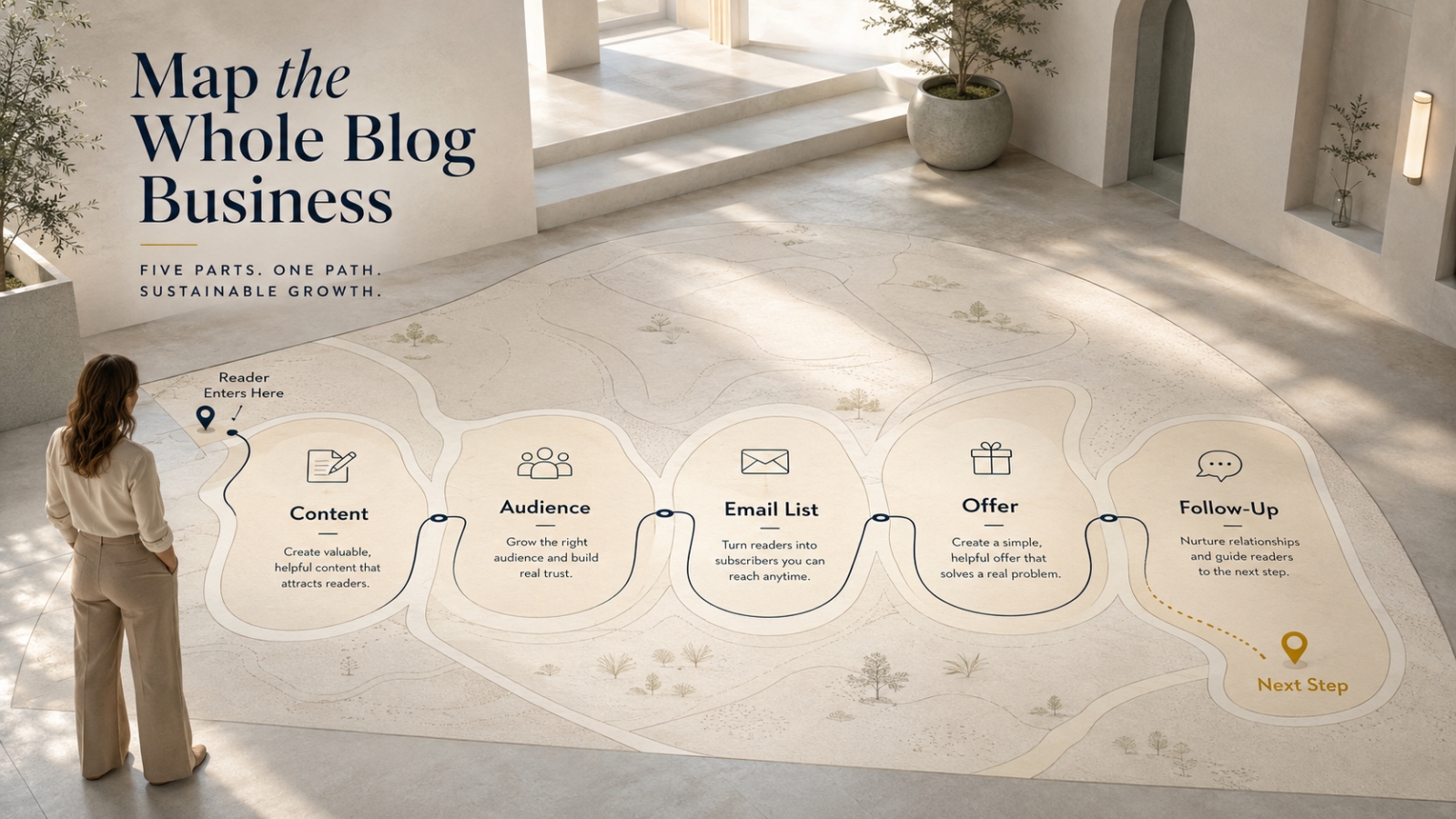
A simple way to understand how content, audience, email list, offer, and follow-up work together.
A blog can start with one post.
That is often where the journey begins.
You write something useful. You publish it. You hope the right reader finds it.
That first step matters.
But if you want your blog to become more than a collection of articles, you need to see the bigger map.
Because a blog business is not built from content alone.
It is built from connected parts.
Content brings people in.
Audience clarity helps you know who you are serving.
An email list keeps the relationship alive.
An offer gives the reader a useful next step.
Follow-up helps the reader continue the journey.
That is the five-part blogging business map.
It is not complicated.
But it is powerful because it helps you stop thinking in scattered pieces.
Instead of asking, “What should I write next?” all the time, you begin asking:
How does this piece help the reader move through the path?
That is where your blog starts to feel more like a business system.
Why a Blogging Business Needs a Map
Without a map, blogging can feel like walking through a room with the lights half on.
You can see a few things.
A post idea here.
An email idea there.
A product idea somewhere else.
A social post you should probably write.
A reader question you forgot to answer.
Everything may matter.
But it does not always feel connected.
That is why many bloggers feel busy but not clear.
A map helps you understand what each part is supposed to do.
You no longer treat content, audience, email, offers, and follow-up as separate jobs.
You see them as one path.
That path helps the reader move from “I found something useful” to “I trust this person enough to take the next step.”
The Big Mistake Beginners Make
The big mistake is focusing on only one part of the map.
Some bloggers only focus on content.
They keep writing posts, but there is no simple way for readers to stay connected.
Some focus only on audience growth.
They chase attention, but the content does not guide readers anywhere useful.
Some focus only on email.
They collect subscribers, but do not know what to send.
Some focus only on offers.
They create products, but readers do not understand why those products matter.
Some focus only on follow-up.
They send reminders, but there is no strong content or trust behind them.
Each part matters.
But none of them should carry the whole business alone.
A stronger blog business connects the parts.
That is what we are building here.
The Five-Part Blogging Business Map
The map has five parts:
- Content
- Audience
- Email list
- Offer
- Follow-up
Think of these like five stepping stones across a stream.
If one stone is missing, the reader may stop halfway.
If the stones are in the wrong order, the path feels awkward.
But when the stones are clear and connected, the reader can move forward naturally.
Let’s walk through each part.
Part 1: Content
Content is usually the first doorway into your blog.
A reader finds your post because something brought them there.
Maybe they searched a question.
Maybe they saw a link.
Maybe someone shared your article.
Maybe they clicked from an email or social post.
Whatever the path, content is often the first real experience they have with your blog.
That means your content has an important job.
It should help the reader with a real problem, question, goal, or decision.
It should make them feel:
“This is useful. This person understands what I need.”
What Content Does in the Business Map
Content helps you:
- attract the right reader
- answer real questions
- show your teaching style
- build early trust
- introduce important ideas
- create a reason for readers to stay connected
A blog post should not be written only because you need something new to publish.
It should serve a purpose.
It should help the reader take one useful step.
Example: Content in Action
Imagine your blog helps new digital product creators build simple offers.
A useful content piece might be:
How to Turn One Checklist Into a Small Starter Product
That post attracts a specific reader.
The reader may have ideas, notes, or PLR content, but they do not know how to shape it into something useful.
The post helps them see one simple product path.
That is content doing its job.
It brings in the right person through a useful lesson.
A Simple Content Question
Before writing your next post, ask:
What problem, question, or next step does this content help my reader with?
If you cannot answer that, the post may need a clearer purpose.
Part 2: Audience
Audience is not just a number.
It is not only pageviews, followers, or subscribers.
Audience means the real people your blog is meant to help.
When you understand your audience, your content becomes clearer.
Your examples become sharper.
Your emails feel more personal.
Your offers become easier to shape.
Without audience clarity, your blog can become too broad.
You may write helpful content, but it may not feel specific enough for anyone to say:
“This is for me.”
What Audience Does in the Business Map
Audience clarity helps you understand:
- who you are writing for
- what problems they care about
- what stage they are in
- what language they use
- what they already know
- what they are confused about
- what kind of help they are ready for
This matters because a beginner and an advanced reader do not need the same thing.
A beginner digital product creator may need a simple product idea checklist.
An experienced creator may need launch tracking, funnel testing, or offer refinement.
Same broad niche.
Different audience stage.
Different content.
Different offer.
Example: Audience in Action
For the digital product creator blog, your audience might be:
Beginners who want to create a simple digital product but feel unsure how to package their ideas.
That is clear.
Now your content does not need to speak to every marketer, every entrepreneur, and every business owner.
It can speak to one type of reader.
This affects your topics.
Instead of writing:
Digital Product Strategy
You might write:
How to Package One Simple Worksheet Into a Beginner-Friendly Product
That feels more specific.
It is easier to understand.
It meets the reader at their stage.
A Simple Audience Question
Ask:
Who is this content helping, and what stage are they in?
That one question can make your writing more useful.
Part 3: Email List
Your email list keeps the connection alive.
This is important because most readers will not return to your blog on their own.
They may read one post and like it.
They may even think:
“That was helpful.”
Then the day moves on.
Life gets busy.
They forget your blog name.
That is not because your content failed.
It is because people are busy and the internet moves quickly.
Your email list creates a bridge back.
What the Email List Does in the Business Map
Your email list helps you:
- stay connected with interested readers
- send useful ideas directly
- share new posts
- build trust over time
- learn from replies and reader behavior
- guide readers toward the right next step
An email list is not just a place to promote.
It is a relationship channel.
It gives you permission to continue the conversation.
Example: Email List in Action
Let’s say someone reads your post:
How to Turn One Checklist Into a Small Starter Product
At the end of the post, you invite them to join your list and receive:
The Small Product Starter Checklist
That checklist helps them decide:
- what problem the product solves
- who it is for
- what format it should take
- what support pieces it needs
- what the first version should include
Now the email list feels natural.
The reader just read a useful article.
The signup resource helps them take the next step.
That is a clean connection.
A Simple Email List Question
Ask:
What helpful reason would make this reader want to hear from me again?
If the reason is clear, your list-building becomes more reader-friendly.
Part 4: Offer
An offer is the next useful step you make available to the reader.
It might be a small product, guide, toolkit, template pack, course, coaching session, PLR product, or service.
But the key word is useful.
An offer should not appear randomly.
It should connect to the reader’s problem and the journey you have already started through your content and email.
If your content teaches a beginner how to shape a small product idea, your offer might help them build that product faster or with better structure.
That feels natural.
What the Offer Does in the Business Map
Your offer helps the reader:
- go deeper
- move faster
- apply the lesson
- solve the problem with more support
- avoid starting from scratch
- create a clearer result
A strong offer is not only something you sell.
It is a support piece in the reader’s journey.
That mindset changes how you create products.
You stop asking only:
What can I sell?
You begin asking:
What would genuinely help this reader take the next step?
Example: Offer in Action
For the digital product creator audience, your offer might be:
Small Starter Product Builder Kit
It could include:
- product idea worksheet
- offer promise template
- checklist-to-product planner
- simple sales page outline
- bonus planning sheet
- delivery checklist
This offer connects naturally to the content.
The blog post opened the idea.
The email list continued the relationship.
The offer gives the reader deeper support.
That is how a product fits into the map.
A Simple Offer Question
Ask:
What next step does my reader need more support with?
That question helps you create offers that feel connected instead of random.
Part 5: Follow-Up
Follow-up is what happens after the reader reads, subscribes, clicks, downloads, or buys.
This part is easy to overlook.
Many bloggers create content and offers, but forget to help the reader continue.
Follow-up can be simple.
It may be an email reminder.
A useful example.
A common mistake to avoid.
A “start here” message.
A checklist reminder.
A question that invites a reply.
A short note showing how to use what they already have.
Follow-up helps readers keep moving.
What Follow-Up Does in the Business Map
Follow-up helps you:
- answer hidden objections
- remind readers to use the resource
- guide subscribers to related content
- support buyers after purchase
- strengthen trust
- learn what readers need next
Follow-up is not about pressure.
It is about guidance.
Sometimes the reader is interested, but distracted.
Sometimes they downloaded the checklist, but did not use it.
Sometimes they bought the product, but do not know where to begin.
A good follow-up helps them take the next step.
Example: Follow-Up in Action
After someone downloads the Small Product Starter Checklist, you might send a follow-up email that says:
If your product idea still feels too big, choose only one small problem to solve first. Do not build the full system yet. A small starter product can be enough to help your buyer take the first step.
That follow-up reinforces the lesson.
It also helps the reader avoid a common mistake.
If they later see your Small Starter Product Builder Kit, it feels connected.
Not random.
Not forced.
Connected.
A Simple Follow-Up Question
Ask:
What reminder, example, or next step would help this reader continue?
That is the heart of good follow-up.
How the Five Parts Work Together
Now let’s connect the full map.
Here is the simple flow:
1. Content Brings the Reader In
The reader finds a helpful blog post.
Example:
How to Turn One Checklist Into a Small Starter Product
2. Audience Clarity Shapes the Message
The post speaks to beginners who want to create a simple digital product but feel unsure how to package their ideas.
3. Email List Keeps the Relationship Alive
The reader joins your list to receive:
The Small Product Starter Checklist
4. Offer Gives a Deeper Next Step
Later, you introduce:
Small Starter Product Builder Kit
This helps the reader build the product with more structure.
5. Follow-Up Helps the Reader Continue
You send helpful emails showing:
- how to choose one small product idea
- how to avoid making the product too big
- how to use the checklist
- how the builder kit can support the next step
That is the map in action.
Each part has a job.
Each part supports the next part.
Worked Example: A Five-Part Map for a Simple Product Blog
Let’s build a full example.
Blog Focus
Helping beginners create simple digital products from ideas, templates, or PLR content.
Audience
Beginners who want to create a small digital product but feel overwhelmed by big product ideas.
Part 1: Content
Blog Post
When to Create a Smaller Offer Instead of a Big Product
Purpose
Help readers understand why a small starter product can be easier to launch, explain, and use.
Reader Outcome
The reader can identify one small offer idea inside a bigger product idea.
Part 2: Audience
Reader Situation
They may have a big product idea but feel stuck because the project looks too large.
Reader Struggle
They do not know how to choose a smaller, focused version they can actually finish.
Part 3: Email List
Signup Resource
Small Offer Planning Worksheet
Signup Promise
Get a simple worksheet to help you turn one big idea into a smaller starter offer your buyer can understand and use.
Part 4: Offer
Product
Starter Offer Builder Kit
What It Helps the Buyer Do
Turn one product idea into a small, focused starter offer with a clear promise, simple structure, and support pieces.
What It Might Include
- offer clarity worksheet
- starter product outline
- bonus fit checklist
- sales page section planner
- delivery checklist
Part 5: Follow-Up
Follow-Up Email 1
Show how to choose one problem instead of trying to solve everything.
Follow-Up Email 2
Share an example of a big product idea turned into a smaller starter offer.
Follow-Up Email 3
Invite the reader to open the worksheet and complete only the first section.
This map feels connected.
The content, email list, offer, and follow-up all support the same reader journey.
That is how a blog starts becoming a business system.
What Happens When One Part Is Missing
A simple map also helps you spot gaps.
If You Have Content but No Audience Clarity
You may publish often, but the blog feels broad.
Fix this by choosing one reader stage and writing more directly to that reader.
If You Have Content but No Email List
Readers may visit once and disappear.
Fix this by offering a simple signup resource related to the post.
If You Have an Email List but No Offer
You may build trust, but readers do not have a clear next step.
Fix this by creating a useful product, guide, toolkit, or resource that supports the problems you already teach.
If You Have an Offer but Weak Content
The offer may feel disconnected.
Fix this by creating content that naturally leads to the problem your offer solves.
If You Have No Follow-Up
Interested readers may drift away.
Fix this by sending useful reminders, examples, next steps, and guidance.
You do not need to fix everything at once.
Start with the gap that matters most.
Common Mistakes to Avoid
Mistake 1: Treating Content as the Whole Business
Content is important.
But content alone is not the full business map.
You also need connection, trust, offers, and follow-up.
Mistake 2: Building an Audience Without Understanding Them
More readers will not help much if you do not know who they are or what they need.
Audience clarity matters more than broad attention.
Mistake 3: Waiting Too Long to Start an Email List
You do not need a huge audience before starting your list.
If one reader finds your content useful, give them a way to stay connected.
Mistake 4: Creating Offers That Do Not Fit the Journey
An offer should feel like the next logical step.
If it feels unrelated to your content, the reader may feel confused.
Mistake 5: Forgetting Follow-Up
Readers are busy.
They may need reminders, examples, and encouragement.
Follow-up helps them continue.
It also helps you learn what they need next.
Quick Exercise: Map Your Blog Business Path
Use this simple worksheet.
Content
What blog post or topic brings the reader in?
[Write one post idea.]
Audience
Who is this for, and what stage are they in?
[Describe one clear reader.]
Email List
What helpful reason would make them join your list?
[Write one signup resource or promise.]
Offer
What useful next step could you offer?
[Write one product, guide, template, toolkit, service, or resource.]
Follow-Up
What reminder, example, or next step would help them continue?
[Write one follow-up idea.]
Do not try to map your entire blog today.
Map one path.
One reader problem.
One post.
One signup idea.
One offer.
One follow-up.
That is enough to begin.
Final Thought: Build the Path, Not Just the Pieces
A blog business becomes easier to understand when you stop looking at each part by itself.
Content is not just content.
It brings the reader in.
Audience is not just numbers.
It tells you who you are serving.
Email is not just messages.
It keeps the relationship alive.
Your offer is not just a product.
It gives the reader a useful next step.
Follow-up is not just reminders.
It helps people continue.
That is the five-part map.
Content.
Audience.
Email list.
Offer.
Follow-up.
When these parts connect, your blog becomes more than a place where articles live.
It becomes a guided path.
And that path is what helps your blog grow with more clarity, purpose, and long-term strength.
Use This With Blogger’s Success Toolkit
If you already own Blogger’s Success Toolkit, log in to the Blogger Success Blueprint members area and use your planning resources to map one simple reader path.
Start with one content idea, one audience problem, one email list invitation, one offer or resource, and one follow-up message.
Members Login:
https://bloggersuccessblueprint.com/members/
New to Blogger’s Success Toolkit?
Blogger’s Success Toolkit gives you a beginner-friendly path to choose your direction, plan useful content, write stronger titles, and begin building your blog or product path with more structure.