A simple way to review what worked, remove what distracted you, and choose the next focused step.
A blogging business can get noisy.
Not all at once.
Usually, it happens slowly.
A new content idea gets added.
A new platform looks tempting.
A new product concept appears.
A new task joins the list.
A new “should” quietly takes up space in your head.
Before long, your blog starts to feel heavier than it needs to.
You may still be working.
You may still be publishing.
You may still be thinking, planning, improving, and trying.
But the path feels less clear.
That is when you need a periodic reset.
Not a dramatic restart.
Not a full rebrand.
Not a new complicated system.
Just a calm pause where you ask:
What is working, what is distracting me, and what should I focus on next?
That one reset can bring a lot of clarity back.
What Is a Periodic Blog Business Reset?
A periodic reset is a planned review of your blog business.
You can do it:
- monthly
- quarterly
- after a launch
- after finishing a content block
- when your routine breaks
- when your offer path feels unclear
- when your blog starts to feel scattered
The goal is simple:
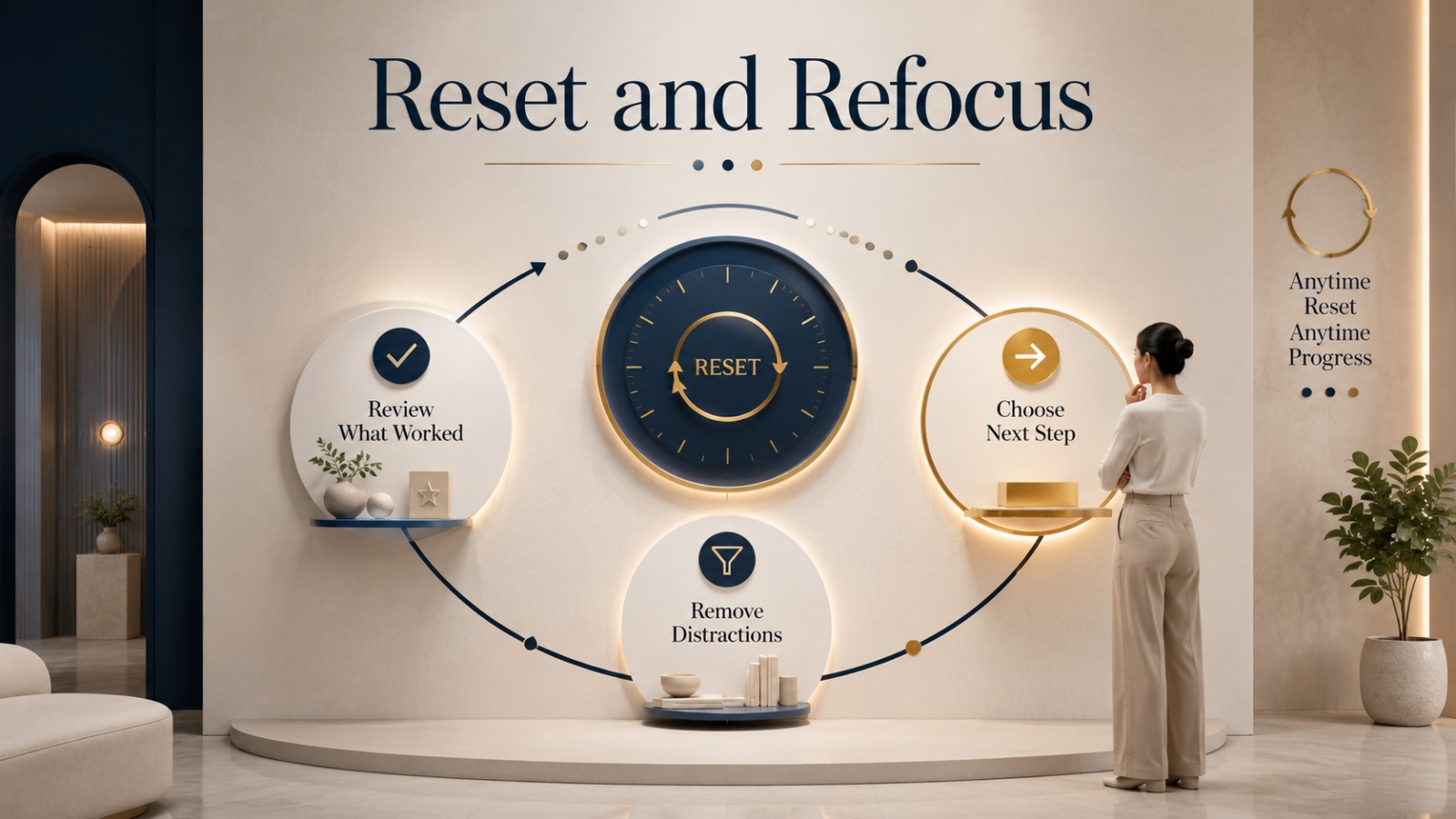
Review what worked.
Remove what distracted you.
Choose the next focused step.
That is it.
You are not trying to rebuild everything.
You are trying to see the current picture clearly enough to make the next better decision.
Why a Periodic Reset Matters
A blog business does not grow only because you add more.
More posts.
More emails.
More products.
More platforms.
More tools.
More plans.
Sometimes growth comes from removing what no longer helps.
A reset gives you space to look at your blog as a system.
You can ask:
- What did I create?
- What helped readers?
- What felt too complicated?
- What should I keep doing?
- What should I stop doing?
- What should I focus on next?
That kind of reflection helps you avoid carrying unnecessary weight into the next season of work.
Think of it like cleaning out a workroom.
You do not throw everything away.
You keep the tools you use.
You repair what still matters.
You remove what keeps getting in the way.
You place the next project where you can actually see it.
Your blog needs that same kind of reset.
The Big Mistake Beginners Make
The big mistake is planning the next step without reviewing the current one.
That usually leads to repeated patterns.
You set new goals but keep the same scattered workflow.
You create new content ideas but ignore the topics readers already responded to.
You plan a new product but leave the old offer unclear.
You promise a stronger email routine but never ask why the old one broke.
That is how confusion continues.
A better reset starts with reflection.
Before you ask:
What should I do next?
Ask:
What did I learn from what I already did?
That question can save you from repeating the same friction.
The Periodic Blog Reset Framework
Use this simple framework:
- Review what you created
- Notice what worked
- Remove what distracted you
- Improve what still matters
- Choose one focused next step
This is not a giant business plan.
It is a calm reset.
Let’s walk through each part.
Step 1: Review What You Created
Start with the facts.
What did you actually create since your last reset?
Do not begin with what you failed to finish.
Begin with what exists.
List your:
- blog posts
- emails
- lead magnets
- product ideas
- published products
- updated content
- useful resources
- reader replies
- improved pages
- routines you tried
This step matters because many bloggers forget how much work they actually did.
The season may feel messy.
But when you list what you created, you may see progress you had not noticed.
Questions to Ask
- What did I publish?
- What did I improve?
- What resources did I create?
- What email habits did I build?
- What product or offer ideas became clearer?
- What reader questions did I answer?
You are not trying to make the period look perfect.
You are simply gathering the truth.
Step 2: Notice What Worked
Next, look for useful signals.
What showed signs of life?
Maybe a topic got more reads.
Maybe one email received replies.
Maybe a lead magnet attracted signups.
Maybe readers clicked a certain resource.
Maybe a product idea felt easier to explain.
Maybe one weekly routine helped you stay consistent.
Do not only look for big numbers.
Small signals count.
A few reader replies can matter.
A small number of email signups can matter.
A post that keeps getting quiet interest can matter.
Questions to Ask
- Which topics got the most interest?
- Which emails received replies or clicks?
- Which resources did readers use?
- Which posts felt useful and clear?
- Which routines helped me stay steady?
- Which offer or product idea felt most connected to my audience?
This helps you decide what to carry forward.
The goal is not to chase every signal.
The goal is to notice what deserves more attention.
Step 3: Remove What Distracted You
This is where the reset becomes powerful.
Not everything deserves to come with you.
Some tasks looked useful but created noise.
Some tools felt exciting but did not help.
Some content ideas pulled you away from your main message.
Some platforms took time but brought little connection.
Some product ideas became too big and unclear.
Removing distractions is not failure.
It is focus.
A blogging business becomes stronger when the main path is easier to see.
Questions to Ask
- What kept pulling me away from the main path?
- Which tasks created pressure without useful progress?
- Which platforms or tools did I use only because I felt I “should”?
- Which product ideas became too broad?
- Which content topics no longer fit?
- What can I stop, pause, or simplify?
You do not need to delete everything.
Sometimes you only need to pause it.
A paused idea can return later if it fits.
But not every idea deserves your attention right now.
Step 4: Improve What Still Matters
After removing distractions, choose what needs improvement.
Look for assets that are still useful but not yet strong enough.
You might improve:
- one important blog post
- one email welcome sequence
- one lead magnet
- one product page
- one offer description
- one category page
- one CTA
- one weekly routine
- one follow-up email
This matters because progress is not always about creating something new.
Sometimes it comes from strengthening the asset you already have.
A clearer blog post can help more readers.
A better signup promise can grow your list.
A stronger offer page can explain the product better.
A simpler routine can help you stay consistent.
Questions to Ask
- Which existing asset still has potential?
- Which post should be updated?
- Which email could be clearer?
- Which offer needs better positioning?
- Which resource should be easier to use?
- Which routine should be simplified?
Choose one improvement first.
One strong improvement is better than a long list you never touch.
Step 5: Choose One Focused Next Step
Now you are ready to choose the next step.
Not ten next steps.
One.
Your next focused step should come from what you learned.
For example:
- If your niche still feels unclear, refine your reader and promise.
- If publishing felt scattered, build a simple weekly routine.
- If readers visited but did not subscribe, improve your signup path.
- If your offer felt unclear, sharpen the product promise.
- If you created useful posts but no follow-up, write a simple email sequence.
- If one topic got strong interest, create a related resource or offer.
A focused next step gives your next season direction.
It stops you from moving forward with too many open loops.
Questions to Ask
- What is the most important thing to fix first?
- What would make the next few weeks easier?
- What would help readers move forward more clearly?
- What should I focus on before adding anything new?
- What one project should get my best attention next?
That last question matters.
Your blog does not need every possible plan.
It needs the next right plan.
Worked Example: A Simple Periodic Reset
Let’s imagine a blogger who helps beginners create small digital products from PLR content.
After finishing a content block, they do a reset.
What They Created
They published posts about:
- PLR customization
- smaller offers
- bonus strategy
- simple blog systems
- email list building
- content-to-offer paths
They also created a small lead magnet:
Starter Offer Planning Worksheet
And they drafted an offer idea:
Starter Offer Builder Kit
What Worked
The posts about smaller offers and bonus strategy received the most interest.
Several readers clicked the Starter Offer Planning Worksheet.
Two readers replied and said they felt overwhelmed by big product ideas.
That is a clear signal.
The audience may need simple, focused product-building help.
What Distracted Them
They spent too much time thinking about a huge “complete digital product empire” course.
It sounded exciting.
But it became too big.
They also tried to post on too many social platforms and felt stretched.
Those distractions created pressure without much progress.
What They Should Improve
The Starter Offer Planning Worksheet is useful, but the signup promise is too vague.
They decide to improve the opt-in copy and add one short welcome email that explains how to use the worksheet.
That is a practical improvement.
Their Next Focused Step
Their next step is:
Build a clear Starter Offer Builder Kit based on the smaller-offer topic readers already responded to.
That step makes sense because it comes from actual signals.
Not random inspiration.
Not pressure.
Not comparison.
A real review.
A clearer next move.
The Periodic Reset Worksheet
Use this simple worksheet for your own blog.
1. What Did I Create Recently?
Blog posts: [List key posts.]
Emails: [List key emails or sequences.]
Resources: [List lead magnets, worksheets, guides, or tools.]
Products or offers: [List product ideas or offers.]
Improvements: [List updated posts, pages, or systems.]
2. What Worked?
Topics that got interest: [List topics.]
Emails that received clicks or replies: [List emails.]
Resources people used: [List resources.]
Routines that helped: [List routines.]
Offers or ideas that felt promising: [List ideas.]
3. What Distracted Me?
Tasks that created noise: [List tasks.]
Tools or platforms that did not help: [List tools/platforms.]
Ideas that pulled me away: [List ideas.]
Products that became too big: [List products.]
Habits that made the work heavier: [List habits.]
4. What Should I Improve?
One post to update: [Write post.]
One email to improve: [Write email.]
One resource to strengthen: [Write resource.]
One offer to clarify: [Write offer.]
One routine to simplify: [Write routine.]
5. What Is My Next Focused Step?
My next focused step is:
[Write one clear project or action.]
I chose this because:
[Write the reason based on what you learned.]
That is your reset.
Simple.
Honest.
Useful.
When to Do a Periodic Reset
You can do this reset at any useful point.
For example:
- at the end of each month
- at the end of each quarter
- after completing a content block
- after launching a product
- after a busy season
- when your blog feels scattered
- when you keep adding ideas but not completing them
- before starting a new major project
You do not need to wait for the end of the year.
Any time your blog feels noisy, a reset can help.
What to Avoid During a Periodic Reset
Mistake 1: Turning the Reset Into Self-Criticism
A reset should help you learn.
It should not become a list of reasons you are behind.
Use calm language.
Instead of:
I failed to build my blog properly.
Say:
My blog needs a clearer content-to-email-to-offer path next.
That gives you something useful to do.
Mistake 2: Planning Too Many Goals
It is easy to over-plan during a reset.
Be careful.
Too many goals can create a noisy start.
Choose one main focus first.
You can add more later.
Mistake 3: Ignoring What Already Worked
Do not abandon a topic just because you are tired of it.
If readers showed interest, that topic may deserve a stronger path.
Use the clues.
Mistake 4: Carrying Every Idea Forward
Some ideas should be paused.
That does not mean they are bad.
It means they are not the next priority.
Focus requires subtraction.
Mistake 5: Creating a Bigger System Than You Can Use
A huge system may look impressive, but it can break quickly.
Choose a simple rhythm you can return to.
A simple system used every week is better than a complex one you avoid.
A Simple 30-Minute Periodic Reset
You can do this in 30 minutes.
First 10 Minutes: Review
Write down what you created and what worked.
Do not overthink.
Just list the obvious signals.
Next 10 Minutes: Remove
Write down what distracted you, drained you, or pulled you away from the main path.
Choose what to stop, pause, or simplify.
Final 10 Minutes: Refocus
Choose one focused next step.
Make it clear.
Make it practical.
Make it connected to what you learned.
That is enough for a useful reset.
Final Thought: Carry Forward What Helps
A blogging business grows better when you learn from what already happened.
A reset is not just a time to make new plans.
It is a time to decide what deserves to continue.
Keep what worked.
Improve what still matters.
Remove what distracted you.
Choose one focused next step.
That is how you enter the next season with more clarity.
Not more noise.
Your blog does not need to carry everything forward.
It only needs to carry the right things forward.
And once you know what those are, the next step becomes much easier to take.
Use This With Blogger’s Success Toolkit
If you already own Blogger’s Success Toolkit, log in to the Blogger Success Blueprint members area and use the planning resources to complete your periodic blog business reset.
Review what worked, remove what distracted you, and choose one focused next step for your blog business.
Members Login:
https://bloggersuccessblueprint.com/members/
New to Blogger’s Success Toolkit?
Blogger’s Success Toolkit gives you a beginner-friendly path to choose your direction, plan useful content, write stronger titles, and begin building your blog or product path with more structure.