
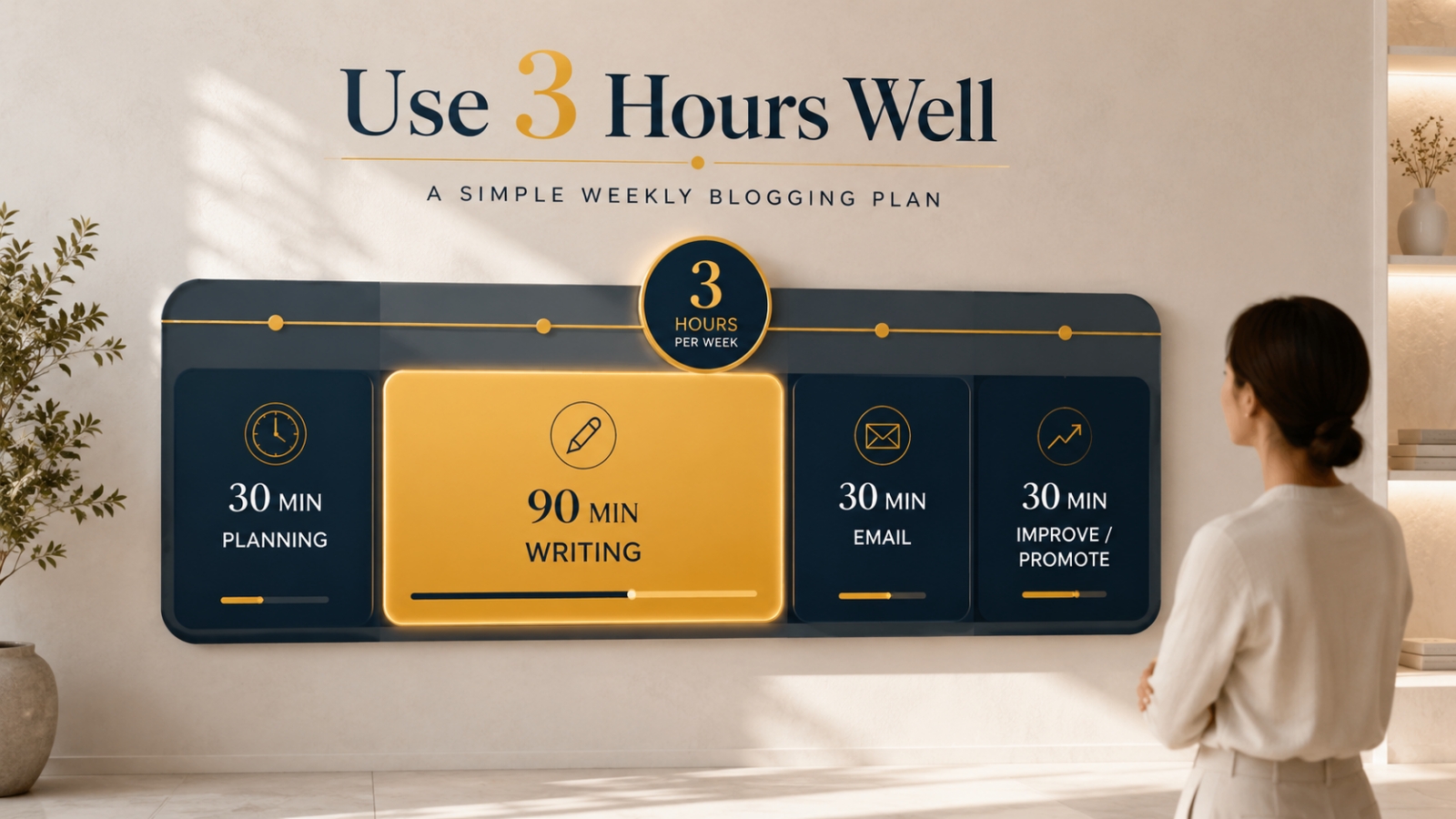
A realistic weekly blogging plan for making progress when your time is limited.
Not every blogger has ten hours a week.
Some weeks, you may only have three.
Three hours between work, family, errands, tired evenings, and everything else life keeps handing you.
And when time is tight, blogging can start to feel impossible.
You look at the list.
Write a post.
Send an email.
Update old content.
Create a lead magnet.
Share on social media.
Plan an offer.
Check analytics.
Improve the website.
No wonder you feel stuck.
But here is the good news.
You do not need to do everything every week.
If you only have 3 hours, the goal is to protect the highest-value tasks.
Plan.
Write.
Email.
Improve or promote.
That simple focus can keep your blog moving without turning your limited time into a guilt machine.
Why 3 Hours Can Still Matter
Three hours may not sound like much.
But three focused hours can do real work.
The problem is not usually the small amount of time.
The problem is trying to squeeze too many tasks into that time.
If you spend 3 hours jumping between tools, checking ideas, editing a half-done page, scrolling for inspiration, and worrying about what you should do first, the time disappears.
But if you give each block a clear job, the same 3 hours can create progress.
You may plan one topic.
Draft one article.
Send one email.
Improve one old post.
Share one useful idea.
That is not small when repeated over time.
That is how momentum returns.
The Big Mistake Time-Limited Bloggers Make
The big mistake is treating limited time like unlimited time.
You sit down with 3 hours and expect yourself to:
- write a full long-form post
- create social posts
- update your site
- send an email
- plan a product
- review analytics
- fix old content
- learn a new tool
That is too much.
When the plan is too big, even a good work session can feel like failure.
A better approach is to choose fewer tasks and finish them.
If you only have 3 hours, your weekly blogging plan should be simple enough to complete.
Not impressive.
Complete.
Completion builds confidence.
Confidence helps you return next week.
The 3-Hour Blogging Framework
Here is a simple weekly allocation:
- 30 minutes planning
- 90 minutes writing
- 30 minutes email
- 30 minutes improvement or promotion
That is the full plan.
You can do it in one session.
Or split it across the week.
The important thing is that each block has a job.
Let’s walk through each part.
30 Minutes: Planning
Planning comes first because it prevents wasted writing time.
When time is limited, you cannot afford to sit down and wonder what to write.
Use the 30-minute planning block to choose one clear direction.
You are not planning the whole month.
You are planning the next useful action.
What to Do During Planning
Use your 30 minutes to:
- choose one topic
- define one reader problem
- decide the main lesson
- outline the key sections
- choose the email angle
- decide the next step for the reader
That is enough.
Do not turn planning into research.
Do not open too many old documents.
Do not compare ten possible topics.
Choose one useful topic and make it small enough to write.
Planning Questions
Ask:
- Who am I helping this week?
- What problem do they need help with?
- What is one useful lesson I can teach?
- What sections should the post include?
- What email can I send from this idea?
- What should the reader do after reading?
When planning is clear, writing becomes easier.
90 Minutes: Writing
Writing gets the largest block because content is still the core asset.
But with only 90 minutes, you need to write with focus.
Do not aim for a perfect masterpiece.
Aim for a useful draft.
That may mean:
- writing a short blog post
- drafting one major section of a longer post
- refreshing an old post
- writing a practical guide outline with key teaching sections
- creating a short post plus a clear next step
A 90-minute writing block can produce a lot when the topic is already chosen.
What to Write
Use a simple structure:
- Start with the reader’s problem
- Explain the main idea
- Give three to five steps
- Add one example
- End with one next action
This keeps the post clear.
You are not trying to cover everything.
You are helping the reader move one step.
Writing Rule
Do not edit every sentence while drafting.
Write first.
Improve later.
If you stop to polish every line, the 90 minutes may vanish before the draft has shape.
A rough draft is allowed.
You can clean it up after the main idea is on the page.
30 Minutes: Email
Your email list matters because it keeps the reader relationship alive.
Even if your blog is small, email helps you stay connected.
If you only have 30 minutes, write a simple email based on your topic.
You do not need a complex newsletter.
Use this structure:
- open with the reader’s problem
- share one helpful idea
- point to the blog post or resource
- invite one simple next step
That is enough.
Example Email Angle
If your blog post is about refreshing an old blog post, your email could open with:
If your blog has been quiet, you may not need a brand-new post this week. You may only need to refresh one old article that still has a useful idea inside it.
Then share one tip.
Then link to the post.
Simple.
Useful.
Connected.
Email Questions
Ask:
- What problem should I open with?
- What one idea can I share?
- What post, resource, or next step should I point to?
- What should the reader do after reading?
A short useful email is better than no email because you tried to make it perfect.
30 Minutes: Improvement or Promotion
The final 30 minutes should support the work you already created.
Choose one of two options:
Improve something or promote something.
Do not try to do both every time.
Pick what matters most this week.
Option 1: Improve Something
You could improve:
- one blog title
- one old intro
- one CTA
- one internal link
- one email subject line
- one lead magnet signup promise
- one section of an older post
- one resource page
Small improvements compound.
A better CTA can guide more readers.
A clearer title can make an old post more useful.
A stronger intro can help readers stay.
Option 2: Promote Something
You could promote by:
- sharing one useful tip from the post
- sending the blog post to your list
- adding the post to a related resource page
- linking to it from an older article
- creating one short social post
- replying to a reader with the relevant post
Promotion does not need to feel loud.
It can simply help people find something useful.
Improvement or Promotion Question
Ask:
What one action would help this week’s content work a little harder?
Choose that.
Then stop.
Worked Example: A 3-Hour Blogging Week
Let’s imagine your blog helps beginners rebuild blogging momentum.
You only have 3 hours this week.
Here is how the plan could work.
Planning: 30 Minutes
You choose the topic:
How to Refresh an Old Blog Post
Reader problem:
They feel stuck because they think they need to write something brand new.
Main lesson:
An older post may only need a stronger title, intro, examples, formatting, and next step.
Outline:
- why old posts still have value
- update the title
- improve the intro
- add examples
- improve formatting
- add a clearer next step
Email angle:
Refresh one old post before writing something new.
Writing: 90 Minutes
You draft the post using the outline.
You keep it focused.
You do not try to turn it into a complete content strategy guide.
The post helps with one useful task:
refresh one old blog post.
Email: 30 Minutes
You write a short email that says:
If your blog has been quiet, you may not need a new idea. You may already have an old post worth improving. Start with the title, intro, example, formatting, and next step.
Then you link to the post.
Improvement or Promotion: 30 Minutes
You choose promotion.
You share one useful takeaway:
Before writing from scratch, choose one old post and improve only five things: title, intro, examples, formatting, and next step.
Now your 3 hours produced:
- one planned topic
- one drafted or published post
- one email
- one promotion step
That is meaningful progress.
What If You Cannot Finish a Full Post in 90 Minutes?
That is okay.
You have options.
Option 1: Write a Shorter Post
Not every post needs to be long.
A clear 800-word post can still be useful if it solves one problem.
Option 2: Refresh an Old Post
Refreshing may be faster than writing from zero.
Improve the title, intro, examples, formatting, and next step.
Option 3: Draft One Section
If the topic needs a longer article, use the 90 minutes to write the main teaching sections.
Finish the rest next week.
Option 4: Create a Two-Part Post
If the idea is too big, split it.
Part one can be the simple overview.
Part two can cover examples or next steps.
Limited time often forces better focus.
That can be a strength.
What to Avoid When You Only Have 3 Hours
Mistake 1: Starting With Design Tasks
Design tasks can swallow time quickly.
Unless something is broken, do not start there.
Focus on content, email, improvement, or promotion first.
Mistake 2: Researching Too Long
Research can feel productive.
But if you spend the whole session researching, nothing gets published.
Keep research limited.
Mistake 3: Trying to Be Everywhere
Do not promote on every platform.
Choose one useful share.
One place.
One message.
Mistake 4: Creating a Giant Topic
A limited-time week needs a focused topic.
Do not choose something too broad.
Make the post smaller.
Mistake 5: Skipping Email
Even a short email matters.
Your list is part of your blog business system.
Do not let email disappear just because time is tight.
A Simple 3-Hour Weekly Schedule
Here are three ways to arrange your 3 hours.
Option 1: One Session
Use one 3-hour block:
- 30 minutes planning
- 90 minutes writing
- 30 minutes email
- 30 minutes improvement or promotion
This works if you have one uninterrupted block.
Option 2: Three One-Hour Sessions
Split it across the week:
Session 1
30 minutes planning
30 minutes writing start
Session 2
60 minutes writing
Session 3
30 minutes email
30 minutes improvement or promotion
This works well if your schedule is busy.
Option 3: Six 30-Minute Blocks
Use small blocks:
- Block 1: plan
- Blocks 2–4: write
- Block 5: email
- Block 6: improve or promote
This works if you only have short windows.
The format does not matter.
The allocation matters.
Quick Exercise: Plan Your 3-Hour Blog Week
Use this worksheet.
My 30-Minute Planning Block Will Be:
[Day and time.]
My 90-Minute Writing Block Will Be:
[Day and time.]
My 30-Minute Email Block Will Be:
[Day and time.]
My 30-Minute Improvement or Promotion Block Will Be:
[Day and time.]
This Week’s Topic Is:
[Write one topic.]
The Reader Problem Is:
[Write one problem.]
My Email Angle Is:
[Write one email idea.]
My Improvement or Promotion Step Is:
[Write one action.]
Keep it simple.
Your goal is not to do everything.
Your goal is to use the 3 hours well.
Final Thought: Limited Time Needs Clear Focus
If you only have 3 hours a week, do not waste those hours trying to do everything.
Give each block a clear job.
Plan for 30 minutes.
Write for 90 minutes.
Email for 30 minutes.
Improve or promote for 30 minutes.
That simple rhythm can keep your blog alive and moving.
It may not feel dramatic.
But steady useful work rarely does.
It builds quietly.
One topic.
One post.
One email.
One improvement.
One week at a time.
And that is enough to keep momentum going.
Use This With Blogger’s Success Toolkit
If you already own Blogger’s Success Toolkit, log in to the Blogger Success Blueprint members area and use the planning resources to map your next 3-hour blogging week.
Choose one topic, one writing block, one email angle, and one improvement or promotion step.
Members Login:
https://bloggersuccessblueprint.com/members/
New to Blogger’s Success Toolkit?
Blogger’s Success Toolkit gives you a beginner-friendly path to choose your direction, plan useful content, write stronger titles, and begin building your blog or product path with more structure.




1 Response to "What to Focus on If You Only Have 3 Hours a Week"
[…] your time is limited, What to Focus on If You Only Have 3 Hours a Week can help you protect the most valuable […]