A simple four-week plan to regain clarity, rebuild rhythm, and choose your next focused step.
Sometimes your blog does not need another random task.
It needs a reset.
Not a dramatic reset.
Not a full rebuild.
Not a new brand, new niche, new website, and new content calendar all at once.
Just a clear 30-day reset that helps you pause, review, simplify, reconnect, and move forward with more focus.
Because when your blog feels scattered, the problem is often not that you have nothing to work with.
You may have posts.
Notes.
Emails.
Ideas.
Drafts.
Templates.
Resources.
Reader questions.
Product thoughts.
But the pieces may not feel connected.
That is what this 30-day reset is for.
It gives you one simple focus for each week so you can rebuild clarity without overloading yourself.
Why a 30-Day Reset Works
A 30-day reset works because it gives your blog enough time to breathe.
One day can feel too rushed.
One week can help, but it may only restart one small action.
A full year plan can feel too big.
But 30 days gives you room to:
- review what exists
- improve one useful asset
- reconnect with readers
- rebuild a simple rhythm
- choose the next focused step
That is practical.
It is also manageable.
You are not trying to become a completely different blogger in 30 days.
You are trying to make the next season clearer.
That is a much better goal.
The Big Mistake Bloggers Make During a Reset
The big mistake is trying to fix everything at once.
You open your blog and suddenly see every possible task.
The old posts need updating.
The email list needs attention.
The lead magnet could be better.
The offer path feels unclear.
The design could be improved.
The content plan needs work.
The old drafts are messy.
The analytics need reviewing.
All of that may be true.
But if you try to fix everything in one reset, the reset becomes another source of pressure.
A better reset has a sequence.
First, review.
Then improve.
Then reconnect.
Then choose the next focus.
That order matters.
It keeps the reset from becoming a pile of disconnected tasks.
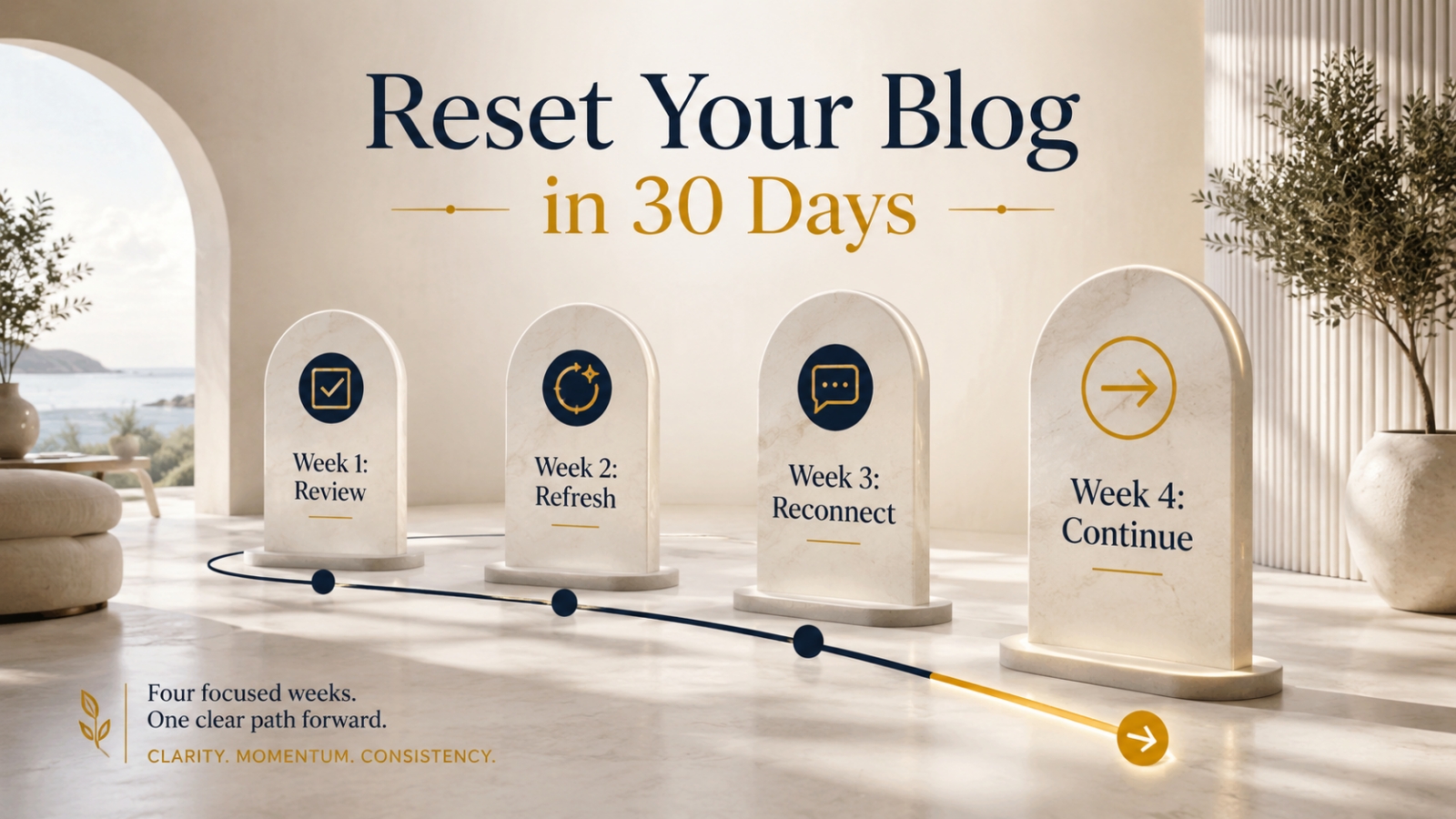
The 30-Day Blogging Reset Framework
Here is the simple plan:
- Week 1: Review and choose your focus
- Week 2: Refresh one useful asset
- Week 3: Reconnect with your audience
- Week 4: Rebuild rhythm and choose the next step
This gives each week a job.
You do not need to do everything every week.
You only need to complete the focus for that week.
Week 1: Review and Choose Your Focus
The first week is not for creating more content.
It is for seeing clearly.
Before you write, publish, or promote anything, look at what already exists.
Your goal is to answer one question:
What is the most useful place to focus next?
What to Review
Look at your:
- published blog posts
- saved drafts
- past emails
- content notes
- outlines
- templates
- lead magnets
- reader replies
- resource clicks
- product or offer ideas
You are not reviewing to judge yourself.
You are reviewing to find useful clues.
What to Look For
Look for:
- posts that still feel useful
- topics that got interest
- emails that received replies or clicks
- resources people downloaded
- old ideas that still fit your direction
- unfinished assets that could become useful
- repeated reader questions
- tasks that created distraction
This helps you avoid guessing.
Your blog may already be showing you what deserves attention.
Week 1 Action Step
Choose one focus area for the reset.
It might be:
- refresh one old post
- rebuild your email rhythm
- improve your signup path
- create one small offer idea
- reconnect with your list
- reuse old content assets
- clarify your next content topic
Do not choose five.
Choose one main focus.
You can still complete a few small supporting actions, but the reset needs one center.
Week 1 Mini-Worksheet
Answer these:
What already exists that still has value?
[Write your answer.]
What got the most interest recently?
[Write your answer.]
What feels most scattered?
[Write your answer.]
What should I stop, pause, or simplify?
[Write your answer.]
My main focus for this 30-day reset is:
[Write one focus.]
That is Week 1.
You are not behind.
You are getting clear.
Week 2: Refresh One Useful Asset
Week 2 is for improvement.
Not creating everything from scratch.
Choose one asset that already exists and make it more useful.
That asset could be:
- an old blog post
- a draft
- a lead magnet
- a welcome email
- a product description
- a resource page
- a checklist
- a template
- an email sequence
Pick one asset that supports your Week 1 focus.
Why Refreshing Works
Refreshing works because it gives you momentum without starting from zero.
You already have the raw material.
Now you make it stronger.
For example, if you choose an old blog post, you can improve:
- the title
- the introduction
- the examples
- the formatting
- the next step
If you choose a lead magnet, you can improve:
- the promise
- the instructions
- the layout
- the CTA
- the welcome email
If you choose an email, you can improve:
- the subject line
- the opening hook
- the reader problem
- the helpful idea
- the link or next step
Week 2 Action Step
Refresh one useful asset and make it ready to share or use.
Keep the improvement focused.
Do not turn it into a giant project.
Week 2 Mini-Worksheet
The asset I will refresh is:
[Write the asset.]
The reason this asset matters is:
[Write the reason.]
I will improve these three things:
- [Improvement 1.]
- [Improvement 2.]
- [Improvement 3.]
The reader’s next step should be:
[Write the next step.]
By the end of Week 2, one useful part of your blog should feel clearer than it did before.
That is progress.
Week 3: Reconnect With Your Audience
Week 3 is for connection.
A blog reset should not only happen behind the scenes.
At some point, you need to bring the reader back into the path.
This does not need to be complicated.
You can reconnect through:
- one email
- one refreshed post
- one useful resource
- one short story
- one helpful question
- one practical tip
- one reader-focused update
The key is usefulness.
Do not overexplain.
Do not make the message heavy.
Reconnect around one problem your reader cares about.
What to Send
You can send:
Option 1: A Useful Note
Share one practical idea that helps the reader take a small step.
Option 2: A Refreshed Resource
Point readers to the asset you improved in Week 2.
Option 3: A Simple Question
Ask what they are working on, struggling with, or trying to restart.
Option 4: A Short Content Path
Share one post and one next step that supports the reader’s current stage.
Week 3 Action Step
Send one reconnection email or publish one useful reader-facing update.
Keep it simple.
The goal is to restart the conversation.
Week 3 Mini-Worksheet
The reader problem I will reconnect around is:
[Write the problem.]
The useful idea I will share is:
[Write the idea.]
The resource or post I will point to is:
[Write the link/resource.]
The simple next step I want the reader to take is:
[Write the action.]
My email or update subject line is:
[Write the subject line.]
By the end of Week 3, your blog should no longer feel like something you are only working on privately.
It should have one visible reconnection point.
Week 4: Rebuild Rhythm and Choose the Next Step
Week 4 is for continuity.
This is where many resets fail.
People review, refresh, and reconnect.
Then they stop again because there is no rhythm after the reset.
So the final week is about choosing a simple continuation plan.
Not a huge plan.
A rhythm you can actually return to.
What Rhythm Means
A rhythm may look like:
- one post every two weeks
- one email per week
- one old post refresh per month
- one monthly review session
- one small offer improvement each month
- one content reuse session every Friday
The rhythm should fit your real life.
Do not choose a schedule that only works during your most motivated week.
Choose something realistic.
Choose the Next Focused Step
At the end of the reset, ask:
What is the next focused step that would make my blog easier to continue?
Possible next steps:
- write the next blog post
- create a 4-email sequence
- improve the lead magnet
- build one small offer
- refresh a second old post
- clarify the offer path
- review analytics monthly
- create a simple weekly routine
Choose one.
The reset should end with direction, not another long list.
Week 4 Action Step
Create a simple continuation plan for the next 30 days.
Week 4 Mini-Worksheet
My realistic rhythm will be:
[Write the rhythm.]
The next focused step is:
[Write one action.]
I will complete it by:
[Write day/date.]
I will review progress every:
[Weekly / monthly / after each content cycle.]
I will stop or pause:
[Write one distraction to remove.]
By the end of Week 4, you should know what happens after the reset.
That is the key.
A reset is not only about restarting.
It is about making the next step easier to continue.
A Simple 30-Day Reset Calendar
Here is how the month could look.
Days 1–3: Review What Exists
Look through posts, emails, notes, drafts, resources, and reader replies.
Write down what still feels useful.
Days 4–7: Choose One Focus
Pick the main focus for the reset.
Do not overchoose.
One focus keeps the reset clear.
Days 8–10: Choose One Asset to Refresh
Select a post, email, lead magnet, template, or resource.
Decide what needs improvement.
Days 11–14: Improve the Asset
Update the title, intro, example, structure, CTA, promise, or instructions depending on the asset.
Days 15–17: Prepare the Reconnection Message
Write a simple email, post update, or useful note that points readers toward the refreshed asset or helpful idea.
Days 18–21: Send or Publish the Reconnection Piece
Share the useful message.
Keep it reader-focused.
Days 22–24: Review the Response
Look for replies, clicks, comments, downloads, or signs of interest.
Do not obsess over large numbers.
Look for useful clues.
Days 25–27: Choose the Next Focused Step
Based on what you learned, choose the next action.
Days 28–30: Set the Continuation Rhythm
Decide how you will keep going after the reset.
Write the next task into your calendar.
Worked Example: A 30-Day Reset for a Quiet Blog
Let’s imagine your blog helps beginners build simple offers from PLR content.
The blog has been inconsistent for a while.
You decide to do a 30-day reset.
Week 1: Review and Choose Focus
You review old posts and notice that readers showed interest in smaller offers and bonus strategy.
You choose one focus:
Help readers create one small starter offer from existing content.
Week 2: Refresh One Asset
You refresh an old post:
When to Create a Smaller Offer Instead of a Big Product
You improve:
- the title
- the examples
- the next step
You add a simple worksheet prompt at the end.
Week 3: Reconnect With Readers
You send one email:
A smaller offer may be the easier way back into motion
Inside the email, you share one idea and link to the refreshed post.
Week 4: Rebuild Rhythm
You choose your next 30-day rhythm:
- one blog post every two weeks
- one email each week
- one old post refresh each month
- one monthly review session
Your next focused step is:
Create a Starter Offer Planning Checklist.
Now the reset has created direction.
Not just activity.
What to Avoid During a 30-Day Reset
Mistake 1: Making the Reset Too Big
If the reset includes too many tasks, you may avoid it.
Keep the plan simple.
One focus per week.
Mistake 2: Starting With a New Project Too Soon
Before creating something new, review what already exists.
You may have useful material waiting.
Mistake 3: Refreshing Too Many Assets
Choose one asset first.
Finish one improvement before opening ten more tabs.
Mistake 4: Reconnecting Without a Useful Point
Do not email only to say you are back.
Email with a helpful idea, resource, or question.
Mistake 5: Ending the Reset Without a Rhythm
A reset should lead somewhere.
Use Week 4 to choose the next rhythm so momentum does not fade again.
Quick Exercise: Build Your 30-Day Blogging Reset
Use this worksheet.
My Reset Start Date Is:
[Write date.]
Week 1 Focus: Review
The assets I will review are:
[Write posts, emails, resources, drafts, notes, or templates.]
The main focus I choose is:
[Write one focus.]
Week 2 Focus: Refresh
The asset I will improve is:
[Write asset.]
The three improvements I will make are:
- [Improvement 1.]
- [Improvement 2.]
- [Improvement 3.]
Week 3 Focus: Reconnect
The message I will send or publish is:
[Write email/post/resource.]
The helpful idea I will share is:
[Write idea.]
Week 4 Focus: Continue
My next rhythm will be:
[Write simple rhythm.]
My next focused step is:
[Write one step.]
That is your 30-day reset plan.
Simple enough to follow.
Strong enough to create movement.
Final Thought: Use 30 Days to Create Clarity
A 30-day blogging reset is not about doing everything.
It is about clearing the fog.
You review what exists.
You refresh one useful asset.
You reconnect with readers.
You choose the next focused step.
That may sound simple.
But simple is exactly what a reset needs.
Because the goal is not to create more noise.
The goal is to make your blog easier to continue.
So give yourself 30 days.
One week to review.
One week to refresh.
One week to reconnect.
One week to rebuild rhythm.
By the end, your blog may not be “finished.”
But it can be clearer.
And clarity is often what helps momentum return.
Use This With Blogger’s Success Toolkit
If you already own Blogger’s Success Toolkit, log in to the Blogger Success Blueprint members area and use the planning resources to complete your 30-day blogging reset.
Review what you already have, refresh one useful asset, reconnect with your audience, and choose the next focused step.
Members Login:
https://bloggersuccessblueprint.com/members/
New to Blogger’s Success Toolkit?
Blogger’s Success Toolkit gives you a beginner-friendly path to choose your direction, plan useful content, write stronger titles, and begin building your blog or product path with more structure.