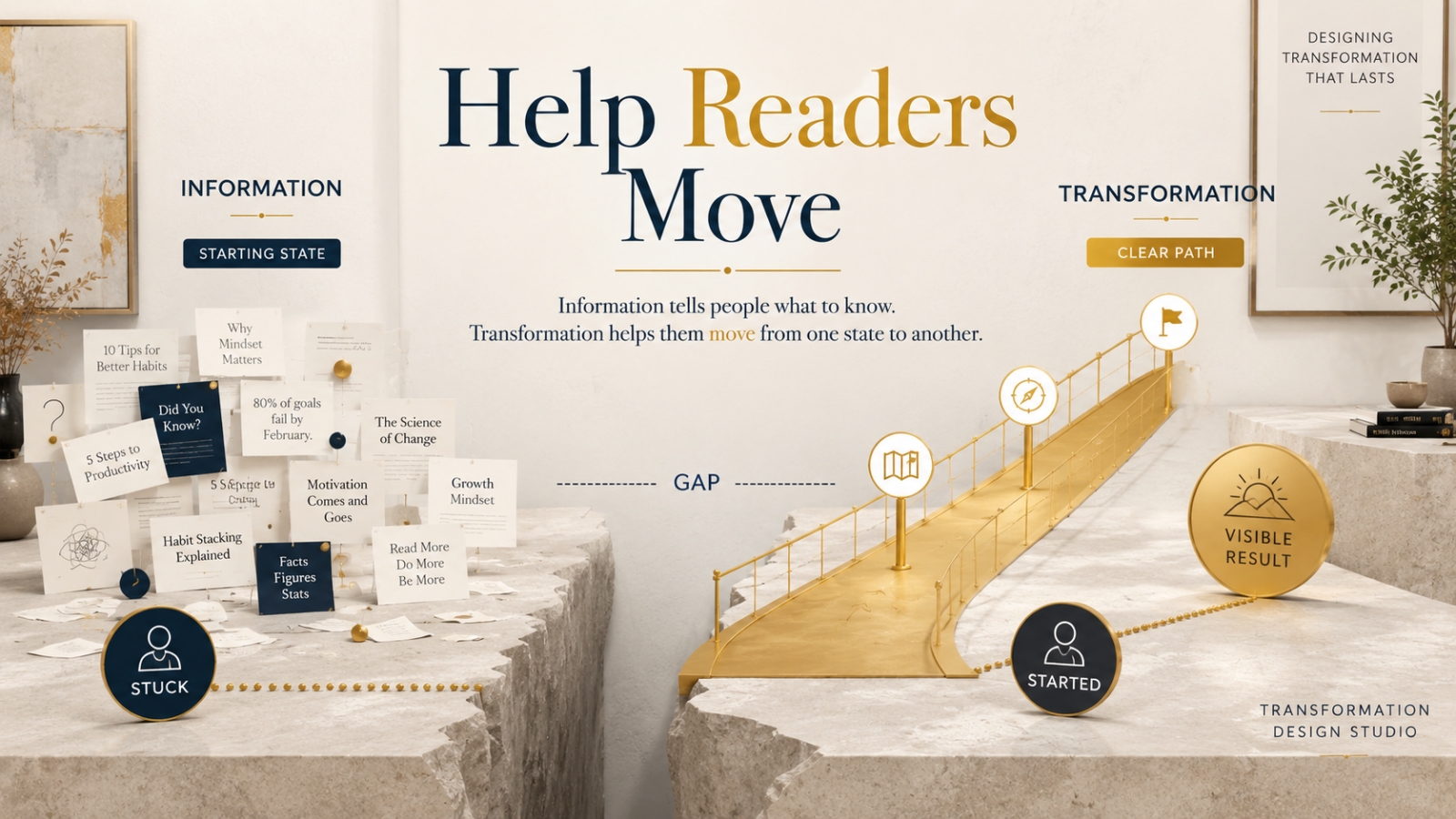
How to design blog posts and products that help readers move from one state to another.
Information is easy to create.
You can list tips.
Explain ideas.
Share facts.
Give examples.
Teach steps.
Create a guide.
Build a checklist.
That can be useful.
But information alone is not always enough.
Readers are usually not looking for more things to know.
They are looking for movement.
They want to move from confused to clear.
From scattered to structured.
From stuck to started.
From overwhelmed to calmer.
From unsure to ready.
From “I should do this” to “I know my next step.”
That movement is transformation.
And when you understand the difference between information and transformation, your blog posts, emails, and digital products become much stronger.
Why This Difference Matters
People are surrounded by information.
They can search anything.
They can watch tutorials.
They can collect tips.
They can save posts, download guides, and bookmark resources.
But many still feel stuck.
Why?
Because knowing more does not always help them move.
A person can know they should plan meals and still stare into the fridge at 6 p.m.
A blogger can know they should email their list and still avoid the blank message box.
A product creator can know they should build a small offer and still keep adding too many pieces.
Information tells them what matters.
Transformation helps them cross the gap.
That is the difference.
The Big Mistake Bloggers and Product Creators Make
The big mistake is thinking more information means more value.
So they add more.
More chapters.
More tips.
More templates.
More bonuses.
More lessons.
More examples.
More pages.
But more can make the reader feel heavier.
A strong blog post or product does not need to include every possible thing.
It needs to help the reader reach a clearer result.
That result may be small.
But it should be real.
For example:
- choose one topic
- write one email
- refresh one old post
- create one checklist
- outline one starter offer
- improve one blog intro
- plan one week of content
Those are transformations.
They move the reader from one state to another.
The 3-Second Hook Test
Before someone reads your post or considers your product, they quickly ask:
What will this help me do?
That question often happens in a few seconds.
If your title, headline, or opening does not show the movement, the reader may drift away.
This is why transformation needs to appear early.
Not buried halfway down the page.
Not hidden inside a long explanation.
Early.
Clear.
Specific.
Weak Information Hook
Meal Planning Tips for Beginners
This gives a topic.
But the transformation is unclear.
Stronger Transformation Hook
How to Plan Three Simple Dinners Before Your Next Grocery Trip
This shows movement.
The reader goes from not knowing what to cook to having three dinners chosen.
Weak Information Hook
Email Marketing Basics
This gives a broad topic.
Stronger Transformation Hook
How to Write One Welcome Email That Helps New Subscribers Know Where to Start
This gives a clearer result.
The reader knows what they will create.
Weak Information Hook
Blog Post Improvement Guide
This gives information.
Stronger Transformation Hook
How to Refresh One Old Blog Post With a Stronger Title, Intro, Examples, Formatting, and Next Step
This gives movement.
The reader can picture the outcome.
The Transformation Framework
Use this simple framework when designing content or products:
- Name the starting state
- Name the desired state
- Identify the gap
- Give a clear path
- End with a visible result
This framework helps you avoid creating content that only informs.
It helps you create content that moves the reader.
Step 1: Name the Starting State
The starting state is where your reader is before your content helps them.
This is often a problem, frustration, confusion, or unfinished task.
Examples:
- They have old blog posts but do not know what to refresh.
- They have a checklist but do not know how to turn it into a product.
- They have an email list but feel awkward reconnecting.
- They have blog ideas but no weekly rhythm.
- They have PLR content but it sounds too generic.
- They have a product idea but it feels too big.
The more clearly you name the starting state, the more relevant your content feels.
Starting State Question
Ask:
Where is my reader right before they need this?
That question helps you write stronger hooks, intros, and product promises.
Step 2: Name the Desired State
The desired state is where the reader wants to be after using your content or product.
Examples:
- They know which old post to refresh.
- They have one checklist product idea.
- They send one simple reconnection email.
- They plan their next week of blog work.
- They improve one PLR piece with their voice and examples.
- They turn a broad product idea into a smaller starter offer.
The desired state should feel clear and believable.
Do not overpromise.
A small transformation is still valuable if it solves a real problem.
Desired State Question
Ask:
What should the reader be able to do, decide, create, or improve after this?
That answer becomes the heart of your content or product.
Step 3: Identify the Gap
The gap is what stops the reader from moving.
It may be:
- confusion
- too many options
- lack of structure
- fear of doing it wrong
- unclear first step
- weak examples
- no template
- no checklist
- no rhythm
- no confidence
Your content or product should help close that gap.
For example, if the reader wants to refresh an old blog post but does not know where to begin, the gap is not “lack of information about blogging.”
The gap is:
They need a simple refresh checklist.
That tells you what to create.
Gap Question
Ask:
What is stopping the reader from moving from the starting state to the desired state?
The answer shows what your content needs to include.
Step 4: Give a Clear Path
A clear path is the sequence that helps the reader move.
This is where structure matters.
The path may be:
- steps
- questions
- checklist items
- prompts
- examples
- templates
- worksheets
- before-and-after models
- simple decisions
A good path reduces guessing.
For example, if your content is about creating a small offer, the path could be:
- Choose one reader problem
- Pick one simple format
- Write one clear promise
- Add only what helps
- Connect the offer to one blog post or email
That path helps the reader move.
Clear Path Question
Ask:
What steps would make this easier to follow and finish?
If the path feels too large, shrink it.
Step 5: End With a Visible Result
A visible result tells the reader what they should have by the end.
Examples:
- one refreshed blog post
- one reconnection email
- one starter offer idea
- one improved blog title
- one 3-hour weekly plan
- one content-to-email-to-offer path
- one reusable content asset
A visible result makes transformation concrete.
Without it, the reader may finish the content thinking:
“That was interesting.”
But you want them thinking:
“I know what to do next.”
Visible Result Question
Ask:
What should the reader have in hand or clearly understand by the end?
That result keeps the content focused.
Worked Example: Information vs Transformation in a Blog Post
Let’s take a simple topic:
Blog titles
Information-Based Version
Title:
Blog Title Tips
This post might explain:
- why titles matter
- how long titles should be
- what makes a title catchy
- common headline formulas
- examples of blog titles
Useful?
Maybe.
But the reader may still leave wondering what title to write.
Transformation-Based Version
Title:
How to Turn a Vague Blog Topic Into a Clear Reader Promise
This post helps the reader move from:
“I have a broad topic.”
to:
“I have a title that tells readers what they will gain.”
The path could be:
- Start with the topic
- Name the reader’s situation
- Name the useful result
- Add one specific detail
- Check whether the title matches the post
The visible result is:
One stronger blog title.
That is transformation.
The post is no longer only about title information.
It helps the reader create a better title.
Worked Example: Information vs Transformation in a Product
Now let’s use a product example.
Information-Based Product
Product name:
Digital Product Creation Guide
It might include:
- what digital products are
- types of digital products
- benefits of digital products
- tools to use
- product creation tips
This may be helpful, but it is broad.
The buyer may still wonder:
“What should I create first?”
Transformation-Based Product
Product name:
Starter Offer Planning Checklist
It helps the buyer move from:
“I have too many product ideas.”
to:
“I have one focused starter offer idea with a clear problem, format, and promise.”
The product could include:
- one-page instruction
- buyer problem prompt
- offer format checklist
- promise-writing prompt
- what-to-include section
- what-to-leave-out section
- final offer clarity check
The visible result is:
One planned starter offer.
That is stronger.
It is smaller, but clearer.
And clearer often feels more valuable.
How to Build a Stronger 3-Second Hook
A strong hook should quickly show the reader’s movement.
Use this simple structure:
Move from [starting state] to [desired state] without [friction].
Examples:
- Move from scattered blog ideas to one clear weekly plan without overthinking your whole content calendar.
- Move from an old weak post to a refreshed article with a clearer title, intro, example, formatting, and next step.
- Move from awkward email silence to one helpful reconnection note without writing a long apology.
- Move from a huge product idea to one small starter offer without building a full course first.
- Move from generic PLR content to a more original product by adding stories, examples, structure, and your point of view.
You do not need to use that exact sentence every time.
But the thinking behind it is powerful.
Starting state.
Desired state.
Reduced friction.
That is a transformation hook.
The Transformation Design Checklist
Use this before publishing content or creating a product.
Starting State
Can I clearly name where the reader is starting?
Desired State
Can I clearly name where the reader should end?
Gap
Do I understand what is stopping the reader?
Path
Have I given a clear sequence, framework, or tool?
Result
Will the reader finish with something useful?
Hook
Can the reader understand the value in 3 seconds?
If any answer is weak, improve that part before adding more information.
What to Avoid
Mistake 1: Adding More Information Instead of a Clearer Path
If readers are stuck, more information may not help.
They may need order, examples, or a smaller next step.
Mistake 2: Making the Transformation Too Big
Do not promise a life-changing result if the content only helps with one task.
Small transformations are more believable and easier to deliver.
Mistake 3: Hiding the Transformation
Do not bury the outcome.
Put it in the title, intro, product promise, or first few lines.
Mistake 4: Teaching Without a Next Step
A lesson is stronger when the reader knows what to do after learning it.
Give one next action.
Mistake 5: Confusing Quantity With Value
More pages, files, or modules do not always create more transformation.
Value comes from helping the reader move.
Quick Exercise: Turn Information Into Transformation
Use this worksheet.
My Topic Is:
[Write the topic.]
The Starting State Is:
[Where is the reader now?]
The Desired State Is:
[Where should the reader be after this?]
The Gap Is:
[What is stopping them?]
The Clear Path Is:
- [Step 1.]
- [Step 2.]
- [Step 3.]
- [Step 4, if needed.]
- [Step 5, if needed.]
The Visible Result Is:
[What will they have, decide, create, or improve?]
My 3-Second Hook Is:
[Write one clear promise.]
This exercise can improve blog posts, emails, guides, templates, products, and sales pages.
Final Thought: Transformation Makes Content More Useful
Information tells people what to know.
Transformation helps them move.
That movement is what makes content and products more valuable.
A reader does not only want a list of tips.
They want a clearer next step.
They want to understand what changed.
They want to feel less stuck.
They want to finish with something useful.
So before creating your next blog post, email, guide, checklist, template, or product, ask:
What transformation does this help the reader make?
If the answer is unclear, do not add more information yet.
Clarify the movement.
From where?
To where?
Through what path?
With what result?
That is how your content becomes more than helpful information.
It becomes a guide toward progress.
Use This With Blogger’s Success Toolkit
If you already own Blogger’s Success Toolkit, log in to the Blogger Success Blueprint members area and review one blog post, email, or product idea through the transformation lens.
Name the starting state, desired state, gap, path, and visible result before adding more content.
Members Login:
https://bloggersuccessblueprint.com/members/
New to Blogger’s Success Toolkit?
Blogger’s Success Toolkit gives you a beginner-friendly path to choose your direction, plan useful content, write stronger titles, and begin building your blog or product path with more structure.