A practical way to turn one strong topic into a connected path readers can follow.
One blog post can be helpful.
It can answer a question, teach a useful idea, or give the reader one clear step.
But sometimes, one post is not enough.
Some topics need a path.
The reader needs to understand one idea before the next idea makes sense.
They need the beginner step before the advanced step.
They need the mistake first, then the method.
They need the plan, then the example, then the action.
That is where a content series helps.
A content series turns one larger topic into a connected set of posts, emails, lessons, or resources.
Instead of giving readers isolated pieces, you guide them through a clear journey.
That builds trust.
It also builds authority.
Because when readers can follow your thinking from one step to the next, your content feels more structured, useful, and mature.
Why a Content Series Works
A content series works because it gives readers continuity.
They do not have to guess where to go next.
Each piece leads naturally into the next one.
For example, a reader who wants to create a small digital product may not need one giant guide right away.
They may need a simple sequence:
First, choose the problem.
Then, choose the format.
Then, write the promise.
Then, build the product.
Then, create the next step.
That sequence is easier to follow than one overwhelming article that tries to cover everything.
A series gives the reader breathing room.
It also gives you more focused content to write.
Instead of forcing everything into one post, each article can do one clear job.
The Big Mistake Bloggers Make
The big mistake is making every post stand alone without thinking about the larger path.
Standalone posts are not bad.
You need them.
But if every post sits alone, readers may not know what to read next.
They may like one article and then leave.
A content series fixes that.
It creates a reason for the reader to continue.
It also helps you plan better because one topic can become several connected pieces.
You stop asking:
What should I write next?
And start asking:
What is the next step in this reader journey?
That is a stronger content strategy.
The Simple Content Series Framework
Use this framework:
- Choose one larger reader goal
- Break it into smaller steps
- Choose the best series style
- Give each part one clear job
- Connect the series to email, resources, or an offer
This keeps your series simple and useful.
Step 1: Choose One Larger Reader Goal
A content series should begin with a reader goal.
Not just a topic.
A topic might be:
Small digital products
A reader goal is more specific:
Create a small starter offer from one simple idea.
That goal gives the series direction.
Other examples:
- Restart a quiet blog in 30 days
- Build a simple email list path
- Refresh old content and reuse existing assets
- Create an ethical affiliate content plan
- Turn PLR into a more original product
- Build authority with honest documentation
The clearer the reader goal, the easier the series becomes.
Goal Question
Ask:
What larger result does my reader want, and what smaller steps would help them get there?
That question gives your series a purpose.
Step 2: Break the Goal Into Smaller Steps
Once you know the goal, break it into steps.
Each step can become one post, email, video, lesson, or resource.
For example:
Reader goal:
Create a small starter offer from one simple idea.
Possible series:
- Choose one buyer problem
- Pick the right product format
- Write a clear product promise
- Decide what to include and leave out
- Create a simple next step or delivery plan
Now the series has shape.
Each part builds on the previous one.
The reader is not just collecting tips.
They are moving.
Step Question
Ask:
What does the reader need to understand or do first, second, third, and next?
That order matters.
A good series feels like a guided path.
Step 3: Choose the Best Series Style
Different goals need different series styles.
Here are four useful options.
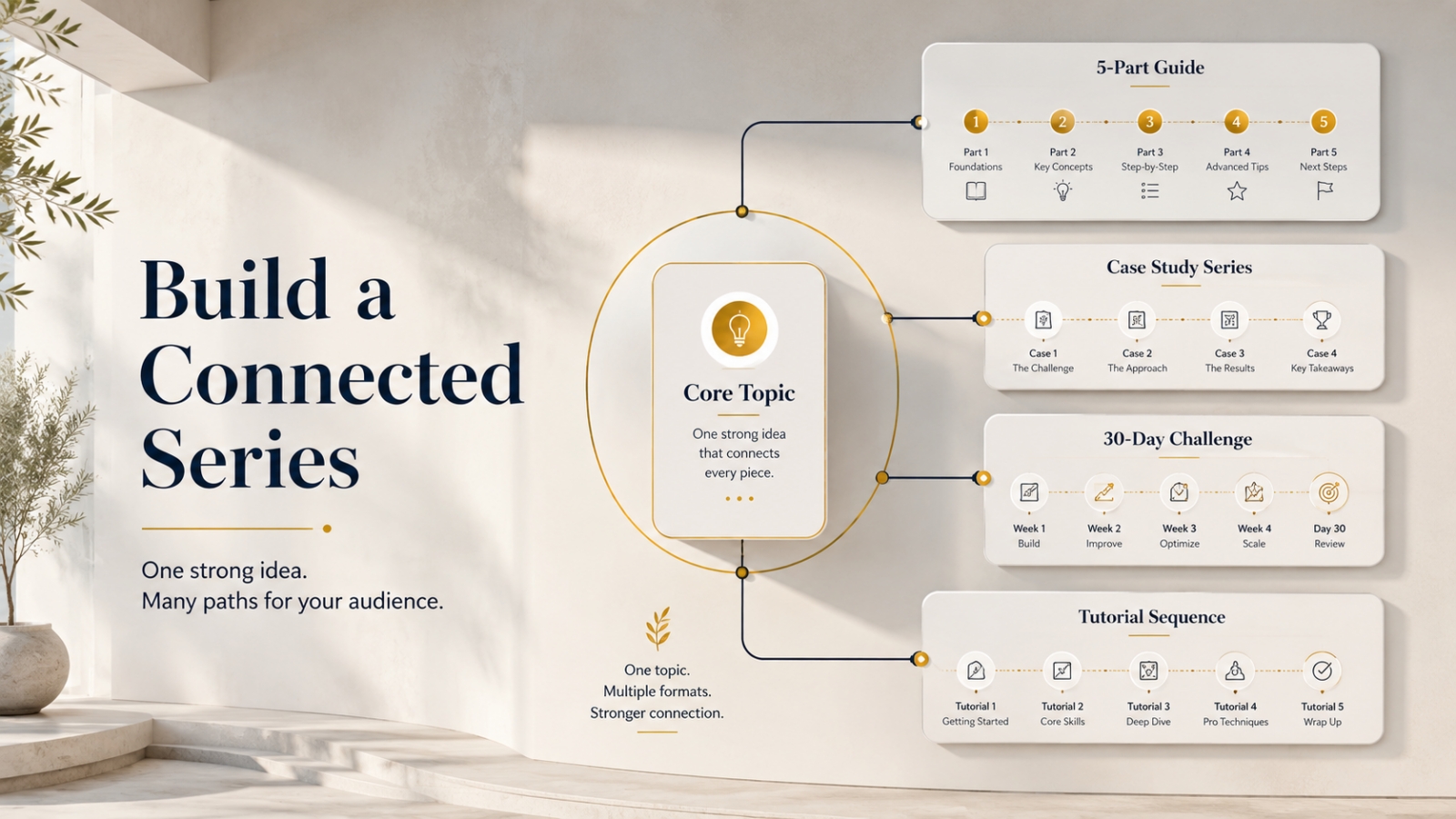
Option 1: 5-Part Beginner Guide
This works when the reader needs a clear introduction to a topic.
Best for:
- new bloggers
- beginners in a niche
- people who feel overwhelmed
- foundational topics
- step-by-step learning
Example:
5-Part Beginner Guide to Creating a Small Digital Product
- Choose one buyer problem
- Choose a simple product format
- Write the product promise
- Add only what supports the result
- Create a simple delivery path
This style is clear, structured, and easy to follow.
Option 2: Weekly Case Study Series
This works when you want to show a process over time.
Best for:
- building authority
- documenting your work
- showing real decisions
- teaching from examples
- making abstract ideas practical
Example:
Weekly Case Study: Building a Small Offer From One Checklist
Week 1: Choosing the checklist
Week 2: Defining the buyer problem
Week 3: Creating the product promise
Week 4: Adding support pieces
Week 5: Reviewing the final offer
This style builds trust because readers see the process.
Option 3: 30-Day Challenge
This works when the reader needs momentum and simple action.
Best for:
- reactivation
- consistency
- habit building
- audience engagement
- simple daily or weekly steps
Example:
30-Day Blog Reset Challenge
Week 1: Review
Week 2: Refresh
Week 3: Reconnect
Week 4: Continue
You can break each week into smaller prompts if needed.
This style works well when the reader needs structure and encouragement.
Option 4: Step-by-Step Tutorial Sequence
This works when the reader needs to complete a practical task.
Best for:
- technical or process-based topics
- templates
- product creation
- writing workflows
- setup guides
Example:
Step-by-Step Tutorial: Turn One Old Post Into a Lead Magnet
- Choose the old post
- Identify the useful idea
- Turn the idea into a checklist
- Add instructions
- Create the signup page
- Write the welcome email
This style is direct and implementation-focused.
Step 4: Give Each Part One Clear Job
A content series becomes weak when each part tries to do too much.
Each post should have one job.
For example, if Part 1 is about choosing a buyer problem, do not also teach product pricing, sales page writing, email marketing, and bonus creation.
Stay focused.
Part 1 should help the reader choose one buyer problem.
That is enough.
When every part has a clear job, the series feels easier to follow.
Clear Job Question
Ask:
What should this part help the reader understand, decide, or do?
If the answer has too many pieces, split the post.
Step 5: Connect the Series to Email, Resources, or an Offer
A content series becomes even stronger when it connects to the rest of your blog business system.
You can turn the series into:
- an email sequence
- a lead magnet
- a mini-course
- a workbook
- a product outline
- a content upgrade
- a future paid offer
- a webinar or workshop structure
For example, a 5-part beginner guide to small offers could lead to:
Starter Offer Planning Checklist
Or later:
Starter Offer Builder Kit
The series teaches the path.
The resource helps the reader apply it.
The offer helps them go deeper.
That is how content supports product growth.
Worked Example: A 5-Part Beginner Content Series
Let’s build a sample series.
Larger Reader Goal
Create a small starter offer from one simple idea.
Audience
Beginner bloggers, PLR buyers, or digital product creators who feel overwhelmed by big product ideas.
Series Title
The Simple Starter Offer Series
Part 1: Choose One Buyer Problem
Main lesson:
A small offer should begin with one specific problem, not a broad topic.
Reader action:
Write one buyer problem in a sentence.
Part 2: Pick a Simple Product Format
Main lesson:
The format should match the problem.
Examples:
- checklist
- worksheet
- template
- short guide
- starter kit
Reader action:
Choose one format that helps solve the problem.
Part 3: Write the Product Promise
Main lesson:
A strong promise shows the buyer what the offer helps them do.
Reader action:
Write one clear promise using:
This helps you [do X] without [common friction].
Part 4: Add Only What Supports the Result
Main lesson:
A small offer should include only what helps the buyer complete the promised step.
Reader action:
List what to include and what to leave out.
Part 5: Create the Next Step
Main lesson:
The buyer needs a simple next action after using the offer.
Reader action:
Write the delivery or next-step instruction.
Why This Series Works
It gives the reader a clear path.
It does not jump around.
It does not try to teach every part of digital product creation.
It helps the reader create one focused starter offer.
That is a strong content series.
How to Plan Your Own Content Series
Use this simple process.
Choose the Series Goal
Write the reader transformation.
Example:
Help readers turn one old blog post into a useful lead magnet.
Choose the Series Type
Pick one:
- beginner guide
- case study
- challenge
- tutorial sequence
Map the Parts
Write each part in order.
Example:
- Choose the old post
- Find the useful idea
- Create the checklist
- Add instructions
- Write the signup promise
Decide the Reader Action for Each Part
Each part should end with one action.
Example:
Part 1 action:
Choose one old post that still solves a useful problem.
Add the Connection
Decide where the series leads.
Example:
- email list signup
- worksheet
- checklist
- product
- related post
- mini-training
Now your content series has purpose.
What to Avoid When Creating a Content Series
Mistake 1: Making the Series Too Big
Do not start with a 25-part series unless you already have the capacity.
A 3-part or 5-part series is often enough.
Mistake 2: Choosing a Topic That Is Too Broad
A broad series becomes hard to finish.
Instead of:
Everything About Blogging
choose:
5 Steps to Restart Your Blog After a Quiet Season
Mistake 3: Repeating the Same Lesson in Every Part
Each part should add something new.
If the posts feel too similar, sharpen the job of each one.
Mistake 4: Forgetting the Next Step
A series should guide the reader forward.
Tell them what to read next, download next, or do next.
Mistake 5: Not Using the Series After Publishing
A series can become more than posts.
Turn it into an email sequence, guide, lead magnet, or product outline.
Do not let it sit in the archive.
Quick Exercise: Plan a Simple Content Series
Use this worksheet.
My Larger Reader Goal Is:
[Write the larger outcome.]
My Series Style Is:
[5-part beginner guide / weekly case study / 30-day challenge / step-by-step tutorial sequence.]
My Series Title Is:
[Write title.]
Part 1:
Title: [Write title.]
Job: [What this part helps the reader do.]
Reader action: [One action.]
Part 2:
Title: [Write title.]
Job: [What this part helps the reader do.]
Reader action: [One action.]
Part 3:
Title: [Write title.]
Job: [What this part helps the reader do.]
Reader action: [One action.]
Part 4:
Title: [Write title.]
Job: [What this part helps the reader do.]
Reader action: [One action.]
Part 5:
Title: [Write title.]
Job: [What this part helps the reader do.]
Reader action: [One action.]
The Series Will Lead To:
[Email signup / checklist / worksheet / offer / related resource / next series.]
This gives you a simple series plan.
Final Thought: A Series Builds a Stronger Path
A content series helps your blog feel more connected.
Instead of publishing one isolated post after another, you give readers a path.
A path builds trust.
It helps readers understand your topic more deeply.
It makes your content easier to reuse in emails, products, guides, and challenges.
And it helps you build authority because readers can see your thinking unfold step by step.
Start small.
Choose one reader goal.
Break it into a few useful parts.
Give each part one clear job.
Then connect the series to a resource, email sequence, or offer.
That is how a simple content series becomes more than content.
It becomes a guided growth asset.
Use This With Blogger’s Success Toolkit
If you already own Blogger’s Success Toolkit, log in to the Blogger Success Blueprint members area and choose one larger topic you can turn into a short content series.
Start with a 3-part or 5-part series, give each part one clear job, and decide where the series should lead next.
Members Login:
https://bloggersuccessblueprint.com/members/
New to Blogger’s Success Toolkit?
Blogger’s Success Toolkit gives you a beginner-friendly path to choose your direction, plan useful content, write stronger titles, and begin building your blog or product path with more structure.