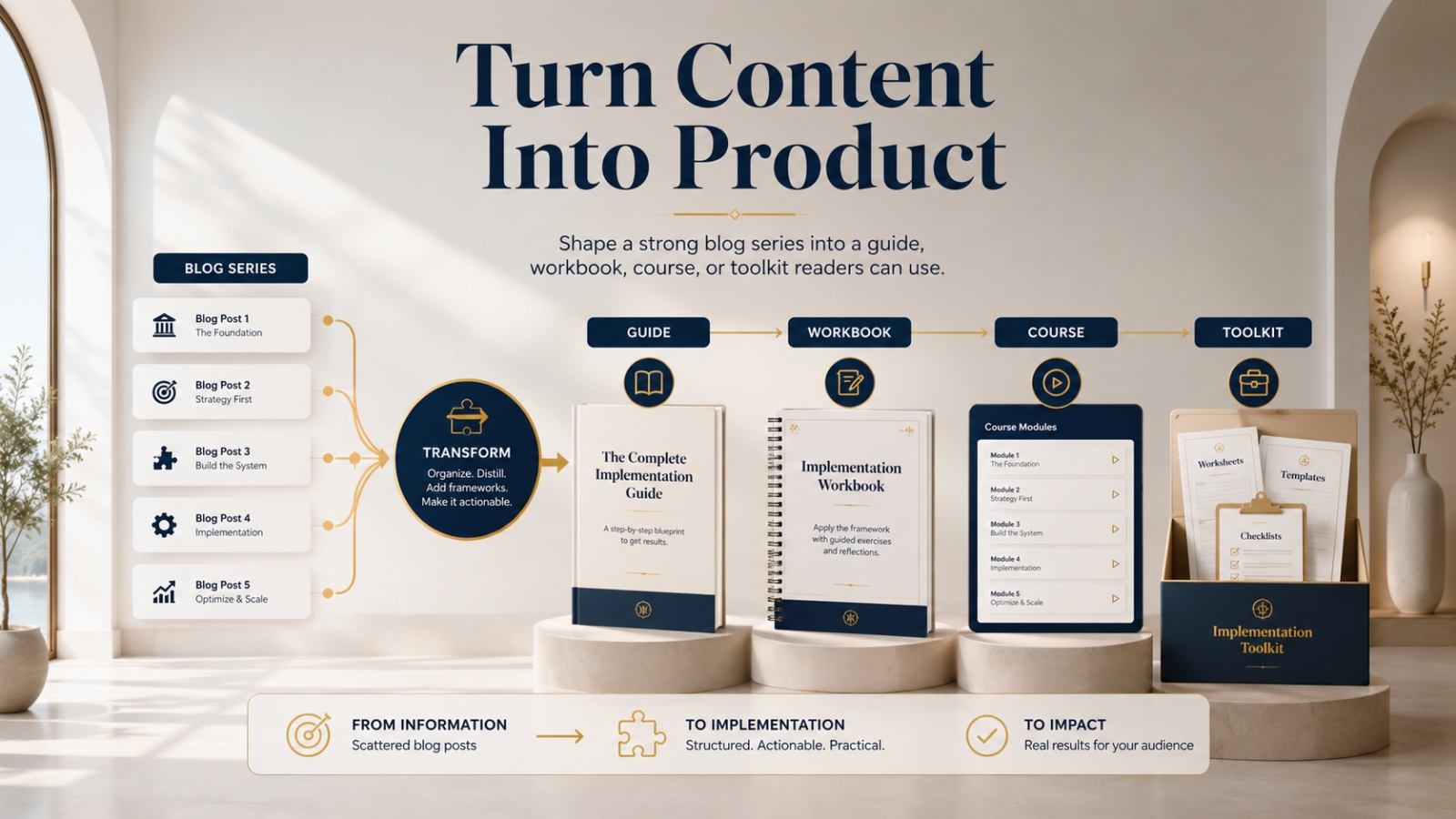
How to shape a strong blog series into a guide, workbook, course, or toolkit your readers can use.
A blog series is more than a group of related posts.
It can be the early shape of a digital product.
That is one of the most useful things about creating connected content.
You are not only publishing articles.
You are testing ideas.
Teaching a path.
Seeing what readers care about.
Building examples.
Creating structure.
Discovering where people need more help.
And when a series is strong, it may become something bigger.
A guide.
A workbook.
A short course.
A toolkit.
A checklist pack.
A mini-training.
But here is the important part.
A product is not just your blog posts copied into a PDF.
A product should help the buyer apply the ideas with more clarity, structure, and support.
That is the shift.
A blog series teaches.
A digital product helps the buyer implement.
Why a Blog Series Can Become a Product
A blog series already has something many product ideas lack.
Structure.
If your series moves readers through a clear path, you already have the beginning of a product framework.
For example, a series about creating a small starter offer may teach:
- choose one buyer problem
- pick the right product format
- write the product promise
- decide what to include
- create the next step
That is not random content.
That is a product path.
The blog version gives the reader useful teaching.
The product version can give them the tools to complete the process.
That is where value grows.
The Big Mistake Bloggers Make
The big mistake is thinking repurposing means copying and pasting.
A blogger takes five posts, combines them into one document, adds a cover, and calls it a product.
That may be a start.
But it is usually not enough.
Why?
Because readers can already read the posts.
If the product does not add anything useful, it may not feel worth buying.
A strong product needs added value.
That added value can include:
- clearer sequence
- worksheets
- templates
- examples
- checklists
- action steps
- progress tracking
- implementation prompts
- bonus resources
- simplified instructions
The product should make the blog series easier to use.
Not just easier to download.
The Blog-Series-to-Product Framework
Use this five-step framework:
- Identify the transformation
- Choose the best product format
- Reorganize the series into a product path
- Add implementation tools
- Create a clear delivery experience
This helps you turn content into a usable product, not just a content bundle.
Step 1: Identify the Transformation
Before turning a blog series into a product, name the transformation.
Ask:
What should the buyer be able to do by the end?
This matters because the product needs a result.
Not a vague topic.
For example:
Weak product idea:
Small Offer Content Pack
Clearer transformation:
Plan one small starter offer with a clear buyer problem, format, promise, and next step.
That is stronger.
It tells the buyer what the product helps them complete.
Transformation Examples
A blog series about refreshing old posts could become:
Refresh one old blog post with a stronger title, intro, examples, formatting, and next step.
A blog series about restarting a blog could become:
Complete one 30-day blogging reset plan and choose the next focused step.
A blog series about content storytelling could become:
Add one purposeful story to a blog post so the lesson becomes easier to understand and remember.
The transformation guides the product.
Step 2: Choose the Best Product Format
Not every blog series should become the same type of product.
The format should match the buyer’s need.
A strong blog series can become:
- a guide
- a workbook
- a course
- a toolkit
- a checklist pack
Each format has a different purpose.
Option 1: Turn It Into a Guide
Best when the buyer needs clear explanation.
A guide works well if your series teaches concepts, frameworks, and examples.
Example:
The Small Starter Offer Guide
Includes:
- refined teaching chapters
- examples
- common mistakes
- step-by-step explanation
- next action after each chapter
A guide is good when readers need understanding before action.
Option 2: Turn It Into a Workbook
Best when the buyer needs to think, plan, and fill things in.
A workbook works well when your series includes decisions, prompts, and exercises.
Example:
Starter Offer Planning Workbook
Includes:
- buyer problem worksheet
- format selection prompts
- product promise exercise
- include/leave-out checklist
- next-step planning page
A workbook is good when the buyer needs to create something.
Option 3: Turn It Into a Course
Best when the buyer needs guided lessons in sequence.
A course works well when each part of the series can become a short lesson.
Example:
Create Your First Starter Offer Mini-Course
Includes:
- video or text lessons
- action steps
- examples
- downloads
- short assignments
A course is good when readers need guided learning over time.
Option 4: Turn It Into a Toolkit
Best when the buyer needs practical tools.
A toolkit works well when your series can be supported by templates, checklists, and swipe files.
Example:
Starter Offer Builder Toolkit
Includes:
- planning worksheet
- offer promise template
- checklist
- product format selector
- sales page outline
- delivery checklist
A toolkit is good when the buyer wants implementation support.
Option 5: Turn It Into a Checklist Pack
Best when the buyer needs quick action.
A checklist pack works well when the process can be broken into simple review points.
Example:
Small Offer Checklist Pack
Includes:
- problem clarity checklist
- format fit checklist
- product promise checklist
- bonus fit checklist
- final offer review checklist
A checklist pack is good when buyers want a fast, practical support tool.
Step 3: Reorganize the Series Into a Product Path
A blog series is written for reading.
A product is designed for use.
That means you may need to reorganize the content.
Blog posts often include:
- introductions
- stories
- SEO sections
- context
- repeated explanations
- blog-style transitions
A product needs:
- clear modules or chapters
- direct instructions
- action steps
- worksheets
- examples
- progress order
- support tools
So do not simply paste the posts in the same form.
Reshape them.
Example Product Path
If your blog series is:
- Choose one buyer problem
- Pick a product format
- Write the product promise
- Add only what supports the result
- Create the next step
Your product structure could become:
Module 1: Clarify the Buyer Problem
Outcome:
The buyer chooses one specific problem their small offer will solve.
Module 2: Select the Right Format
Outcome:
The buyer chooses whether the offer should be a guide, checklist, template, workbook, or starter kit.
Module 3: Write the Product Promise
Outcome:
The buyer writes one clear promise for the offer.
Module 4: Build the Offer Contents
Outcome:
The buyer decides what to include and what to leave out.
Module 5: Prepare the Next Step
Outcome:
The buyer creates a simple delivery or action path after purchase.
Now the series has become a product path.
Step 4: Add Implementation Tools
This is where the product becomes more valuable than the blog series.
Implementation tools help the buyer do the work.
They may include:
- worksheets
- templates
- checklists
- examples
- prompts
- scripts
- swipe files
- planners
- trackers
- resource lists
For a blog series about small offers, you could add:
- Buyer Problem Worksheet
- Product Format Selector
- Product Promise Template
- Include/Leave-Out Checklist
- Starter Offer Example Pack
- Final Offer Review Checklist
These tools help the buyer apply the lessons.
That is product value.
Implementation Tool Question
Ask:
What would make this easier for the buyer to complete?
That answer tells you what tools to add.
Do not add tools just to make the product look larger.
Add tools that reduce friction.
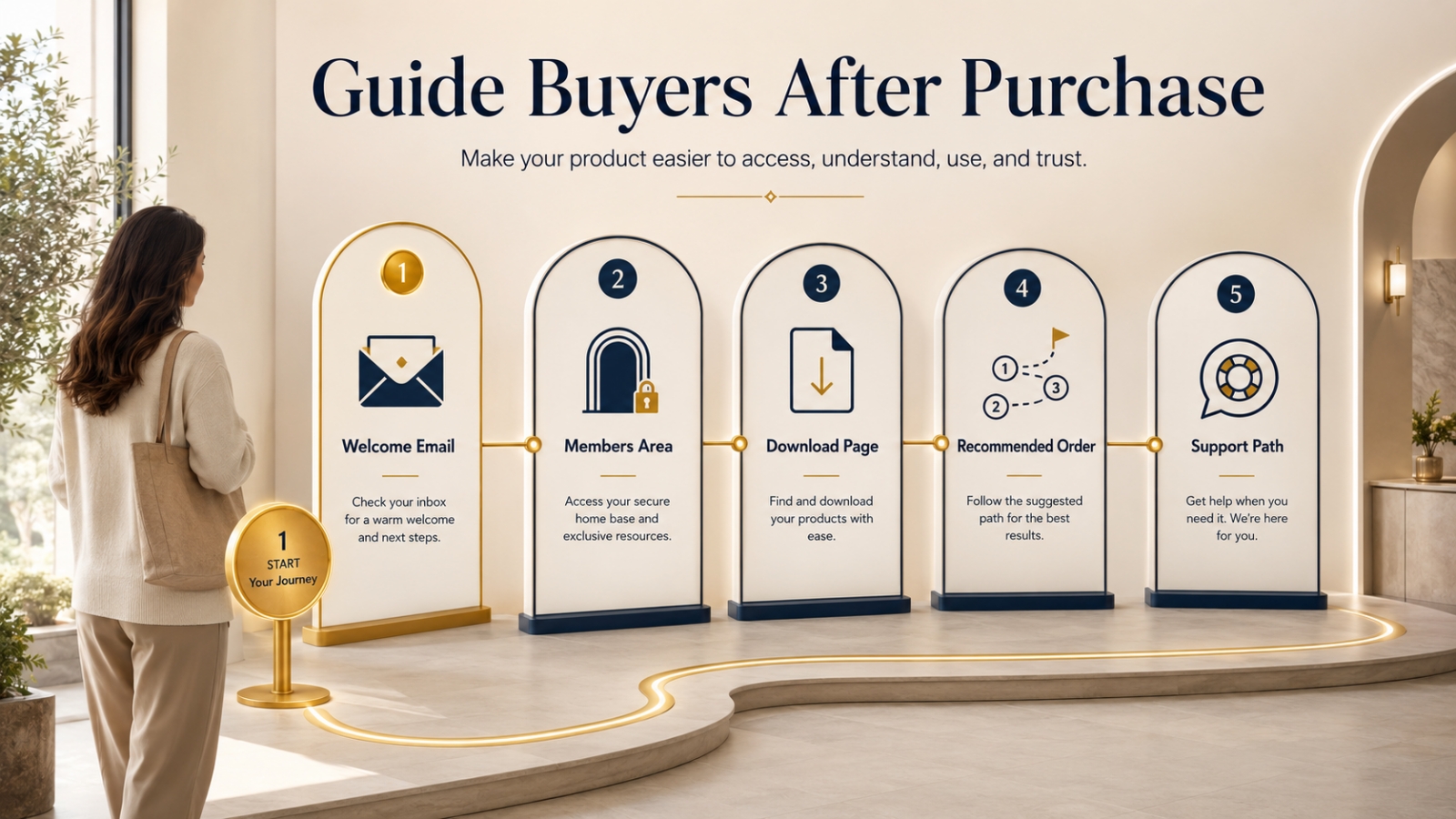
Step 5: Create a Clear Delivery Experience
A product should feel easy to use.
The buyer should know where to begin.
They should not open the product and think:
“This looks useful, but what do I do first?”
A clear delivery experience can include:
- a welcome note
- start-here page
- recommended order
- module list
- download links
- action checklist
- simple progress path
- final completion step
This matters because product experience is part of product value.
A well-organized product feels more professional.
It also helps the buyer follow through.
Simple Delivery Structure
For a small product, you can use:
Start Here
Brief note explaining what the product helps them do.
Step 1
Complete the buyer problem worksheet.
Step 2
Choose the product format.
Step 3
Write the product promise.
Step 4
Build the included pieces.
Step 5
Review the offer and choose the next action.
That is simple.
And simple is good.
Worked Example: Turning a Blog Series Into a Toolkit
Let’s use a blog series example.
Blog Series
The Simple Starter Offer Series
Posts:
- Choose One Buyer Problem
- Pick a Simple Product Format
- Write the Product Promise
- Add Only What Supports the Result
- Create the Next Step
Product Idea
Starter Offer Builder Toolkit
Product Transformation
Help the buyer plan one small starter offer with a clear buyer problem, format, promise, included pieces, and next step.
Product Format
Toolkit.
Why?
Because the buyer does not only need explanation.
They need worksheets, templates, and checklists to build the offer.
Product Structure
Part 1: Buyer Problem Clarity
Includes:
- short lesson
- buyer problem worksheet
- example buyer problems
Part 2: Product Format Selection
Includes:
- format selector
- guide/checklist/template/workbook comparison
- format fit checklist
Part 3: Product Promise Writing
Includes:
- promise formula
- fill-in-the-blank prompts
- before-and-after examples
Part 4: Offer Contents Planner
Includes:
- what-to-include worksheet
- what-to-leave-out checklist
- simple value stack page
Part 5: Next Step and Delivery
Includes:
- delivery checklist
- buyer next-step prompt
- final offer review checklist
Why This Product Works
It does not simply bundle the blog posts.
It turns the teaching into an implementation system.
The reader can now do the work.
They can complete worksheets.
They can make decisions.
They can finish with a clear starter offer plan.
That is what makes it a product.
How to Decide What Product Your Series Should Become
Use this simple guide.
If the Series Explains a Topic
Turn it into a guide.
Example:
Beginner’s Guide to Small Starter Offers
If the Series Helps Readers Make Decisions
Turn it into a workbook.
Example:
Starter Offer Planning Workbook
If the Series Teaches Step by Step
Turn it into a course.
Example:
Create Your First Starter Offer Mini-Course
If the Series Needs Templates and Tools
Turn it into a toolkit.
Example:
Starter Offer Builder Toolkit
If the Series Is Action-Based
Turn it into a checklist pack.
Example:
Small Offer Action Checklist Pack
Choose the format that helps the buyer get the result.
Not the format that sounds most impressive.
What to Add Beyond the Blog Posts
Here are simple value additions.
Add Worksheets
Help buyers apply the lesson.
Example:
Buyer Problem Worksheet.
Add Templates
Give buyers a starting structure.
Example:
Product Promise Template.
Add Checklists
Help buyers review their work.
Example:
Final Offer Review Checklist.
Add Examples
Make the idea easier to understand.
Example:
Three starter offer examples.
Add Instructions
Tell buyers how to use the product.
Example:
Start Here page.
Add Progress Steps
Help buyers complete the product.
Example:
Step 1 to Step 5 action path.
These additions make the product more useful than the free blog series.
What to Avoid
Mistake 1: Copying Blog Posts Without Adding Usefulness
A product should help buyers apply the ideas.
Add tools, structure, examples, or action steps.
Mistake 2: Making the Product Too Big
Do not turn a simple series into a giant product if the buyer only needs a focused result.
Keep the product aligned with the transformation.
Mistake 3: Choosing the Wrong Format
A workbook is better than a guide if the buyer needs to fill in answers.
A toolkit is better than a course if the buyer needs practical tools.
Match the format to the need.
Mistake 4: Forgetting the Start-Here Page
Buyers should know how to use the product.
A short start-here page can improve the whole experience.
Mistake 5: Leaving Out the Final Result
Make it clear what the buyer should have by the end.
A product without a visible result feels less complete.
Quick Exercise: Turn One Blog Series Into a Product
Use this worksheet.
My Blog Series Is:
[Write the series name.]
The Series Helps Readers:
[Write the main reader goal.]
The Product Transformation Is:
By the end, the buyer will:
[Write the result.]
The Best Product Format Is:
[Guide / workbook / course / toolkit / checklist pack.]
The Product Sections Will Be:
- [Section 1.]
- [Section 2.]
- [Section 3.]
- [Section 4.]
- [Section 5.]
Implementation Tools I Can Add:
- [Worksheet.]
- [Template.]
- [Checklist.]
- [Example.]
- [Prompt.]
- [Start-here page.]
The Buyer’s Final Result Will Be:
[Write what the buyer has, decides, creates, or completes.]
This gives you the first product plan.
Final Thought: Your Blog Series May Already Be Product Material
A strong blog series can become more than content.
It can become a product.
A guide.
A workbook.
A course.
A toolkit.
A checklist pack.
But the goal is not to sell the same posts in a different wrapper.
The goal is to turn the series into a clearer implementation path.
Your blog series teaches the idea.
Your product helps the buyer apply it.
That is the difference.
So look at your strongest series.
What transformation does it support?
What format would help the reader best?
What worksheets, templates, examples, or checklists would make the process easier?
Answer those questions, and you may find your next digital product is already taking shape inside your blog.
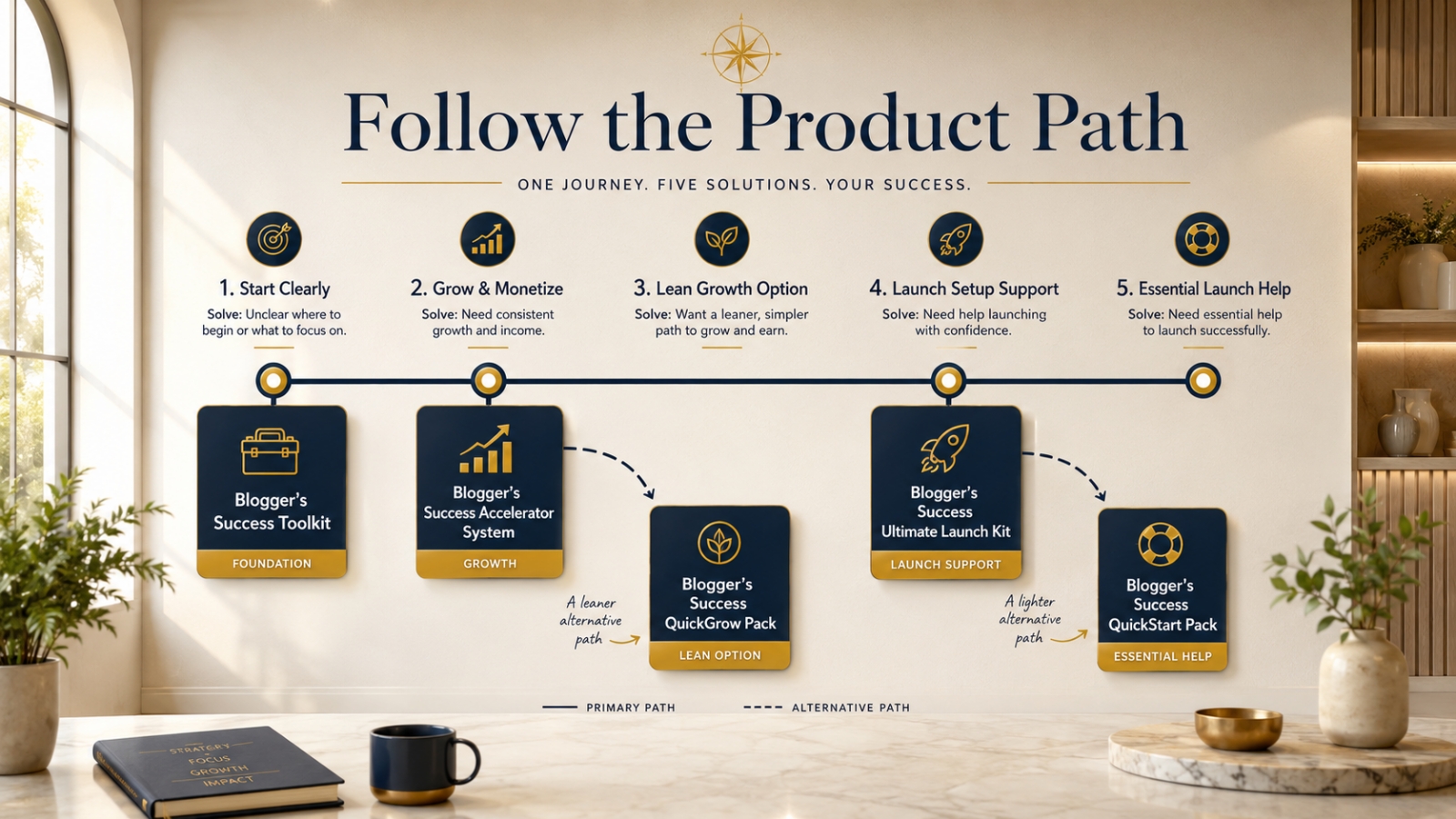
Use This With Blogger’s Success Toolkit
If you already own Blogger’s Success Toolkit, log in to the Blogger Success Blueprint members area and choose one blog series you can turn into a product.
Start by naming the transformation, choosing the format, organizing the product path, and adding implementation tools.
Members Login:
https://bloggersuccessblueprint.com/members/
New to Blogger’s Success Toolkit?
Blogger’s Success Toolkit gives you a beginner-friendly path to choose your direction, plan useful content, write stronger titles, and begin building your blog or product path with more structure.
Learn More About Blogger’s Success Toolkit
Featured Image Guidelines
Blog Post: How to Turn a Blog Series Into a Digital Product
Tagline: Shape a strong blog series into a guide, workbook, course, or toolkit readers can use.
Creative Featured Image Direction:
Create a premium, realistic blog header image that feels like a calm content-to-product creation studio.
Show a connected blog series being transformed into digital product formats. Include visual cues such as:
- Blog Series
- Guide
- Workbook
- Course
- Toolkit
Use a creative visual metaphor such as:
- a sequence of blog posts flowing into one polished product package
- content cards being organized into a workbook or toolkit
- a product assembly path where lessons become worksheets, templates, and checklists
- a refined transformation wall showing “Posts” becoming “Product”
Avoid clutter, messy desks, laptops, dashboards, busy product stacks, and anything that looks like copying blog posts into a PDF without adding value.
Use brand colors tastefully:
- dark navy blue #132636 for structure, labels, or product path
- gold #de9f00 for the transformation highlight, finished product marker, or implementation tools
The image should feel strategic, premium, and practical — showing that a blog series becomes a product when it is shaped into a usable implementation path.
Most Suitable Text Overlay:
Turn Content Into Product
Best File Name:
turn-blog-series-into-digital-product.jpg
Excellent, Peter — Week 62 is a key product-growth lesson. I’ll make it about honest offer clarity: make the promise visible quickly, explain the problem it helps solve, and also help readers understand that clarity means attracting the right buyers, not forcing everyone to buy.
Polish checks completed: this version uses clear Block 8 Week 62 positioning, SEO Tags, an offer-promise framework, honest-fit messaging, product clarity examples, and a simple featured image guideline section.
Block / Week / Topic
Block / Week: Block 8, Week 62
Topic: Why Your Product Needs a Clear Promise
Message Focus: Offer clarity
Core Idea: Buyers need to quickly understand what the product helps them do and what problem it helps resolve — not just what files, features, or modules are included. A clear promise should be honest upfront, and if the product is not a fit for the buyer’s problem, that is okay.
Blog Post Setup
Parent Category: Authority & Long-Term Growth
Category: Authority & Growth
Category Description: Authority & Growth helps readers strengthen their blog’s credibility, deepen audience trust, and build long-term growth assets. This category covers advanced content strategy, authority positioning, expert-style content, product expansion, audience trust, and sustainable ways to grow beyond the beginner stage.
SEO Tags: product promise, offer clarity, digital product strategy, product positioning, sales page clarity, buyer problem, product benefits, honest marketing, offer positioning, digital product creation, authority and growth, Blogger Success Blueprint
Slug: why-your-product-needs-a-clear-promise
Recommended Email Subject
Can buyers understand your product promise quickly?
Alternative Subject Lines
- Your product needs more than a file list
- Make the promise clear before listing features
- Buyers need to know what your product helps them do
- A clear promise makes your offer easier to trust
- The honest way to explain your product
Hi {{ subscriber.first_name | capitalize }},
A buyer should not have to work hard to understand your product.
Before they care about the files, templates, lessons, or bonuses, they want to know one thing:
What will this help me do?
That is why your product needs a clear promise.
For example, instead of leading with:
“Includes 12 PDFs, 5 templates, 3 checklists, and 2 bonus guides.”
You could first say:
“This helps you plan one small starter offer with a clear buyer problem, product promise, and simple delivery path.”
Now the buyer understands the result.
Then the files make more sense.
A clear promise is not about hype.
It is about honesty.
If the product solves their problem, they can see the fit quickly.
If it does not, they can move on without confusion.
I wrote a full guide on Blogger Success Blueprint showing why your product needs a clear promise before the feature list.
You can read it here:
[Insert Blog Post Link]
Regards,
Peter Teo
Why Your Product Needs a Clear Promise
How to help buyers quickly understand what your product helps them do, what problem it supports, and whether it is the right fit.
A product can include many useful things and still feel confusing.
It can have guides.
Templates.
Checklists.
Worksheets.
Bonuses.
Examples.
Videos.
Swipe files.
Resource lists.
All of that may be valuable.
But if the buyer does not quickly understand what the product helps them do, the offer can feel unclear.
That is why your product needs a clear promise.
A promise tells the buyer:
This is what this product helps you move toward.
It does not need to be loud.
It does not need to be exaggerated.
It does not need to claim everything.
In fact, the best promise is honest, specific, and easy to understand.
It helps the right buyer see the fit quickly.
And if the product is not for their current problem, that is okay too.
Good offer clarity is not about convincing everyone.
It is about helping the right people make a confident decision.
Why a Clear Promise Matters
Buyers do not start by caring about your file list.
They start by caring about their problem.
They are wondering:
- Is this for me?
- Does this solve the problem I have now?
- Will this help me take the next step?
- Do I understand what I will be able to do?
- Is this too advanced, too basic, or just right?
- Can I trust the person explaining it?
A clear promise answers those questions faster.
It gives the buyer a simple reason to keep reading.
Without a clear promise, the buyer may see a long list of features and still feel unsure.
They may think:
“This includes a lot… but what does it actually help me do?”
That is not the buyer’s fault.
That is an offer clarity problem.
The Big Mistake Product Creators Make
The big mistake is leading with the inventory instead of the outcome.
Many creators start by listing everything inside the product:
- 10 guides
- 20 templates
- 5 checklists
- 3 bonus modules
- 50 prompts
- 12 worksheets
Those details can be useful later.
But they should not carry the whole offer.
A feature list tells buyers what they receive.
A promise tells buyers why it matters.
For example:
Feature-First Message
You get 12 worksheets, 5 templates, 3 checklists, and a bonus planning guide.
This tells the buyer what is included.
But the buyer may still wonder what it helps them accomplish.
Promise-First Message
This helps you plan one small starter offer with a clear buyer problem, product format, promise, and next step.
Now the buyer understands the purpose.
After that, the worksheets and templates make more sense.
The features support the promise.
They do not replace it.
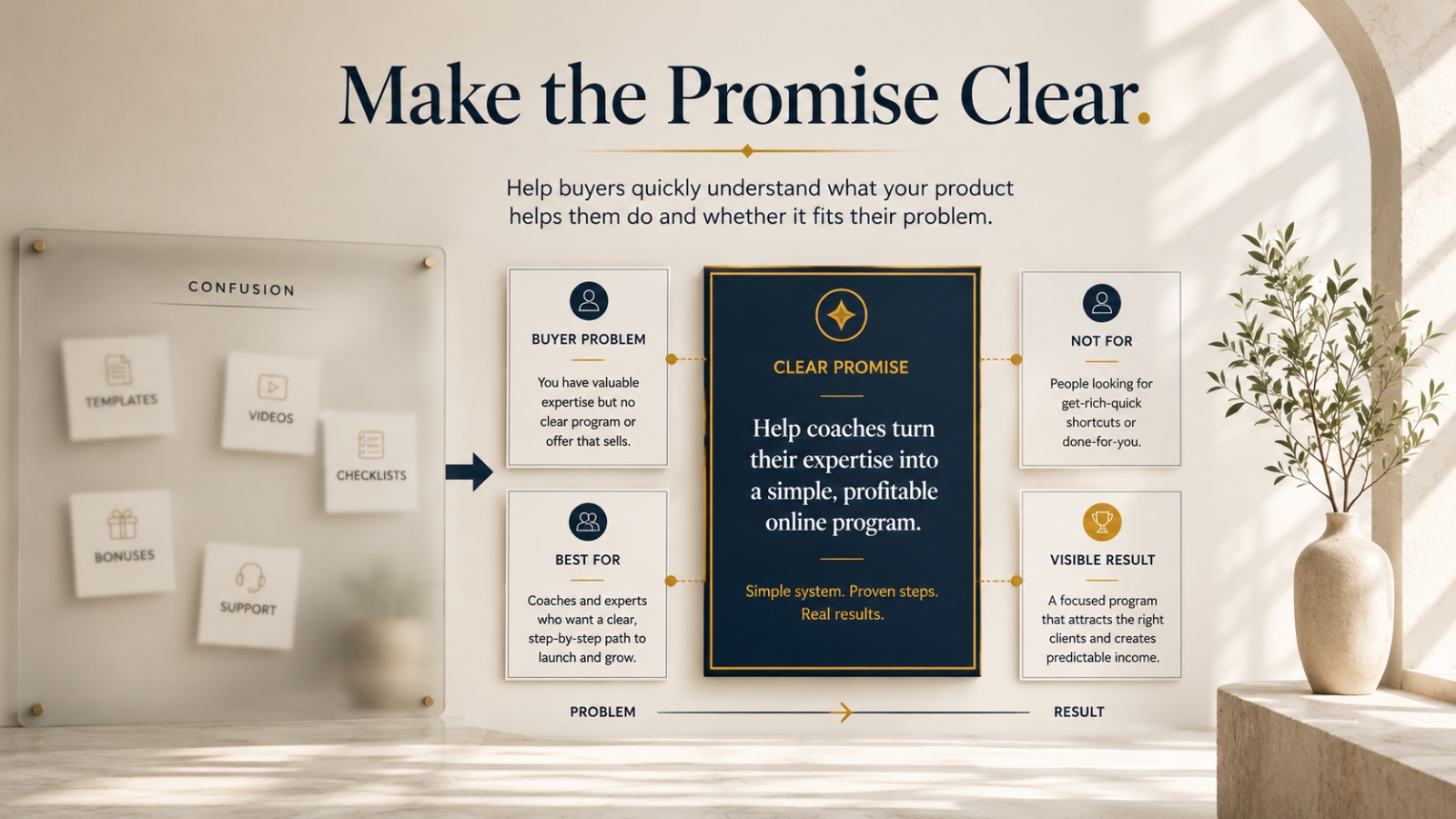
The Clear Promise Framework
Use this simple framework:
- Name the buyer problem
- Name the useful outcome
- Show the movement
- Define who it is for
- Be honest about who it is not for
This helps your promise become clear without becoming hype.
Step 1: Name the Buyer Problem
A clear promise begins with the buyer’s problem.
Not your product.
Not your file count.
Not your bonus stack.
The buyer’s problem.
For example:
- They have a product idea but cannot explain it clearly.
- They have PLR content but it sounds too generic.
- They have old blog posts but do not know what to refresh.
- They want to reconnect with their email list but feel awkward.
- They have too many ideas and no simple offer path.
- They have a blog series but do not know how to turn it into a product.
When you name the problem clearly, the right buyer feels seen.
They think:
“Yes, that is what I am dealing with.”
That moment matters.
Problem Question
Ask:
What problem is the buyer trying to solve when they look at this product?
If you cannot answer that clearly, the product promise will be weak.
Step 2: Name the Useful Outcome
The outcome tells the buyer what the product helps them do.
This should be practical and specific.
Not vague.
For example:
Weak outcome:
Improve your digital business.
Clearer outcome:
Plan one small starter offer with a clear promise and simple structure.
Weak outcome:
Create better content.
Clearer outcome:
Turn one blog series into a guide, workbook, course, or toolkit.
Weak outcome:
Grow your authority.
Clearer outcome:
Build trust by using research, experience, clarity, documentation, and helpful guidance in your content.
A useful outcome gives the buyer something they can picture.
Outcome Question
Ask:
After using this product, what should the buyer be able to do, decide, create, or improve?
That answer belongs near the top of your offer.
Step 3: Show the Movement
A promise becomes stronger when it shows movement.
The buyer is moving from one state to another.
Examples:
- From scattered ideas to one focused offer
- From generic PLR to more original product content
- From old posts to refreshed content assets
- From email silence to one helpful reconnection note
- From a blog series to a usable digital product
- From confusion to a clear next step
This movement helps buyers understand the transformation.
Information tells them what is inside.
Transformation shows what changes.
Movement Formula
Use this formula:
This helps you move from [starting state] to [desired state] without [common friction].
Examples:
This helps you move from a vague product idea to one clear starter offer without building a huge product first.
This helps you move from an old weak blog post to a refreshed article with a stronger title, intro, examples, formatting, and next step.
This helps you move from a quiet email list to one helpful reconnection message without writing a long apology.
You do not have to use the formula word for word.
But the thinking behind it is useful.
Starting state.
Desired state.
Reduced friction.
That is a strong promise.
Step 4: Define Who It Is For
A clear promise should help the right buyer self-identify.
Do not be afraid to say who the product is for.
For example:
This is for beginner digital product creators who have ideas, PLR content, or templates but need help turning them into one small focused offer.
That is clearer than:
This is for everyone who wants to make money online.
A good “who it is for” statement makes the offer feel more trustworthy.
It shows that you are not trying to sell to everyone.
Fit Question
Ask:
Who has the exact problem this product is designed to help with?
Write that clearly.
Step 5: Be Honest About Who It Is Not For
This is where trust grows.
A clear promise should not pretend the product is right for every buyer.
If it is not a fit, say so.
That may feel risky, but it builds credibility.
For example:
This is not for you if you are looking for advanced funnel strategy, paid ads training, or a complete business automation system. This is for creating one clear starter offer first.
That kind of honesty helps the right buyer feel safer.
It also reduces disappointment.
A buyer who needs advanced support should not buy a beginner starter kit and feel misled.
Offer clarity protects both sides.
Not-For Question
Ask:
Who would not be served well by this product right now?
This helps you set honest boundaries.
The 3-Second Promise Test
Your product promise should be visible quickly.
In a few seconds, the buyer should understand:
- what the product helps with
- who it is for
- what problem it addresses
- what result it supports
This is not about using loud hype.
It is about making the value easy to see.
Weak 3-Second Message
The Ultimate Digital Product Toolkit
This sounds big, but it does not explain enough.
Stronger 3-Second Message
Plan one small starter offer from your ideas, PLR content, or templates — without building a huge product first.
This is clearer.
The buyer knows what the product helps them do.
Weak 3-Second Message
Content Growth Bundle
Vague.
Stronger 3-Second Message
Turn one strong blog series into a guide, workbook, course, or toolkit your readers can use.
Clearer.
The buyer can picture the result.
Weak 3-Second Message
Email Re-Engagement Pack
Better, but still incomplete.
Stronger 3-Second Message
Write one helpful reconnection email after a quiet season without overexplaining the silence.
Now the promise is specific.
What to Put Before the Feature List
Before listing the files, add a short promise section.
You can use this structure:
Product Promise
This helps you [do X] so you can [reach Y] without [common problem].
Best For
This is for [specific buyer] who wants to [specific outcome].
Not For
This is not for [buyer/problem mismatch].
What You Will Create or Complete
By the end, you will have [visible result].
Only after that should you list the files.
Now the features have context.
The buyer understands why each piece matters.
Worked Example: Clear Promise for a Small Offer
Let’s use a product example.
Product Name
Starter Offer Planning Checklist
Feature-First Version
Includes:
- 10-page checklist
- product idea worksheet
- offer promise prompts
- format selector
- final review page
This is useful, but incomplete.
Now let’s make it promise-first.
Promise-First Version
Starter Offer Planning Checklist helps beginner product creators turn one idea, PLR piece, or template into a small focused offer with a clear buyer problem, simple format, honest promise, and next step.
Best For
This is for beginners who feel overwhelmed by large product ideas and want to create one small offer first.
Not For
This is not for advanced sellers looking for full funnel strategy, paid advertising, or complex launch planning.
What You Will Complete
By the end, you will have one starter offer idea mapped with:
- buyer problem
- product format
- clear promise
- included pieces
- next step
What Is Included
- starter offer checklist
- buyer problem worksheet
- product format selector
- promise-writing prompt
- final offer review page
Now the feature list feels stronger because the buyer understands the purpose.
The files are not random.
They support the promise.
How to Rewrite a Feature Into a Promise
Here is a simple way to improve product messaging.
Feature
Includes a 20-page workbook.
Better Promise
Use the workbook to choose one buyer problem, plan your product format, and write a clear offer promise.
Feature
Includes 50 headline prompts.
Better Promise
Use the prompts to write clearer headline options without starting from a blank page.
Feature
Includes a bonus checklist.
Better Promise
Use the checklist to review your offer before publishing so the buyer’s next step is easier to understand.
Feature
Includes email templates.
Better Promise
Use the templates to write a helpful reconnection email after a quiet season without overexplaining the silence.
Features matter.
But they become stronger when you explain what they help the buyer do.
How Honest Clarity Improves Trust
Honest clarity means you do not oversell the product.
You explain the fit.
You explain the limit.
You make the promise specific.
You avoid pretending it solves every problem.
That kind of messaging can feel calmer and more premium.
It also attracts better-fit buyers.
A buyer who understands the promise is more likely to use the product properly.
A buyer who understands who it is not for is less likely to feel disappointed.
That is good business.
Honest Promise Examples
Instead of Saying:
This gives you everything you need to build a successful product business.
Say:
This helps you plan your first small starter offer so you can move from idea to clearer product structure.
Instead of Saying:
This product is perfect for everyone.
Say:
This is best for beginners who need one focused starting point, not advanced sellers looking for complex funnel strategy.
Instead of Saying:
You will get results fast.
Say:
This gives you a simple structure to make the next step easier to complete.
Honesty does not weaken the offer.
It strengthens trust.
What to Avoid When Writing a Product Promise
Mistake 1: Leading With the File List
Files are not the promise.
Explain the outcome first.
Then show the files that support it.
Mistake 2: Making the Promise Too Broad
A broad promise feels impressive but unclear.
Make the promise specific enough to picture.
Mistake 3: Promising a Result the Product Cannot Control
Do not promise outcomes that depend on the buyer’s effort, market, audience, or execution.
Promise what the product helps them do.
Mistake 4: Hiding Who It Is Not For
If the product is not a fit for certain buyers, say so.
This helps protect trust.
Mistake 5: Using Clever Names Without Clear Meaning
A clever product name is fine, but it still needs a clear promise.
Do not make buyers guess what the product does.
Quick Exercise: Write Your Product Promise
Use this worksheet.
My Product Is:
[Write product name.]
The Buyer Problem Is:
[Write the problem.]
The Product Helps the Buyer:
[Write what it helps them do.]
The Starting State Is:
[Where is the buyer before using it?]
The Desired State Is:
[Where should they be after using it?]
The Product Is Best For:
[Write who it is for.]
The Product Is Not For:
[Write who it is not for.]
The Visible Result Is:
[Write what the buyer will create, decide, complete, or improve.]
My Clear Product Promise Is:
[Write one clear promise.]
That one promise can improve your sales page, product page, email, and offer description.
Final Thought: Clarity Is Part of the Product Experience
A clear promise helps buyers understand your product quickly.
It tells them what problem the product supports.
It shows what the product helps them do.
It helps them decide whether it fits their current need.
And it gives your features a reason to matter.
That is why your product promise should appear before the file list.
Not because features are unimportant.
But because buyers need context first.
They need to know:
Is this for my problem?
Will this help me take the next step?
What will I be able to do with it?
Answer those questions honestly and early.
If the product is a fit, the buyer will understand faster.
If it is not, they can move on with clarity.
That is not a loss.
That is trust.
And trust is the foundation of long-term product growth.
Use This With Blogger’s Success Toolkit
If you already own Blogger’s Success Toolkit, log in to the Blogger Success Blueprint members area and review one product, offer, or resource description.
Before listing what is included, write one clear promise that explains what the product helps the buyer do, what problem it supports, and who it is best suited for.
Members Login:
https://bloggersuccessblueprint.com/members/
New to Blogger’s Success Toolkit?
Blogger’s Success Toolkit gives you a beginner-friendly path to choose your direction, plan useful content, write stronger titles, and begin building your blog or product path with more structure.