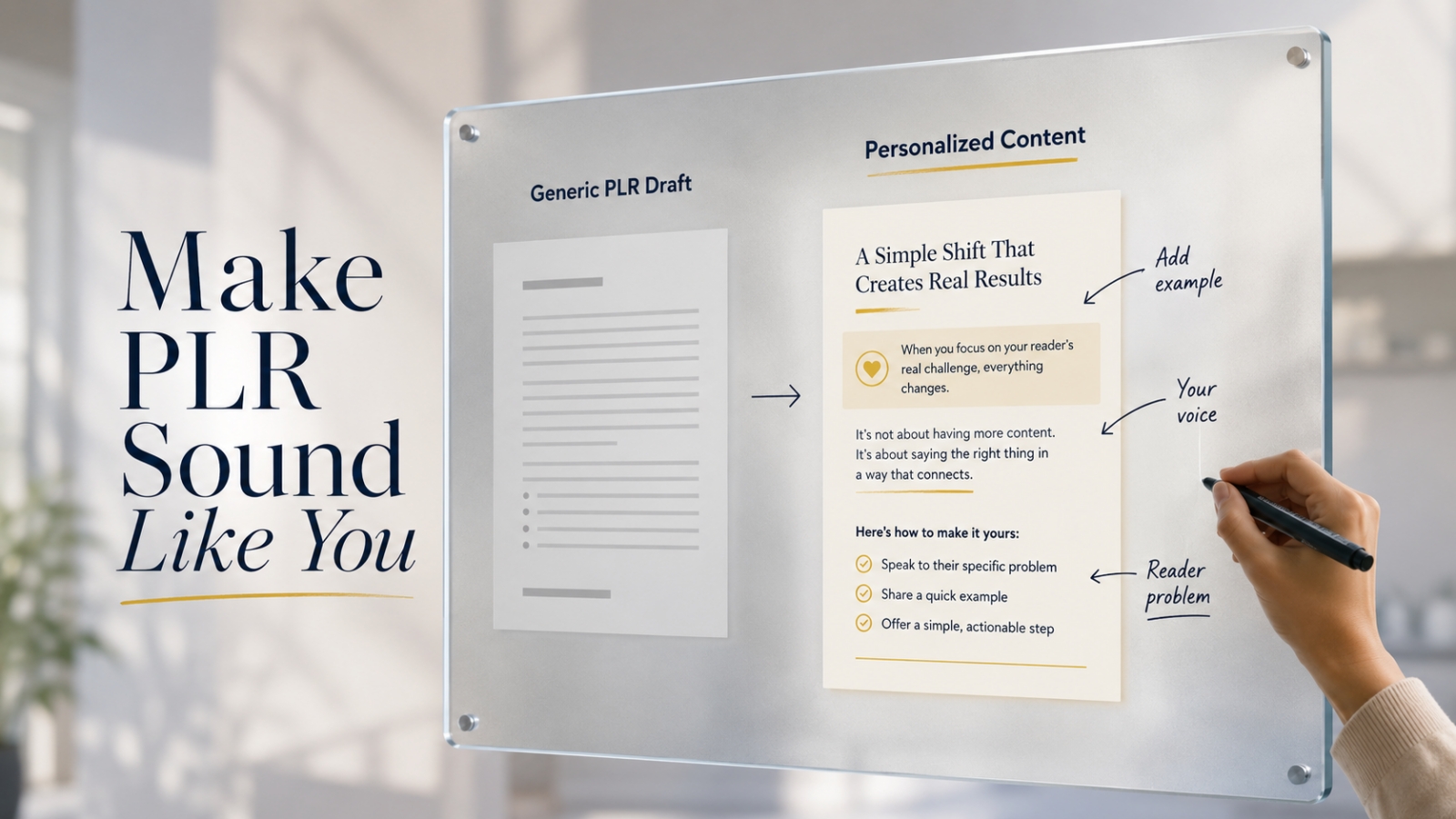
A simple guide to making PLR content feel personal, useful, and aligned with your audience.
PLR can save a lot of time.
But there is one trap.
If you use it exactly as it arrives, it can sound like everyone else’s content.
Same words.
Same examples.
Same plain voice.
Same “this could belong to anyone” feeling.
That is not what you want.
Good PLR should not feel like a finished painting you hang on the wall without touching it.
It is more like a strong pencil sketch.
The shape is already there.
But you still need to add the color, the detail, the warmth, and the point of view.
That is how PLR becomes useful, ethical, and much more valuable.
Why PLR Can Sound Generic
Most PLR is written for a broad audience.
That makes sense.
The original creator does not know your exact brand, your readers, your story, or your product path.
So the content often starts in a neutral place.
It may be correct.
It may be organized.
It may contain useful information.
But it may not feel personal yet.
That is where many buyers stop too early.
They see a ready-made document and think:
“This is done. I can publish it.”
Technically, maybe they can.
But strategically, they should slow down.
Readers can feel generic content.
They may not know exactly why it feels flat, but they sense it.
It lacks the small human details that make content feel alive.
For example, a generic guide may say:
Create a relaxing evening routine to improve sleep.
That is fine.
But it is also forgettable.
A more personal version could say:
If your evenings feel like a race from dinner to laundry to phone scrolling, your sleep routine does not need to be perfect. It just needs one calming signal that tells your body, “We are winding down.”
That sounds warmer.
It speaks to a real moment.
It feels like one person talking to another person.
That is the difference.
The Big Mistake Beginners Make
The big mistake is treating PLR like a finished product instead of a starting draft.
PLR can give you structure.
It can give you ideas.
It can help you move past the blank page.
But it should not replace your thinking.
If you use PLR without changing the voice, examples, promise, and reader angle, the content may feel distant.
It may sound polished, but not personal.
It may be useful, but not memorable.
And it may not connect clearly with your audience.
A better way is to ask:
How can I make this more useful to my specific reader?
That one question changes the way you use PLR.
You stop treating it like a file to publish.
You start treating it like material you can shape.
The Right Way to Think About PLR
PLR is not meant to replace your voice.
It is meant to give you a starting structure.
Think of PLR like a plain room.
The walls are up.
The floor is there.
The lights work.
But it does not feel like home yet.
To make it yours, you add the details:
- your colors
- your layout
- your furniture
- your photos
- your little habits
- your reason for using the room
Content works the same way.
The PLR gives you the room.
Your customization makes it feel lived in.
The PLR Personalization Framework
Here is a simple framework you can use before publishing, packaging, or sharing PLR content.
It has six steps:
- Clarify who the content is for
- Adjust the promise
- Add your voice
- Replace generic examples
- Add your point of view
- Match the content to your blog or product path
Let’s walk through each one.
Step 1: Clarify Who the Content Is For
Before editing the words, decide who the content is meant to help.
Do not aim at everyone.
Choose one clear reader.
For example, if the PLR topic is better sleep habits, the audience could be:
- busy parents
- shift workers
- college students
- stressed office workers
- new entrepreneurs
- people trying to reduce evening screen time
Each audience needs a slightly different angle.
A busy parent may need short, realistic routines.
A student may need help shutting down after late study sessions.
A shift worker may need tips that do not assume a normal bedtime.
Same PLR topic.
Different reader.
And once the reader changes, the content should change too.
Ask yourself:
Who exactly needs this content most?
Step 2: Adjust the Promise
A lot of PLR titles and introductions are broad.
Your job is to sharpen the promise.
A broad promise might be:
Improve Your Sleep Habits
A stronger promise might be:
Create a Simple Evening Routine That Helps You Wind Down Without Overhauling Your Whole Night
See the difference?
The second promise feels more specific.
It also feels more believable.
It speaks to a reader who wants help, but does not want a complicated routine.
When you adjust the promise, the whole piece becomes easier to position.
Ask yourself:
What does my reader really want from this content in real life?
Not in theory.
In real life.
Step 3: Add Your Voice
This is where PLR begins to feel less generic.
Your voice does not need to be loud or dramatic.
It just needs to sound like a real person.
You can add your voice by changing:
- stiff sentences into natural ones
- long paragraphs into shorter sections
- broad advice into reader-friendly guidance
- formal phrases into warmer language
- dull transitions into conversational ones
For example:
Generic:
Individuals should establish a consistent bedtime routine to promote improved sleep quality.
More natural:
Try giving your evening a simple rhythm. It does not need to be fancy. Even one repeatable habit can help your mind slow down.
The second version is easier to read.
It feels more supportive.
It also sounds less like a manual.
That matters.
Readers do not only respond to information.
They respond to tone.
Step 4: Replace Generic Examples
Examples are where PLR often feels weakest.
Generic examples may be technically correct, but they do not always feel close to the reader’s life.
If your PLR says:
Reduce stress before bed.
That is fine, but thin.
Make it more real.
For a busy parent, you might write:
After the children are finally asleep, it can be tempting to scroll your phone for an hour just to feel like you have a little time to yourself. That is understandable. But even five quiet minutes with dim lights and no screen can help your brain begin to slow down.
That feels more human.
It shows you understand the reader’s actual evening.
For a student, the example may change:
After a late study session, your mind may still feel switched on. Instead of jumping straight into bed, take five minutes to write down what you need to continue tomorrow.
Same topic.
Different example.
That is how PLR becomes more useful.
Step 5: Add Your Point of View
This is one of the most important steps.
PLR often tells people what to do.
Your point of view explains how you think about the topic.
For example, on better sleep habits, your point of view might be:
You do not need a perfect evening routine. You need a repeatable signal that helps your body understand the day is ending.
That is a simple belief.
It gives the content personality.
It also helps readers trust you because they can feel there is a person behind the advice.
You can add your point of view with lines like:
- The way I see it…
- A better way to think about this is…
- The mistake many people make is…
- This does not need to be complicated…
- Start smaller than you think…
These small phrases make the content feel guided instead of generic.
Step 6: Match the Content to Your Product or Blog
PLR should not sit by itself like a loose file.
It should fit into your bigger message.
Ask:
Where does this content belong in my reader’s journey?
For example, a sleep habits guide could be used as:
- a blog post
- a lead magnet
- a short email series
- a bonus inside a wellness product
- a worksheet inside a productivity course
The format depends on your goal.
If your blog helps stressed office workers build calmer daily routines, the sleep guide could support that message.
If your product teaches productivity, the sleep guide may become a bonus about energy and focus.
When the PLR fits your bigger path, it feels intentional.
When it does not, it feels random.
Worked Example: Customizing a Sleep Habits PLR Guide
Let’s walk through a simple example.
Imagine you have a PLR guide called:
Better Sleep Habits
That title is okay, but broad.
The content may include tips like:
- keep a regular bedtime
- reduce screen time
- avoid caffeine late
- create a relaxing routine
- make the bedroom comfortable
Those tips are useful.
But if you publish the guide exactly like that, it may feel like something the reader has seen many times before.
Let’s customize it.
Choose the Reader
Let’s choose:
A busy parent who feels tired at night but still struggles to wind down.
Now the content has a clearer person in mind.
We can almost see the scene.
The dishes are still in the sink.
A school bag sits near the door.
The house is finally quiet.
The phone is in hand because this is the first silent moment of the day.
That is the world of the reader.
Adjust the Promise
Original:
Better Sleep Habits
Stronger:
A Simple Wind-Down Routine for Busy Parents Who Feel Tired but Wired at Night
That feels more specific.
It speaks to a real problem.
The reader is tired, but the mind will not slow down.
Add a Warmer Introduction
Generic intro:
Sleep is important for physical and mental health. Developing better sleep habits can improve your energy and well-being.
Improved intro:
You finally reach the end of the day. The house is quieter, the lights are lower, and for the first time in hours, nobody needs anything from you. But instead of resting, your mind keeps running. Tomorrow’s lunch. The laundry. The message you forgot to reply to. If that sounds familiar, you are not broken. You may just need a simple way to help your evening slow down.
This version feels more human.
It creates a moment.
It helps the reader feel seen.
Replace One Generic Tip
Generic tip:
Avoid using screens before bed.
Improved version:
If your phone has become your “finally, my time” habit, do not try to change everything in one night. Start with the last ten minutes before sleep. Put the phone across the room, dim the lights, and let those ten minutes become your quiet landing strip.
That is more vivid.
It also feels more realistic.
The phrase “quiet landing strip” gives the reader an image.
They can feel the shift.
Add a Practical Next Step
End the guide with one small action.
For example:
Tonight, choose one calming signal. It could be dimming the lights, placing your phone away from the bed, writing tomorrow’s first task on paper, or making a cup of caffeine-free tea. Do not choose five things. Choose one. Let your body learn the signal slowly.
That is simple.
It gives the reader a clear place to begin.
What to Change Before You Publish PLR
Before you use any PLR content, review these areas.
The Title
Does the title sound clear and specific?
If it feels too broad, sharpen it.
The Introduction
Does the opening speak to a real reader moment?
If it sounds like an encyclopedia, rewrite it.
The Examples
Do the examples match your audience?
If they feel generic, replace them.
The Tone
Does it sound like your brand?
If it feels stiff, loosen it.
The Structure
Is the content easy to follow?
If it feels dense, break it into shorter sections.
The Next Step
Does the reader know what to do after reading?
If not, add a simple action.
Common PLR Customization Mistakes
Mistake 1: Changing Only the Title
A new title helps, but it is not enough.
If the body still sounds generic, readers will feel it.
Change the examples, voice, promise, and flow too.
Mistake 2: Keeping Examples That Do Not Fit Your Audience
If your audience is busy parents, do not keep examples written for corporate executives.
If your audience is students, do not use examples that assume full-time office work.
The closer the example is to the reader’s life, the stronger the content feels.
Mistake 3: Making the Content Sound Too Polished
This may sound strange, but content can feel too smooth.
Real human writing has rhythm.
Some sentences are short.
Some are a little longer.
Some feel like a thought spoken out loud.
Do not make every sentence sound like it came from a brochure.
Let the writing breathe.
Mistake 4: Forgetting the Reader’s Problem
PLR often covers a topic.
Your job is to connect it to a problem.
A topic says:
Sleep habits.
A problem says:
I am tired, but my mind will not slow down at night.
The second one is more powerful.
Always write toward the problem.
Quick Exercise: Make One PLR Piece Sound More Like Yours
Choose one PLR article, guide, or email.
Then answer these five questions.
Who Is This Really For?
[Choose one clear reader.]
What Problem Are They Facing?
[Name the real situation or struggle.]
What Promise Should This Content Make?
[Write a clearer outcome.]
What Example Can I Replace?
[Choose one generic example and rewrite it.]
What Personal Line Can I Add?
[Add one short note, belief, or point of view.]
You do not need to rewrite the whole piece in one sitting.
Start with these five areas.
They will already make the content feel more personal.
Final Thought: PLR Should Help You Move Faster, Not Sound Smaller
PLR is useful because it gives you a starting point.
But your readers should not feel like they are reading something copied from a plain folder.
They should feel like the content was shaped with them in mind.
That happens when you add:
- your voice
- your examples
- your positioning
- your reader’s real problems
- your clear next step
Do that, and PLR becomes more than ready-made content.
It becomes a flexible asset you can shape into something helpful, ethical, and aligned with your brand.
Start with the draft.
Then make it yours.
Use This With Blogger’s Success Toolkit
If you already own Blogger’s Success Toolkit, log in to the Blogger Success Blueprint members area and review one PLR resource through this lens.
Do not only ask, “Can I use this?”
Ask:
How can I make this sound more useful, more personal, and more aligned with my audience?
Members Login:
https://bloggersuccessblueprint.com/members/
New to Blogger’s Success Toolkit?
Blogger’s Success Toolkit gives you a beginner-friendly path to choose your direction, plan useful content, write stronger titles, and begin building your blog with more structure.
Learn More About Blogger’s Success Toolkit