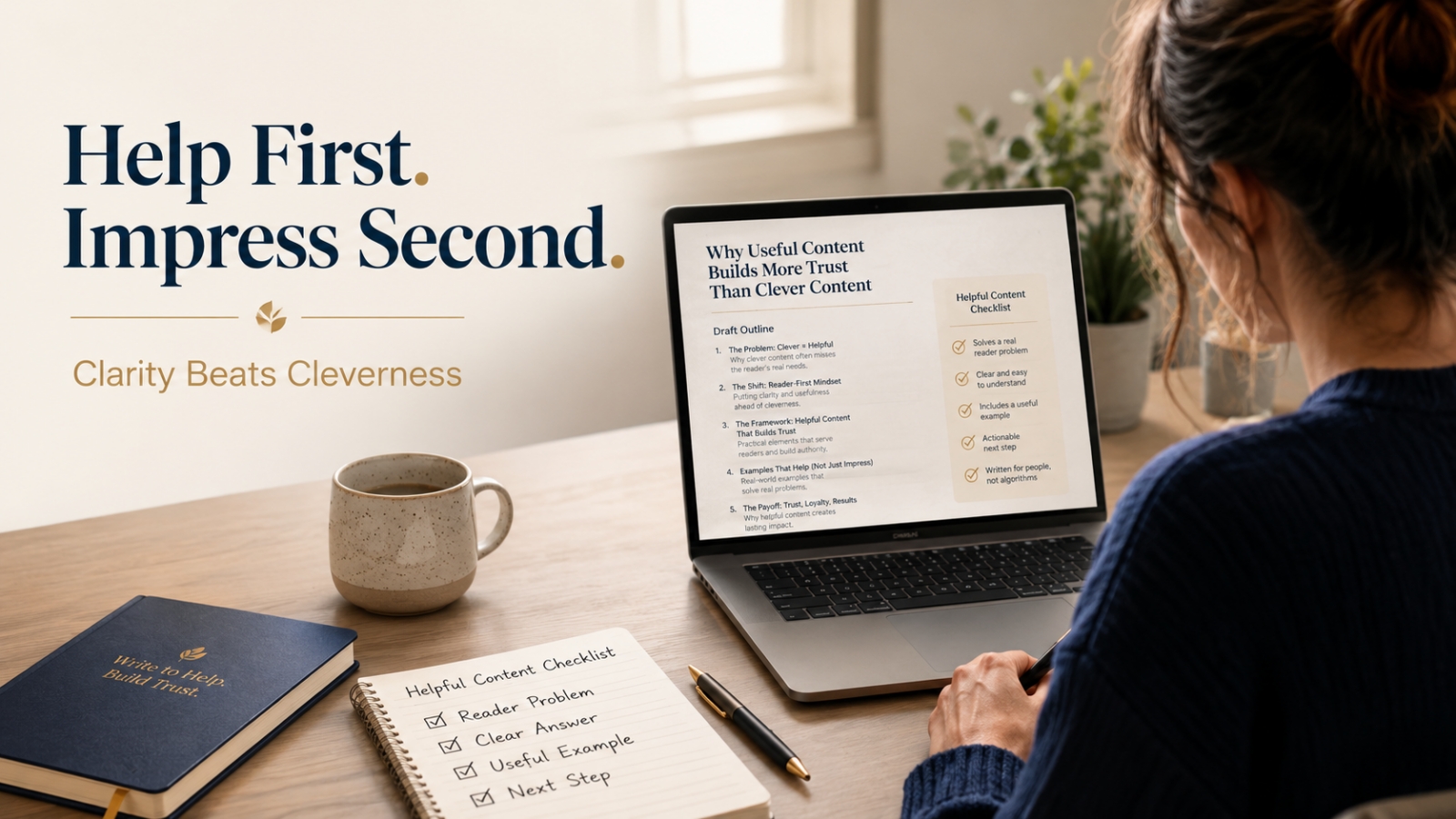
How to write content that helps readers make progress instead of only trying to impress them
Clever writing can feel exciting.
A sharp phrase.
A funny line.
A smart comparison.
A sentence that makes you think, “That sounds good.”
There is nothing wrong with that.
A little cleverness can make content enjoyable.
But cleverness is not the same as usefulness.
And if readers came looking for help, clever writing alone will not be enough.
They need the answer.
They need the next step.
They need the fog to clear a little.
If your content helps them make progress, they remember you.
If it only sounds clever, they may smile and move on.
That is why useful content builds more trust.
Why Readers Return to Useful Content
Readers return when your content helps them do something.
Maybe they solve a small problem.
Maybe they understand something that felt confusing.
Maybe they finally know what to try next.
That kind of progress feels good.
It creates a tiny moment of trust.
The reader thinks:
“That helped me.”
And that thought matters.
Trust does not always begin with a big promise.
Sometimes it begins with a small useful moment.
A checklist that saves time.
An example that makes the lesson clear.
A simple step that removes confusion.
A sentence that helps the reader feel less alone.
Useful content gives the reader something they can carry away.
That is what brings people back.
The Big Mistake: Trying to Sound Impressive Before Being Helpful
Many beginners try too hard to sound clever.
They want the writing to feel polished.
So they add stylish phrases, big ideas, witty lines, and clever angles.
That can work in small doses.
But if the reader has to fight through cleverness to find the point, the content becomes tiring.
Imagine someone is packing for a weekend trip.
They are standing beside an open suitcase.
Clothes are on the bed.
The weather app says rain.
The charger is missing.
They are leaving in two hours.
They do not need an artistic reflection on the beauty of travel.
They need a simple packing plan.
What should go in the bag?
What can stay at home?
What is easy to forget?
How do they avoid overpacking?
That is the reader’s moment.
If your content meets that moment clearly, it becomes useful.
And useful is what builds trust.
The Useful-First Content Framework
Before writing your next post, use this simple framework.
It will help you keep the reader’s progress at the center.
- Name the reader’s problem
- Give the clearest answer first
- Use examples that make the answer easier
- Remove clever lines that slow the reader down
- End with one practical next step
Let’s walk through each part.
Step 1: Name the Reader’s Problem
Useful content starts by showing the reader you understand why they are there.
Do not begin too far away.
Start close to the problem.
For our example, the reader is packing for a short weekend trip.
Their problem is not “travel planning.”
That is too broad.
Their real problem is:
They do not know what to pack without overpacking or forgetting something important.
That is clearer.
Now the content has a job.
It should help them pack simply and confidently.
Ask This Before You Write
What problem is my reader trying to solve right now?
Step 2: Give the Clearest Answer First
Do not make readers wait too long for the useful part.
A clever introduction that takes five paragraphs to reach the point may lose them.
Give the clearest answer early.
For the weekend packing example, you might say:
For a short weekend trip, pack by category: clothes, toiletries, weather items, tech, documents, and one comfort item. Then remove anything that does not fit the actual plan for the trip.
That is helpful.
The reader immediately has a way to think.
You can still explain more later.
But you have already given them a useful starting point.
Ask This Before You Write
What is the simplest helpful answer I can give first?
Step 3: Use Examples That Make the Answer Easier
Examples turn advice into something the reader can picture.
If you say:
Pack only what you need.
That is true, but vague.
A clearer example would be:
If you are going away for two nights, you may only need two outfits, sleepwear, one backup top, basic toiletries, phone charger, travel documents, and one light jacket if the weather may change.
Now the reader can see it.
The example does the work.
Useful content often becomes stronger when examples are simple and specific.
Ask This Before You Write
What example would make this easier to understand?
Step 4: Remove Clever Lines That Slow the Reader Down
Clever lines are not bad.
But they should not block clarity.
After writing your draft, look for lines that sound nice but do not help the reader.
Ask:
Does this sentence make the idea clearer, warmer, or easier to use?
If yes, keep it.
If no, cut it.
For example, a line like this may sound polished:
Packing is the art of carrying your intentions in folded form.
Interesting?
Maybe.
Useful?
Not really.
A clearer line would be:
Pack for the trip you are actually taking, not the imaginary version where every possible situation happens.
That is still a little playful.
But it helps.
That is the balance.
Do not remove all personality.
Just make sure personality serves the reader.
Step 5: End With One Practical Next Step
Useful content should leave the reader with something to do.
Not a huge assignment.
One step.
For the weekend packing example, the next step could be:
Before packing, write down the actual activities planned for the trip. Then pack only what supports those activities.
That is simple.
It gives the reader a way to act.
And action is what makes content feel valuable.
Ask This Before You Write
What should the reader do after reading?
Worked Example: Turning a Clever Post Into a Useful One
Let’s take a broad post idea.
Broad Topic
Packing for a weekend trip
A clever version might focus on stylish travel thoughts.
It may have nice phrases, but not enough practical help.
A useful version focuses on the reader’s real need.
Clear Reader
Someone packing for a two-night weekend trip.
Real Problem
They are worried about overpacking, forgetting something, or feeling unprepared.
Useful Result
They can pack a simple weekend bag based on the trip they are actually taking.
Stronger Post Title
How to Pack for a Weekend Trip Without Overpacking
That title is not fancy.
But it is clear.
The reader knows what they will get.
How the Useful Post Could Flow
Opening
Start with the reader’s moment.
The suitcase is open.
The bed is covered with clothes.
The trip is only two nights, but somehow the bag is already half full.
The reader feels seen.
Section 1: Why Overpacking Happens
Explain that people often pack for imagined emergencies instead of the actual trip.
Section 2: The Simple Packing Categories
Give the categories:
- clothes
- toiletries
- weather items
- tech
- documents
- one comfort item
Section 3: The “Actual Trip” Check
Ask the reader to list the real activities planned.
Then pack for those activities.
Section 4: What to Remove
Help them remove extras:
- duplicate outfits
- “just in case” shoes
- full-size toiletries
- items they can borrow or buy if truly needed
Section 5: Quick Weekend Packing Checklist
Give a simple checklist they can use.
Ending
Tell them to pack once, close the bag, and stop adding extras unless they match the actual trip.
That is useful.
Not dull.
Not overcomplicated.
Just helpful.
What Makes Useful Content Feel Trustworthy
Useful content earns trust because it respects the reader’s time.
It does not make them dig for the answer.
It does not hide behind fancy language.
It does not make a simple problem feel bigger than it is.
Instead, it says:
“I know why you are here. Here is the clearest next step.”
That kind of content feels generous.
It helps before it asks.
It teaches before it promotes.
It builds trust because the reader gets something valuable from the post itself.
How to Keep Useful Content From Feeling Boring
Some people worry that useful content sounds plain.
It does not have to.
Useful does not mean dry.
You can still use:
- warm examples
- gentle humor
- simple analogies
- personal observations
- vivid scenes
- friendly phrasing
- short memorable lines
The key is to make sure those elements support the lesson.
For example:
Your suitcase should not become a storage unit for every fear your brain invents before a trip.
That line has personality.
But it also teaches something useful.
It reminds the reader not to pack for every imaginary scenario.
That is the sweet spot.
Helpful first.
Clever second.
Common Mistakes to Avoid
Mistake 1: Hiding the Answer Too Deep in the Post
Readers should not have to scroll forever to find the useful part.
Give them a clear answer early.
Then expand.
Mistake 2: Choosing Cleverness Over Clarity
A clever phrase is only strong if it helps the reader understand.
If it creates confusion, simplify it.
Mistake 3: Giving Advice Without Examples
Advice becomes more useful when readers can picture it.
Add simple examples.
Mistake 4: Trying to Sound More Advanced Than the Reader Needs
Beginner readers often need simple, direct guidance.
Do not make the topic feel harder than it is.
Mistake 5: Ending Without a Next Step
If the reader finishes and thinks, “Okay, but what should I do?” the post is incomplete.
Give one clear action.
Quick Exercise: Make Your Next Post More Useful
Before publishing your next post, answer these questions.
What Problem Is My Reader Trying to Solve?
[Write the real problem]
What Is the Clearest Helpful Answer?
[Write the simple answer]
What Example Can Make This Easier?
[Write one practical example]
What Clever Line Might I Need to Cut?
[Write or identify one line that sounds nice but does not help]
What Is the Reader’s Next Action?
[Write one clear step]
Using the weekend packing example:
Problem
The reader does not know what to pack for a short trip without overpacking.
Clear Answer
Pack based on the actual activities planned, not every possible situation.
Example
For two nights, pack two outfits, sleepwear, toiletries, charger, documents, and one weather layer.
Clever Line to Cut
“Travel is the poetry of movement.”
Nice, maybe. Helpful, no.
Next Action
Write down the planned activities before packing.
That is how content becomes clearer and more useful.
Final Thought: Help First, Impress Second
Clever content can catch attention.
But useful content earns trust.
Readers come back when your posts help them make progress.
They remember the article that made something easier.
They remember the example that finally made sense.
They remember the checklist that saved time.
They remember the voice that did not make them feel silly for needing help.
So yes, add personality.
Use good lines.
Make the writing enjoyable.
But do not let cleverness stand in front of clarity.
Help first.
Impress second.
That is how readers learn to trust you.
And trust is what keeps them coming back.
Use This With Blogger’s Success Toolkit
If you already own Blogger’s Success Toolkit, log in to the Blogger Success Blueprint members area and use the planning resources to review your next post through a useful-first lens.
Ask: “Is this helping the reader make progress, or am I trying too hard to sound clever?”
Members Login:
https://bloggersuccessblueprint.com/members/
New to Blogger’s Success Toolkit?
Blogger’s Success Toolkit gives you a beginner-friendly path to choose your direction, plan useful content, write stronger titles, and begin building your blog with more structure.