How to write clearer titles that tell readers what useful result they can expect.
A blog title may look small.
Just one line at the top of the post.
But that line carries a lot of weight.
It tells the reader:
“Here is why this is worth your time.”
Or it does not.
A weak title may describe the topic, but it does not give the reader a clear reason to care.
A strong title does something better.
It makes a promise.
Not a wild promise.
Not an exaggerated promise.
Not a “this will change your whole life by Tuesday” kind of promise.
A useful promise.
It tells the reader what result, answer, relief, or insight they can expect from the post.
That is why title writing matters.
Your title is the front door to your article.
If the door is unclear, many readers will not walk in.
Why Blog Titles Matter More Than We Think
Most readers decide quickly.
They scan.
They compare.
They wonder:
“Is this for me?”
Your title helps them decide.
If the title is vague, the reader has to guess what the post will actually do.
And guessing takes effort.
A clear title removes that effort.
It tells the reader:
- what the post is about
- who it may help
- what problem it addresses
- what result they may get
- why it is worth reading now
That does not mean every title needs to be long.
It means every title should carry a clear promise.
The Big Mistake Beginners Make
The big mistake is using a topic as the title.
For example:
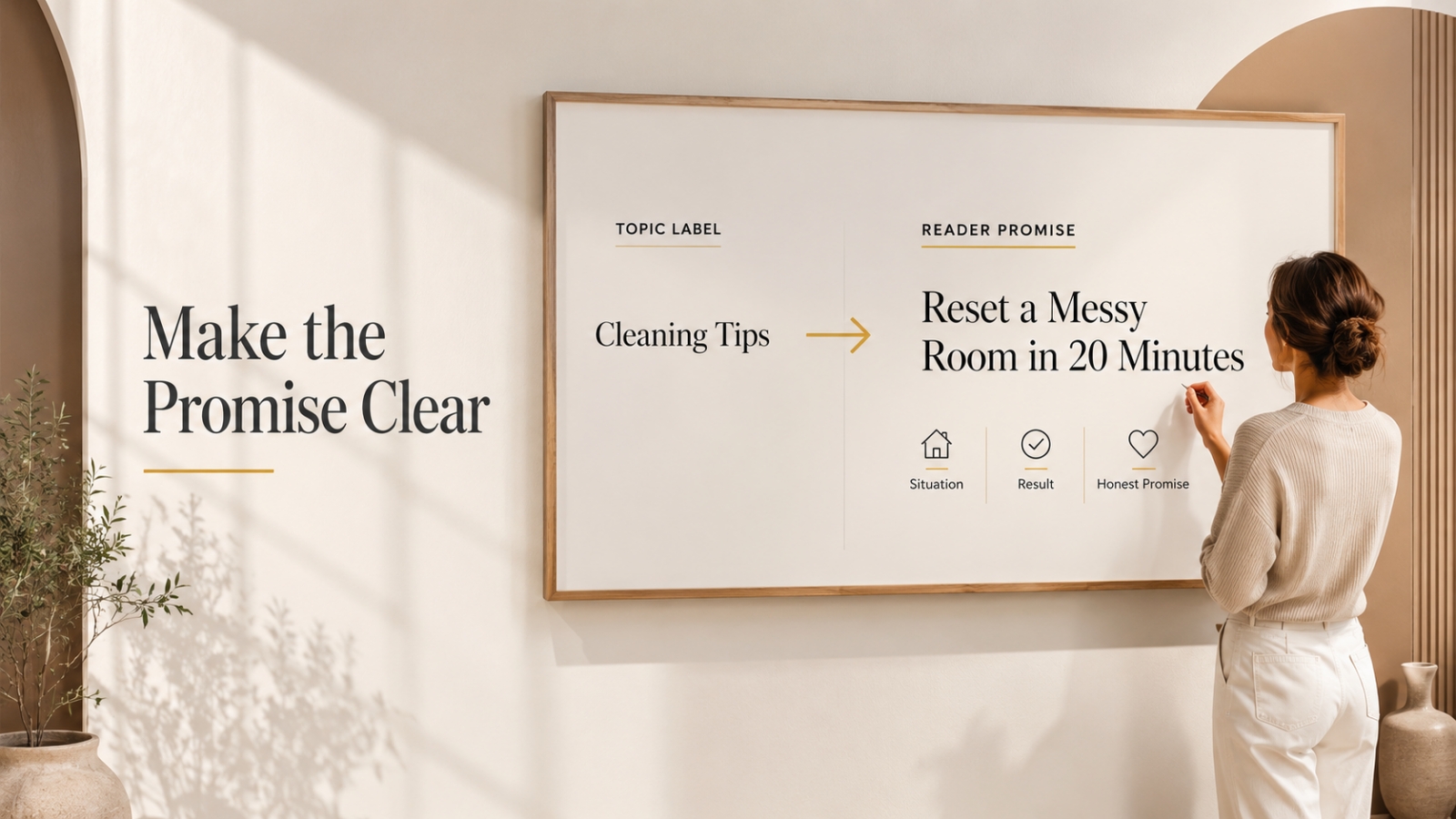
Living Room Cleaning Tips
That tells us the topic.
But it does not tell us much else.
Who is this for?
What problem does it solve?
How fast can the reader use it?
What kind of cleaning tips?
What will feel different after reading?
The title is not wrong.
It is just weak.
A stronger title might be:
How to Reset a Messy Living Room in 20 Minutes Before Guests Arrive
Now the promise is clearer.
The reader can picture the moment.
The living room is messy.
Guests are coming.
Time is short.
They need a quick reset, not a deep clean.
That title gives the post direction.
It also helps the writer stay focused.
The Title Promise Framework
Before you publish your next post, use this simple framework:
- Start with the topic
- Name the reader’s situation
- Name the useful result
- Add a specific detail
- Keep the promise honest
This framework helps you turn a plain topic into a title that gives the reader a real reason to click.
Step 1: Start With the Topic
Start simple.
Do not worry about writing the perfect title yet.
Just name the broad topic.
For example:
Living room cleaning
That is not the final title.
It is only the starting point.
A topic gives you the subject.
But it does not yet give the reader a strong reason to care.
Ask yourself:
What is this post about at the broadest level?
Step 2: Name the Reader’s Situation
A stronger title often begins with a real reader situation.
Not always, but often.
Ask:
When would someone need this post?
For our example, the situation is:
Guests are coming soon, and the living room is messy.
That is specific.
It has natural urgency, but not fake urgency.
A reader can recognize the moment quickly.
They can almost see the cushions out of place, the coffee table cluttered, and the doorbell getting closer.
That is much more useful than a plain topic.
Step 3: Name the Useful Result
Next, ask:
What will the reader gain from this post?
For the living room example, the useful result is:
They can make the living room feel presentable quickly.
That is the promise.
Not a spotless house.
Not a full home makeover.
Not a perfect deep clean.
Just a fast, practical reset.
That makes the title believable.
A good title promise should feel useful and realistic.
Step 4: Add a Specific Detail
Specific details make titles clearer.
They help the reader understand what kind of help the post gives.
For example:
in 20 minutes
That detail changes the title.
Now the reader knows this is not a long cleaning system.
It is a quick reset.
Specific details can include:
- a timeframe
- a number
- a reader type
- a situation
- a method
- a clear result
You do not need all of them.
One strong detail may be enough.
Step 5: Keep the Promise Honest
A title should attract attention, but it should not trick the reader.
If the post teaches a quick surface reset, do not promise a full deep clean.
If the post gives beginner steps, do not make it sound advanced.
If the post offers ideas, do not make it sound like a complete system.
Trust begins with the title.
Make sure the post delivers what the title promises.
Worked Example: From Weak Title to Stronger Promise
Let’s walk through one example.
Weak Title
Living Room Cleaning Tips
This title is simple, but too broad.
It does not create a clear picture.
It could mean anything.
Now let’s improve it.
Clearer Reader
Someone whose living room is messy and who has guests arriving soon.
Clear Problem
They do not have time for a full clean, but they want the space to look better quickly.
Useful Result
They can reset the living room in 20 minutes.
Stronger Title
How to Reset a Messy Living Room in 20 Minutes Before Guests Arrive
This title works because it gives the reader:
- a clear problem
- a clear timeframe
- a clear result
- a real-life situation
The title is not trying to sound clever.
It is trying to be useful.
And useful often wins.
What Makes a Title Feel Stronger
A strong title usually does at least one of these things well.
It Shows the Problem
The reader can see the issue right away.
Example:
How to Stop Your Desk From Becoming a Paper Pile by Friday
That is more vivid than:
Desk Organization Tips
The stronger title gives the reader a specific problem they can recognize.
It Shows the Result
The reader knows what they may gain.
Example:
How to Create a 10-Minute Evening Reset for a Calmer Morning
That is clearer than:
Evening Routine Ideas
The stronger title promises a simple result.
It Shows the Reader
The title makes it obvious who the post is for.
Example:
A Simple Meal Planning Method for People Who Hate Complicated Recipes
That is more specific than:
Meal Planning Guide
The stronger title speaks to a real type of reader.
It Shows the Situation
The title names the moment when the post is useful.
Example:
What to Do When Your Child Refuses to Start Homework
That is more immediate than:
Homework Tips for Parents
The stronger title puts the reader in the moment.
It Shows the Type of Help
The reader knows what kind of post they are getting.
Example:
A Step-by-Step Closet Reset for Small Bedrooms
That is clearer than:
Closet Organization
The stronger title sets expectations.
A Simple Title Improvement Method
Use this method when your title feels too plain.
Start With the Topic
Write the simple topic first.
Example:
Living room cleaning
This is not the final title.
It is just the starting point.
Add the Reader’s Problem
What is happening?
Example:
The living room is messy before guests arrive.
Now the title has a situation.
Add the Useful Result
What should the reader be able to do?
Example:
Reset the room quickly.
Now the title has a promise.
Add a Specific Detail
Can you make it clearer?
Example:
in 20 minutes
Now the title feels more concrete.
Shape the Final Title
Put it together:
How to Reset a Messy Living Room in 20 Minutes Before Guests Arrive
That is much stronger than the original topic.
Before-and-After Title Examples
Here are a few simple examples.
Before
Budgeting Tips
After
How to Plan a Weekly Grocery Budget Without Feeling Restricted
Why It Works
The stronger title names a specific budget area and lowers the reader’s fear.
Before
Morning Routine Ideas
After
How to Build a 10-Minute Morning Routine When Your Day Starts Busy
Why It Works
The stronger title gives a timeframe and speaks to a real-life situation.
Before
Dog Training Basics
After
How to Teach Your Puppy to Sit Without Turning Practice Into a Battle
Why It Works
The stronger title feels more human and addresses a common frustration.
Before
Decluttering Advice
After
How to Clear One Closet Shelf When the Whole Room Feels Overwhelming
Why It Works
The stronger title makes the task feel smaller and more doable.
What to Avoid When Writing Titles
Avoid Titles That Are Too Broad
Broad titles often feel weak because they do not say enough.
Fitness Tips is too broad.
How to Choose a Beginner Workout You Can Finish This Week is clearer.
A specific title helps the reader understand the promise faster.
Avoid Clever Titles That Hide the Promise
Clever can work if the promise is still clear.
But if the reader has to decode the title, they may move on.
Clarity usually beats cleverness.
The reader should not need to solve a puzzle before deciding whether to read.
Avoid Overpromising
Do not promise a huge result if the post teaches a small step.
A clear, honest promise builds more trust than a dramatic one.
If your post gives a 20-minute living room reset, do not promise a fully organized home.
Keep the promise matched to the post.
Avoid Titles That Do Not Match the Post
This is important.
If your title promises a checklist, include a checklist.
If your title promises beginner steps, keep the post beginner-friendly.
If your title promises a 20-minute method, make sure the method can reasonably fit that timeframe.
The title should open the right door.
The post should deliver what is behind that door.
Avoid Writing the Title Only Once
Your first title may not be your best title.
That is normal.
Write a few versions before choosing.
Sometimes the stronger title appears after the article is clearer.
Try writing five title options.
You may be surprised how much stronger version four or five becomes.
Quick Exercise: Turn a Topic Into a Promise
Use this simple worksheet before publishing your next post.
My Topic Is:
[Write the broad topic.]
My Reader’s Situation Is:
[Describe the moment or problem.]
The Useful Result Is:
[What will the reader gain?]
A Specific Detail I Can Add Is:
[Timeframe, number, situation, type of reader, or method.]
My Stronger Title Is:
[Write the final title.]
Here is the living room example.
My Topic Is:
Living room cleaning.
My Reader’s Situation Is:
The living room is messy and guests are arriving soon.
The Useful Result Is:
They can make the room feel presentable quickly.
A Specific Detail I Can Add Is:
20 minutes.
My Stronger Title Is:
How to Reset a Messy Living Room in 20 Minutes Before Guests Arrive.
That is the shift.
From topic to promise.
Final Thought: A Clear Title Helps the Reader Say Yes
Your blog title does not need to be flashy.
It needs to be clear.
It should tell the reader what useful result, answer, or insight they can expect.
When the title is vague, the reader has to guess.
When the title is clear, the reader can decide quickly:
“Yes, this is what I need.”
That is the goal.
Before you publish your next post, look at your title and ask:
What promise is this making to the reader?
If the promise is unclear, sharpen it.
Name the situation.
Show the result.
Keep it honest.
Make it useful.
That is how a title becomes more than a label.
It becomes a reason to read.
Use This With Blogger’s Success Toolkit
If you already own Blogger’s Success Toolkit, log in to the Blogger Success Blueprint members area and use the title resources to improve one post title before you publish.
Start with the reader’s situation, then make the promise clearer.
Members Login:
https://bloggersuccessblueprint.com/members/
New to Blogger’s Success Toolkit?
Blogger’s Success Toolkit gives you a beginner-friendly path to choose your direction, plan useful content, write stronger titles, and begin building your blog with more structure.
Learn More About Blogger’s Success Toolkit