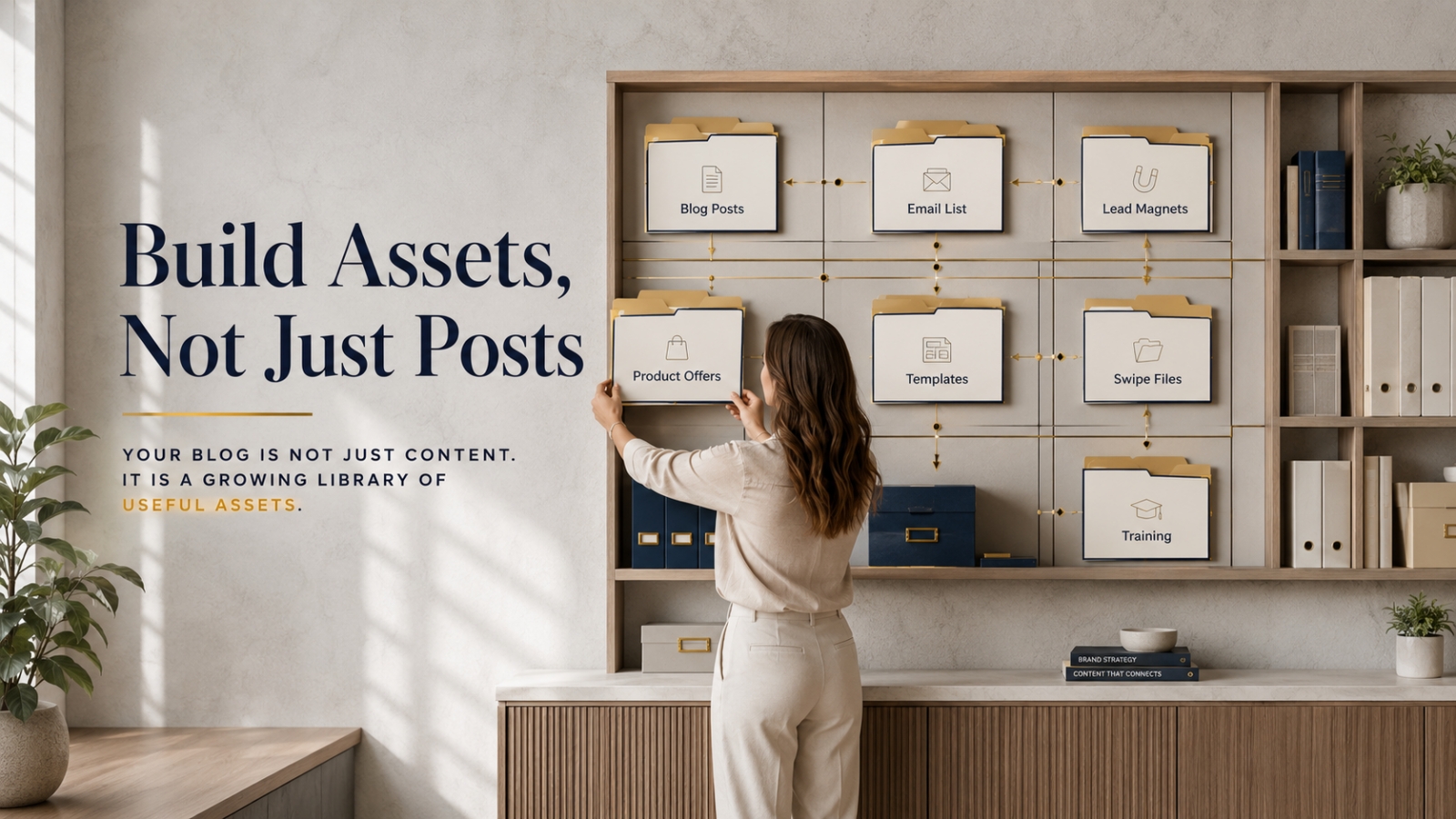
Your blog is not just a place to publish ideas. It can become a growing library of useful resources that support your readers and your business over time.
The Moment Blogging Starts to Feel Like a Treadmill
You sit down to plan your next post.
The page is blank.
Again.
You think, “What should I write this time?”
So you search your notes, scan a few old ideas, and try to find something useful to say. You write the post, publish it, share it, and feel good for a short while.
Then next week arrives.
And the same question comes back.
“What should I write next?”
That is where many bloggers quietly lose energy. Not because they are lazy. Not because they don’t care. But because every post feels like a fresh start from zero.
There is a better way to look at your blog.
Instead of thinking only in posts, start thinking in assets.
Why This Shift Matters
A post is something you publish.
An asset is something that keeps working.
That is the simple difference.
A helpful post can teach one idea. But when you build around that post, it can also support your email list, lead magnet, product offer, template, swipe file, or training.
That means your work does not disappear after you publish it.
It becomes part of a larger system.
This is how a blog slowly grows from “content I write” into “value I own.”
And that matters if you want your blog to become more than a hobby.
The Big Mistake Beginners Make
Many new bloggers treat every post like a separate task.
They write one post about one topic.
Then they move to a different topic.
Then another.
Nothing connects.
The blog may have many articles, but there is no clear path for the reader. There is also no clear path for the blogger.
This creates three common problems:
- The blogger keeps needing fresh ideas from scratch
- Readers enjoy one post but don’t know what to do next
- Useful content never turns into deeper resources or offers
That is why asset thinking is so important.
It helps you ask a better question.
Not just, “What should I publish?”
But, “What can this become?”
What Is a Blogging Asset?
A blogging asset is something you create once and can reuse, improve, share, package, or connect to your wider business.
It may be simple.
It may start small.
But it has lasting value.
Blogging assets can include:
- Blog posts
- Email list
- Lead magnets
- Product offers
- Templates
- Swipe files
- Training
The key idea is this:
An asset does not just sit there.
It helps your reader move forward.
It helps your business become more structured.
It gives your content a longer life.
The Asset Builder Framework
Here is a simple way to think about it.
Before or after you create a blog post, ask yourself:
1. What problem does this content help solve?
Every useful asset begins with a real problem.
Not a vague topic.
Not a random idea.
A real problem your reader cares about.
For example, in a home organization niche, the problem might be:
“I can’t keep my entryway tidy because bags, shoes, keys, and mail pile up every day.”
That is specific.
You can work with that.
A vague topic like “home organization tips” is harder to turn into assets. But a clear problem creates a clear path.
2. What simple resource could help the reader act?
Once you know the problem, ask what tool would make the next step easier.
For the messy entryway example, you could create:
- A five-minute entryway reset checklist
- A simple storage planning worksheet
- A before-and-after photo guide
- A small product comparison guide for hooks, baskets, and trays
Notice what is happening.
The blog post teaches.
The extra resource helps the reader apply.
That is how content begins to become an asset.
3. What could this become later?
You do not need to create a full product right away.
But you can look at the post and ask:
“Could this become something bigger later?”
The entryway example could later become:
- A home organization starter kit
- A room-by-room checklist bundle
- A short video training on small-space routines
- A template pack for weekly home reset planning
This is long-term thinking.
You are not forcing every post to become a product.
You are simply noticing which posts have asset potential.
4. How can this connect to your reader journey?
A strong asset should guide the reader somewhere useful.
After reading the post, what is the next natural step?
For the entryway example, maybe the reader should download a checklist.
After using the checklist, maybe they should join a short email series about simple home reset habits.
After that, maybe they would appreciate a paid planning kit.
This is not pushy when the path is helpful.
It feels natural because each step solves the next part of the problem.
Blog Posts Are the Starting Point
Your blog posts are still important.
They are often the first asset people find.
A strong blog post can:
- Answer a question
- Build trust
- show your teaching style
- introduce your point of view
- guide readers toward a useful next step
But the post should not always be the end of the journey.
Think of it like planting a seed.
The post is the seed.
Your lead magnet, email sequence, template, offer, or training can grow from that seed.
This is how one useful idea becomes more valuable over time.
Your Email List Is a Relationship Asset
Your email list is one of the most important assets you can build.
Why?
Because a blog visitor may come and go.
They may read one post and leave.
They may enjoy your article but forget to return.
An email list gives you a way to keep the relationship alive.
It allows you to:
- Teach in smaller pieces
- Share helpful resources
- Invite readers back to useful content
- Understand what your audience cares about
- Introduce offers when they make sense
Your email list is not just a place to send updates.
It is a trust-building asset.
And trust is what makes long-term monetization feel natural instead of forced.
Lead Magnets Turn Interest Into Connection
A lead magnet is a free resource that helps your reader take a clear next step.
It might be a checklist, planner, guide, worksheet, template, or short training.
The best lead magnets are not complicated.
They are useful.
They solve a small problem.
They connect directly to what the reader already cares about.
Let’s return to the home organization example.
If your post is about fixing a messy entryway, your lead magnet could be:
“The 10-Minute Entryway Reset Checklist”
That is simple.
It is specific.
It feels immediately useful.
The reader does not have to wonder why it matters. They can see the value right away.
That is what makes a lead magnet a strong asset.
Product Offers Help Readers Go Further
A product offer does not need to be huge.
Many beginners think a product must be a large course, a complex membership, or a complete system.
But a useful offer can begin much smaller.
It can be:
- A template pack
- A checklist bundle
- A short guide
- A mini training
- A starter toolkit
- A planning worksheet set
The purpose of a product is not just to sell something.
The purpose is to help the reader go further than the free content can take them.
Your blog post may explain the idea.
Your lead magnet may help them begin.
Your product can help them finish with more structure.
That is a helpful path.
Templates Make Action Easier
Templates are powerful because they reduce thinking time.
Most readers do not only want more information.
They want help applying it.
In the home organization example, a reader may understand that their entryway needs zones.
But they may still wonder:
“What should I put where?”
A simple template can help them map:
- Bags
- Shoes
- Keys
- Daily items
- Return-to-car items
That kind of resource feels practical.
It turns advice into action.
And when a reader can act faster because of your resource, your blog becomes more valuable to them.
Swipe Files Help Readers See Examples
A swipe file is a collection of examples, prompts, scripts, outlines, or ready-to-adapt ideas.
It is helpful because many people learn by seeing examples.
They do not want to stare at a blank page.
They want a starting point.
For the home organization example, a swipe file could include:
- Example entryway layouts
- Storage label ideas
- Family reminder notes
- Weekly reset prompts
- Simple household rule examples
This gives readers something to model.
It also helps them feel less stuck.
A good swipe file does not replace thinking. It supports thinking.
That is why it can become a valuable asset.
Training Adds Guidance and Confidence
Some readers prefer to watch or listen.
Others need to see the process before they try it.
That is where training can help.
Training can be simple:
- A short video walkthrough
- A screen-recorded lesson
- An audio explanation
- A step-by-step mini class
- A practical demonstration
Using the home organization example, you could create a short training called:
“How to Reset Your Entryway in 15 Minutes”
That training could show the process step by step.
Clear the surface.
Sort the daily items.
Choose one basket.
Add one hook.
Create one simple rule.
Now the reader can see the action.
That builds confidence.
And confidence helps people follow through.
How One Topic Can Become Many Assets
Let’s put this together.
Topic: Fixing a messy home entryway.
That one idea could become:
Blog Post
“Why Your Entryway Gets Messy and How to Reset It in 15 Minutes”
This teaches the main idea.
Lead Magnet
“The 10-Minute Entryway Reset Checklist”
This helps the reader take action.
Email List
A short email series on simple home reset habits.
This builds trust over time.
Template
A one-page entryway zone planner.
This helps the reader design their own setup.
Swipe File
A collection of sample labels, storage ideas, and family reminder notes.
This gives examples.
Product Offer
A small home reset starter kit.
This helps the reader solve the problem with more structure.
Training
A short video showing the reset process.
This gives guided support.
One topic.
Many assets.
That is the point.
You are not just creating more content.
You are building a connected path.
Common Mistakes to Avoid
Asset thinking is powerful, but it can become overwhelming if you try to do too much too quickly.
Here are a few mistakes to watch for.
Mistake 1: Trying to Turn Every Post Into a Product
Not every post needs a lead magnet, template, and offer.
Some posts are simple trust-builders.
Some answer quick questions.
Some support your audience in smaller ways.
That is fine.
Look for posts with strong asset potential, especially posts that solve a clear problem or receive strong reader interest.
Mistake 2: Creating Random Assets That Don’t Connect
A lead magnet should connect to the post.
A product should connect to the reader’s next problem.
A template should help the reader apply the lesson.
If your assets feel random, readers may feel confused.
Keep the path simple.
Post → next step → deeper support.
Mistake 3: Making Assets Too Big Too Early
Your first asset does not need to be huge.
Start with something useful and manageable.
A one-page checklist can be enough.
A short template can be enough.
A three-part email sequence can be enough.
Small useful assets are better than large unfinished ideas.
Mistake 4: Forgetting the Reader’s Real Problem
Do not create assets just because they sound impressive.
Create assets because they help.
Ask:
“What would make this easier for my reader?”
That question will keep your assets practical and grounded.
A Simple Asset Exercise for This Week
Choose one blog post you have already written or plan to write.
Then answer these questions:
Step 1: What reader problem does this post solve?
Write it in one sentence.
Make it specific.
Step 2: What is the reader’s next natural step?
Do they need a checklist?
A planner?
A template?
A guide?
A short video?
Step 3: What simple free resource could help?
Keep it small.
Think one clear action.
Step 4: What paid resource could help them go further later?
Do not build it yet unless you are ready.
Just name the possibility.
Step 5: How could this fit into your larger blog path?
Could it support your email list?
Could it lead into a product?
Could it become part of a future training?
Could it strengthen your authority around one topic?
This exercise helps you see your content differently.
You are no longer looking at one post.
You are looking at what that post can become.
How This Helps You Build a More Sustainable Blog
When you think in assets, your blog becomes easier to grow.
Not because there is less work.
There is still work.
But the work becomes more connected.
Your posts support your lead magnets.
Your lead magnets support your email list.
Your email list supports trust.
Your trust supports your offers.
Your offers support your readers at a deeper level.
That is a stronger path than random publishing.
It also helps you feel more focused because each piece has a purpose.
Final Encouragement
You do not need to build a full asset library this week.
Start with one useful post.
Then ask one better question:
“What could this become?”
That question can change the way you plan, write, and build.
Because your blog is not only a place to publish.
It can become a growing collection of assets that help readers, build trust, and support your long-term business.
One post can be useful.
One asset can be reusable.
One connected system can become the foundation for something much bigger.
Use This With Blogger’s Success Toolkit
If you already own Blogger’s Success Toolkit, log in to the Blogger Success Blueprint members area and use the relevant planning tools, worksheets, or resources to apply this lesson.
Start simple.
Open one product.
Choose one section.
Complete one small task.
Apply what you already own before adding anything else.
Members Login:
https://bloggersuccessblueprint.com/members/
New to Blogger’s Success Toolkit?
Blogger’s Success Toolkit gives you a beginner-friendly path to choose your direction, plan useful content, write stronger titles, and begin building your blog with more structure.